AH-1 Cobra vs UH-1 Iroquois "Huey"
AH-1 Cobra vs UH-1 Iroquois "Huey" at a glance — top speed 277 vs 222 km/h, range 570 vs 510 km, max takeoff weight 8,391 vs 4,309 kg, built 1,116 vs 16,000 units.
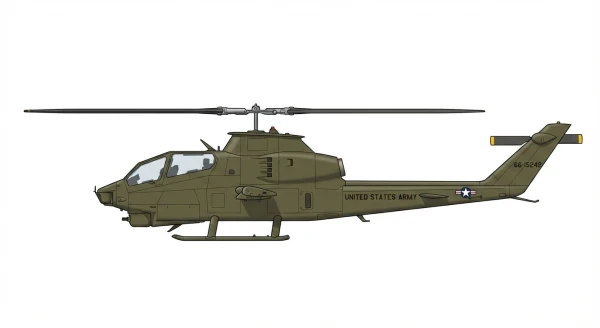
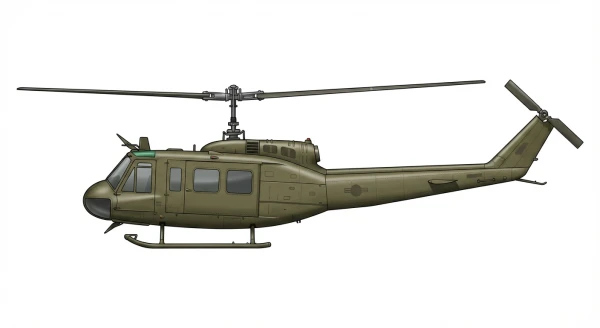
| AH-1 Cobra | UH-1 Iroquois "Huey" | |
|---|---|---|
| Origin country | 🇺🇸 United States | 🇺🇸 United States |
| Category | Military Helicopters | Military Helicopters |
| Manufacturer | Bell | Bell |
| First flight | 7 September 1965 | 22 October 1956 |
| Year introduced | 1967 | 1959 |
| Number produced | 1116 units | 16000 units |
| Average unit price | $13 million | $1.3 million |
| Wingspan | 13.4 m | 14.6 m |
| Height | 4.4 m | 4.5 m |
| Length | 17.8 m | 12.7 m |
| Maximum speed | 277 km/h | 222 km/h |
| Operational range | 570 km | 510 km |
| Service ceiling | 6,096 m | 5,910 m |
| Max. takeoff weight | 8,391 kg | 4,309 kg |
| Empty weight | 5,579 kg | 2,087 kg |
| Total thrust | 2 x 1,342 kW | 1 x 820 kW |
Detailed Comparison
Forged in the same 1960s requirement for rotary-wing air mobility, Bell’s UH-1 Iroquois and AH-1 Cobra share a mechanical lineage but serve fundamentally diverging tactical mandates. The UH-1 initiated modern heliborne infantry operations, inserting utility aircraft into combat zones. The AH-1 was developed directly to solve the UH-1's survivability deficit, stripping the transport capability to create a dedicated, low-profile gunship capable of escorting the slower utility fleet.
Development and Design
The UH-1 was engineered around a 1952 U.S. Army requirement for medical evacuation and utility, centering on a wide, modular cabin and a single Lycoming T53 turboshaft. This airframe pioneered the "slick" troop transport and ad-hoc gunship roles. Armed UH-1B/C models carrying rocket pods and door guns lacked the aerodynamic efficiency to keep pace with the transports they escorted. To solve this, Bell utilized the UH-1C's dynamic system (engine, transmission, and rotor) and packaged it within a slender, 38-inch-wide tandem fuselage to create the AH-1G. This tandem seating reduced the Cobra’s frontal visual cross-section, improving survivability against ground fire compared to the Huey’s broad profile.
Specifications and Performances
The aerodynamic differences yield stark performance contrasts. The AH-1’s streamlined fuselage allows a maximum speed of 277 km/h, outpacing the UH-1’s 222 km/h limit. This speed delta was what Bell engineered the Cobra to achieve for forward reconnaissance and escort. Weight and powerplant evolution mirror their distinct paths. The baseline UH-1 (4,309 kg max takeoff weight) relied on a single 820 kW T53 engine, optimizing lift for troops. Later AH-1 iterations shifted to twin General Electric T700 engines generating 1,342 kW to support a heavier 8,391 kg max takeoff weight, entirely dedicated to armor, sensors, and munitions like TOW and AGM-114 Hellfire missiles.
Deployment and usage
Combat in Vietnam validated the air cavalry doctrine but exposed utility airframes to severe attrition.
- UH-1s flew 7 million sorties in Vietnam, executing the air assault doctrine by delivering infantry directly into combat zones like the Ia Drang Valley.
- AH-1Gs deployed in 1967 specifically to suppress anti-aircraft fire around UH-1 landing zones.
Post-Vietnam, the platforms diverged. The U.S. Army replaced the UH-1 with the UH-60 Black Hawk and the AH-1 with the AH-64 Apache. The U.S. Marine Corps retained both platforms. The upgraded twin-engine UH-1Y Venom and AH-1Z Viper operate as a combined team in Marine Light Attack Helicopter Squadrons, sharing 85% parts commonality to reduce logistical footprints on amphibious assault ships.
Conclusion
The AH-1 dictates the edge in contested airspace and anti-armor operations. Its narrow fuselage, superior speed (277 km/h), and integrated precision fires make it a survivable platform for close air support and interdiction against mechanized forces, as demonstrated during the 1991 Gulf War. The UH-1 holds the advantage in logistical and assault environments. Its wide-cabin architecture allows for rapid troop insertion, medical evacuation, and cargo transport—functions the AH-1 structurally cannot perform. If the mission requires destroying a tank column, deploy the Cobra. If the operational objective dictates seizing terrain with infantry or extracting casualties, the UH-1 is the required asset.