AH-1Z Viper
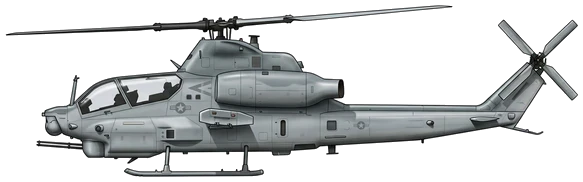
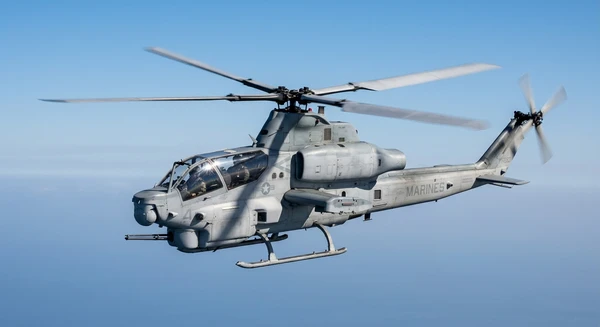
American twin-engine attack helicopter, developed in the late 20th and early 21st centuries, extensively deployed in expeditionary and maritime operations. Key figures: top speed 411 km/h, range 690 km, service ceiling 6,100 m, max takeoff weight 8,391 kg, built 195. In service with 3 air forces as of 2026 — United States (189), Bahrain (12), Czechia (4).
| Crew | 2 (pilot, co-pilot/gunner) |
| Length | 17.8 m (58.2 ft) |
| Wingspan | 15 m (49.2 ft) |
| Height | 4.4 m (14.3 ft) |
| Wing area | 168 m² (1808.3 sqft) |
| Empty weight | 5,579 kg (12,300 lbs) |
| Max. takeoff weight | 8,391 kg (18,499 lbs) |
| Powerplant | 2 × General Electric T700-GE-401C 1,300 kW each |
| Maximum speed | 411 km/h (255 mph) |
| Operational range | 690 km (429 mi) |
| Service ceiling | 6,100 m (20,013 ft) |
| Climb rate | 14.2 m/s (46.6 ft/s) |




- Air-to-Air Short-Range AIM-9 Sidewinder
- Air-to-Surface AGM-114 Hellfire
- Air-to-Surface AGM-179 JAGM
- Rocket Pod Hydra 70
- Rocket Pod APKWS II
Recent Events — AH-1Z Viper
4 events →
Description
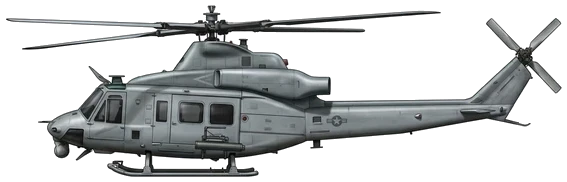
The Bell AH-1Z Viper is a twin-engine attack helicopter designed and produced by Bell Helicopter. Developed during the 1990s and 2000s under the United States Marine Corps (USMC) H-1 upgrade program, the aircraft modernizes the existing AH-1W SuperCobra fleet. The design shares 84% of its components with the Bell UH-1Y Venom utility helicopter, including a common tailboom, engines, rotor system, drivetrain, and avionics architecture. The AH-1Z completed its maiden flight on 8 December 2000. Low-rate initial production commenced in October 2003, and the Department of the Navy approved full-rate production in December 2010. Bell delivered the 189th AH-1Z to the USMC in November 2022, completing the service's program of record. A total of 195 units have been built.
Design
The helicopter features a four-blade, bearingless, hingeless composite main rotor system with a semi-automatic folding mechanism for shipboard storage. It is powered by two General Electric T700-GE-401C turboshaft engines, each producing 1,800 shp. Redesigned airframe elements to increase crashworthiness include energy-absorbing landing gear, self-sealing fuel tanks, and energy-attenuating seating. Defensive systems include radar, missile, and laser spot warning receivers, countermeasure dispensers, and a Hover Infrared Suppression System. The cockpit features identical front and rear stations equipped with a Hands on Collective and Stick (HOCAS) architecture and three liquid crystal displays. Pilot systems include the Thales "Top Owl" helmet-mounted display and the nose-mounted Lockheed Martin Target Sight System (TSS), which integrates a third-generation forward-looking infrared (FLIR) sensor and TV tracking.
Armament
The AH-1Z is equipped with an under-nose A/A49E-7 turret housing a 20 mm M197 three-barreled rotary cannon with a 750-round capacity. Two stub wings provide six hardpoints with a maximum payload capacity of 5,764 lb (2,615 kg). The wingtip stations can carry AIM-9 Sidewinder air-to-air missiles or an AN/APG-78 Longbow fire control radar. Underwing stations support combinations of 2.75-inch (70 mm) Hydra 70 unguided or APKWS II guided rockets, AGM-114 Hellfire air-to-surface missiles, and the AGM-179A Joint Air-to-Ground Missile (JAGM). Under the Precision Attack Strike Munition program, the helicopter will integrate the Red Wolf long-range missile for kinetic strikes and the Green Wolf for electronic warfare up to 200 nautical miles (370 km).
Operational History
The USMC declared the AH-1Z combat-ready in September 2010, and the type fully replaced the AH-1W by October 2020. The aircraft operates within the Aviation Combat Element for offensive air support, anti-air warfare, and aerial reconnaissance. In May 2021, several USMC aircraft were placed in long-term storage at the 309th AMARG in Arizona. Export customers include the Royal Bahraini Air Force, which ordered 12 units in 2018, with deliveries completed in 2023. The Czech Air Force ordered four units in 2019 and received ten total, including six delivered via the Excess Defense Articles program. Nigeria has 12 units on order. Delivery of 12 built units for Pakistan remains blocked at the 309th AMARG due to political tensions.
Frequently Asked Questions
What type of aircraft is the AH-1Z Viper?
What is the maximum speed of the AH-1Z Viper?
What is the range of the AH-1Z Viper?
When did the AH-1Z Viper first fly?
How many AH-1Z Viper have been built?
Which countries operate the AH-1Z Viper?
What is the service ceiling of the AH-1Z Viper?
- JUL 242026 Created Page created: AH-1Z Viper