JAS 39 Gripen vs Rafale
JAS 39 Gripen vs Rafale at a glance — top speed 2,100 vs 1,912 km/h, range 4,000 vs 3,700 km, max takeoff weight 14,000 vs 24,500 kg, built 300 vs 316 units.
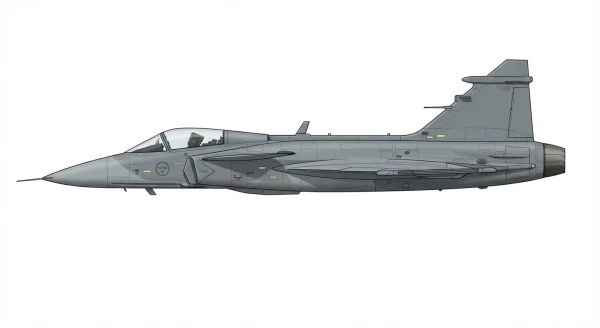
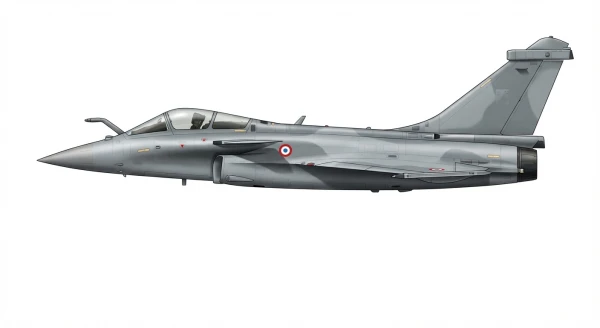
| JAS 39 Gripen | Rafale | |
|---|---|---|
| Origin country | 🇸🇪 Sweden | 🇫🇷 France |
| Category | Combat Aircraft | Combat Aircraft |
| Manufacturer | Saab | Dassault |
| First flight | 9 December 1988 | 4 July 1986 |
| Year introduced | 1996 | 2001 |
| Number produced | 300 units | 316 units |
| Average unit price | $30 million | $95 million |
| Wing area | 30.0 m² | 45.7 m² |
| Wingspan | 8.4 m | 10.9 m |
| Height | 4.5 m | 5.3 m |
| Length | 14.9 m | 15.3 m |
| Maximum speed | 2100 km/h | 1912 km/h |
| Operational range | 4,000 km | 3,700 km |
| Service ceiling | 15,240 m | 15,835 m |
| Max. takeoff weight | 14,000 kg | 24,500 kg |
| Empty weight | 6,800 kg | 9,850 kg |
| Total thrust | 1 x 8,209 kgf | 2 x 7,648 kgf |
Detailed Comparison
The Saab JAS 39 Gripen and Dassault Rafale are both European canard-delta multirole fighters, but they stem from divergent strategic needs. The Gripen is a single-engine lightweight fighter designed for cost-efficiency, ease of maintenance, and dispersed operations from austere bases, reflecting Sweden's defensive doctrine. The Rafale is a heavier, twin-engine "omnirole" aircraft born from France's pursuit of strategic autonomy, capable of performing multiple mission types within a single sortie and operating from aircraft carriers.
Development and Design
The Gripen's design philosophy is centered on effectiveness and affordability. Its "JAS" designation (Air-to-Air, Air-to-Surface, Reconnaissance) underscores its multirole nature, while its modular architecture allows for straightforward upgrades and maintenance. A key design driver was the ability to operate from Swedish road bases, requiring short takeoff and landing distances and minimal ground crew, which in turn facilitates high sortie generation rates. It uses a single Volvo RM12 engine, a derivative of the General Electric F404, balancing performance with operational economy.
The Rafale program was initiated after France withdrew from the collaborative Eurofighter project to maintain its own industrial and technological base. It is designed for power projection. Its twin SNECMA M88 engines provide greater thrust and redundancy, essential for its carrier-based variant (Rafale M) and for carrying heavy payloads over long distances. While not a full stealth aircraft, the Rafale incorporates a reduced radar cross-section through shaping and composite materials. Its highly integrated SPECTRA electronic warfare suite and advanced sensor fusion are central to its survivability and operational effectiveness.
Specifications and Performances
A comparison of specifications reveals the difference in scale. The Rafale is substantially heavier, with a maximum takeoff weight of 24,500 kg compared to the Gripen's 14,000 kg. This allows the Rafale to carry a larger payload and more fuel, giving it greater range and endurance for strike missions. While the Gripen C/D possesses a higher maximum speed at over Mach 2, the Rafale has a superior climb rate (305 m/s vs. 254 m/s). Both aircraft are exceptionally agile due to their delta-canard configuration and fly-by-wire controls. The latest Gripen E/F and Rafale F3/F4 variants both feature AESA radars and can employ the advanced Meteor long-range air-to-air missile.
Deployment and usage
The Rafale has a more extensive and varied combat record. It has been deployed by France in conflicts over Afghanistan, Libya, Mali, Iraq, and Syria, conducting a full spectrum of operations including deep-strike, close air support, reconnaissance, and air-to-air missions. The Rafale M's service with the French Navy provides a distinct carrier-based power projection capability. The Gripen's combat experience is limited, primarily consisting of reconnaissance missions during the 2011 Libyan intervention and Baltic Air Policing duties. It serves as a capable air defense and regional patrol asset for its operators, which include Sweden, Brazil, the Czechia, Hungary, South Africa, and Thailand.
Conclusion
The choice between the Gripen and Rafale is a function of national strategy and budget. The JAS 39 Gripen is a sophisticated yet pragmatic lightweight fighter, offering credible multirole performance with exceptionally low acquisition and operational costs. It is an ideal solution for nations requiring a modern, sustainable air force for defensive roles. The Dassault Rafale is a more powerful and strategically versatile asset. Its twin-engine design, higher payload, carrier capability, and extensive combat record make it a premier platform for nations seeking to project air power and maintain strategic independence.