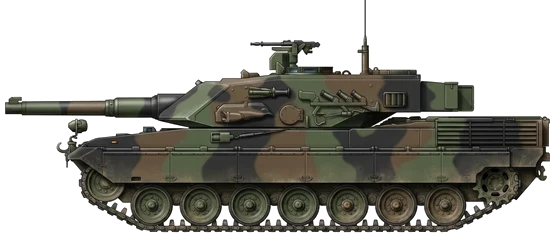
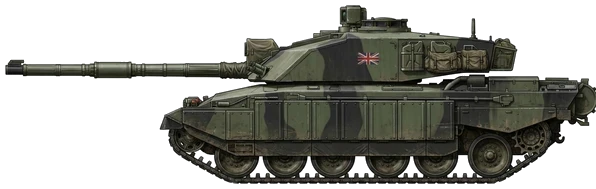
Ariete 1 vs Challenger 2 at a glance — weight 54,000 vs 75,000 kg, top speed 65 vs 59 km/h, range 500 vs 550 km, crew 4 vs 4 (commander, gunner, loader–operator, driver).
Perkins CV-12 Condor 12-Cylinder Diesel Engine with 1200 hp
Detailed Comparison
Italy's C1 Ariete and the UK's Challenger 2 prioritize different survivability and lethality metrics. At 54.0 tons, the Ariete relies on strategic mobility and a standard NATO logistical footprint, while the 75.0-ton Challenger 2 trades mobility for mass and specialized composite armor. Both platforms entered service in the late 1990s but diverged in combat exposure and modernization trajectories.
Development and Design
The Ariete emerged from the Consorzio Iveco-Fiat as a domestic solution to replace obsolete M60s. Limited to a production run of 200 units, the program suffered from underfunding, leaving the platform largely frozen in its 1995 configuration until the recent C2 modernization. Vickers Defense Systems developed the Challenger 2 as a private venture to rectify the fire control and reliability flaws of the Challenger 1. Entering service in 1998, the British tank prioritized crew survivability, incorporating electric turret drives early on to eliminate the fire hazards of hydraulic systems—a vulnerability the Ariete is only now addressing in its C2 refit.
Protection and Firepower
The Challenger 2 heavily outclasses the Ariete in kinetic and chemical protection. Its Dorchester composite armor pushes its combat weight to 75.0 tons, providing extreme crew protection but stressing the powertrain. The Ariete’s lighter steel-composite blend caps its weight at 54.0 tons, rendering it highly vulnerable to modern anti-tank guided missiles (ATGMs) without the modular add-on armor currently being retrofitted. Firepower presents a reverse dynamic. The Ariete utilizes the NATO-standard 120mm OTO Breda L/44 smoothbore gun, ensuring ammunition interoperability with allied forces. The Challenger 2 mounts the L30A1 120mm rifled gun. While this allows the use of High-Explosive Squash Head (HESH) rounds against structures, it isolates the UK from the NATO supply chain and limits the muzzle velocity of modern APFSDS penetrators.
Mobility and Logistics
The Ariete holds a clear logistical advantage:
The Italian tank's Fiat V-12 produces 1275 hp for a 54.0-ton chassis, yielding a power-to-weight ratio of 23.6 hp/ton and a top speed of 65.0 km/h.
The Challenger 2’s 1200 hp Perkins diesel pushes a 75.0-ton mass, resulting in 16.0 hp/ton and a 59.0 km/h maximum speed.
The Challenger 2 requires heavy equipment transporters and exceeds the weight limit of many Eastern European bridges. The Ariete's lower mass allows for easier strategic airlift and rail transport, though its proprietary Fiat powertrain complicates maintenance compared to the MTU engines common in other European fleets.
Deployment and Combat Record
The Challenger 2 possesses an extensive combat record, sustaining hits from RPGs and MILAN ATGMs during the 2003 invasion of Iraq with minimal crew casualties. However, its 2023 deployment to Ukraine exposed the logistical burden of its unique ammunition and extreme weight in mud-heavy terrain, necessitating field-expedient slat armor to counter drone threats. The Ariete lacks high-intensity combat experience, deploying only in permissive peacekeeping environments like the Balkans and post-invasion Iraq.
Conclusion
The Challenger 2 is the better platform for static defense and high-intensity armored assaults where absorbing enemy fire is unavoidable. Its baseline armor and combat record validate its design, despite the logistical penalty of its rifled gun and extreme mass. The Ariete functions well as a highly mobile fire-support vehicle, but its baseline armor is insufficient for a contested battlespace. Until the C2 upgrades are fully integrated across the fleet, the Italian tank remains a lightweight asset outmatched in survivability by its heavier European counterparts.
The Ariete 1 is faster with a maximum road speed of 65 km/h compared to the Challenger 2's 59 km/h.
Which has longer operational range, the Ariete 1 or Challenger 2?
The Challenger 2 has a longer operational range at 550 km compared to the Ariete 1's 500 km.
Which is heavier, the Ariete 1 or Challenger 2?
The Challenger 2 is heavier at 75.0 tons combat weight compared to the Ariete 1's 54.0 tons.
Which is larger, the Ariete 1 or Challenger 2?
The Challenger 2 is longer at 13.50 meters compared to the Ariete 1's 9.67 meters.
How many crew members do the Ariete 1 and Challenger 2 require?
Both the Ariete 1 and Challenger 2 require a crew of 4.
Which is more expensive, the Ariete 1 or Challenger 2?
The Challenger 2 is more expensive at approximately $5.3 million per unit compared to the Ariete 1 at $2.9 million.
Which has been built in greater numbers, the Ariete 1 or Challenger 2?
The Challenger 2 has been produced in greater numbers with 447 units compared to 200 units of the Ariete 1.
What are the main armaments of the Ariete 1 and Challenger 2?
The Ariete 1 is armed with 1 OTO-Breda 120mm smoothbore barrel (42 shells) gun while the Challenger 2 carries L30A1 120 mm rifled gun as its main armament.