Challenger 2 vs Leclerc
Challenger 2 vs Leclerc at a glance — weight 75,000 vs 57,400 kg, top speed 59 vs 71 km/h, range 550 vs 650 km, crew 4 (commander, gunner, loader–operator, driver) vs 3 (Commander, gunner, driver).
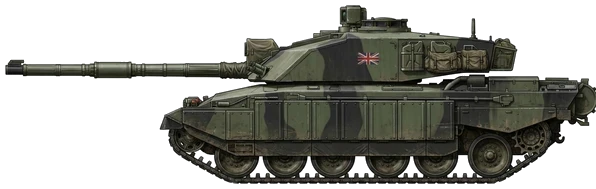
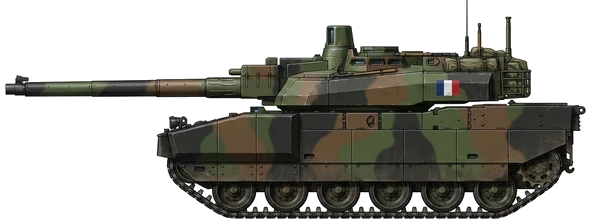
| Challenger 2 | Leclerc | |
|---|---|---|
| Origin country | 🇬🇧 United Kingdom | 🇫🇷 France |
| Category | Main Battle Tank | Main Battle Tank |
| Type | Heavy Main Battle Tank | Heavy Main Battle Tank |
| Manufacturer | Vickers Defense Systems | KNDS |
| Number produced | 447 units | 862 units |
| Estimated unit price | $5.3 million | $17 million |
| Combat weight | 75.0 tons | 57.4 tons |
| Maximum speed | 59 km/h | 71 km/h |
| Operational range | 550 km | 650 km |
| Length | 13.50 m | 9.87 m |
| Width | 4.20 m | 3.60 m |
| Height | 2.49 m | 2.53 m |
| Crew | 4 (commander, gunner, loader–operator, driver) | 3 (Commander, gunner, driver) |
| Challenger 2 | Leclerc | |
|---|---|---|
| Main armament | L30A1 120 mm rifled gun | GIAT CN120-26/52 120mm tank gun |
| Secondary weapon | 7.62 mm coaxial L94A1 chain gun | 12.7 mm coaxial M2HB machine gun (1,100 rounds) |
| Engine | Perkins CV-12 Condor 12-Cylinder Diesel Engine with 1200 hp | V8X SACM (Wärtsilä) 8-cylinder diesel engine 1,100 kW (1,500 hp) |
Detailed Comparison
The British Challenger 2 and French Leclerc are contemporary European third-generation main battle tanks that entered service in the 1990s. While the Challenger 2 prioritizes heavy armor protection and a traditional four-man crew configuration, the Leclerc emphasizes high mobility, active protection, and a reduced profile through a three-man crew and autoloader system. The Challenger 2 weighs 75.0 tons compared to the Leclerc's 57.4 tons, creating a distinct operational variance in logistics, strategic transportability, and power-to-weight ratios.
Development and Design
The Challenger 2 originated as a private venture by Vickers Defense Systems in 1986 to replace the Chieftain and Challenger 1, formally entering service in 1998. It retains the standard Western manual loading layout. Conversely, the Leclerc (KNDS) developed from the "EPC" program following the cancellation of the joint Franco-German Napoléon I project. Entering service in 1992 to succeed the AMX-30, the Leclerc incorporates an autoloader, eliminating the loader position. This design choice allowed for a compact chassis and reduced internal volume, aligning with a philosophy of protection through mobility and low visibility.
Protection and Firepower
The Challenger 2 utilizes a 120mm L30A1 rifled gun, unique among NATO operators. This allows the use of High-Explosive Squash Head (HESH) rounds alongside Armour-Piercing Fin-Stabilized Discarding-Sabot (APFSDS) projectiles. Protection relies on "Dorchester" composite armor, contributing to its high mass. The Leclerc mounts a 120mm CN120-26/52 smoothbore gun with a 52-caliber barrel, imparting higher muzzle velocity than shorter NATO standard 44-caliber guns. Its autoloader enables a fire rate of 12 rounds per minute, even while moving. The Leclerc utilizes modular composite armor, with SXXI variants adding titanium and semi-reactive layers. The French tank integrates the GALIX self-defense system and digital fire control enabling hunter-killer operations.
Mobility and Logistics
Mobility parameters diverge significantly. The Leclerc functions with a 1,500 hp V8X Hyperbar diesel engine, providing a high power-to-weight ratio and a maximum speed of 71.0 km/h. The Challenger 2, at 75.0 tons, uses a 1,200 hp Perkins CV-12, limiting road speed to 59.0 km/h. The Challenger's hydropneumatic suspension focuses on stability for firing, while the Leclerc's Hyperbar system integrates a gas turbine to reduce visible smoke and infrared signature. The Leclerc offers an operational range of 650 km compared to the Challenger's 550 km.
Deployment and Combat Record
The Challenger 2 saw combat during the 2003 invasion of Iraq, particularly around Basra, and is currently active with Ukrainian Ground Forces against Russian armor. It also serves in NATO's Enhanced Forward Presence in Estonia. The Leclerc has been deployed by the French Army in peacekeeping roles in Kosovo (KFOR) and Lebanon (UNIFIL). The United Arab Emirates deployed the Leclerc in the Yemeni Civil War beginning in 2015, where vehicles sustained damage from mines and ATGMs; reports indicate crew casualties occurred, though no complete hull losses were recorded.
Conclusion
The Challenger 2 serves as a heavily protected platform suited for direct fire support and defensive positions where survivability outweighs speed. Its rifled gun offers utility against fortifications but complicates ammunition interoperability within NATO. The Leclerc functions as a high-mobility offensive asset, utilizing superior acceleration and an autoloader for rapid maneuver warfare. The French platform offers easier strategic transport due to lower weight, whereas the British tank provides maximum passive crew protection at the cost of operational mobility.