Challenger 2 vs Leopard 2
Challenger 2 vs Leopard 2 at a glance — weight 75,000 vs 62,500 kg, top speed 59 vs 70 km/h, range 550 vs 340 km, crew 4 (commander, gunner, loader–operator, driver) vs 4.
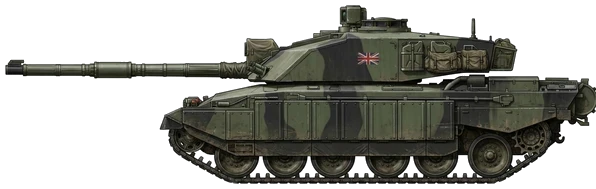
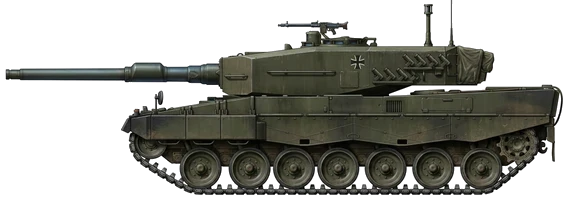
| Challenger 2 | Leopard 2 | |
|---|---|---|
| Origin country | 🇬🇧 United Kingdom | 🇩🇪 Germany |
| Category | Main Battle Tank | Main Battle Tank |
| Type | Heavy Main Battle Tank | Heavy Main Battle Tank |
| Manufacturer | Vickers Defense Systems | Krauss-Maffei |
| Number produced | 447 units | 3,600 units |
| Estimated unit price | $5.3 million | $29 million |
| Combat weight | 75.0 tons | 62.5 tons |
| Maximum speed | 59 km/h | 70 km/h |
| Operational range | 550 km | 340 km |
| Length | 13.50 m | 9.97 m |
| Width | 4.20 m | 3.76 m |
| Height | 2.49 m | 3.00 m |
| Crew | 4 (commander, gunner, loader–operator, driver) | 4 |
| Challenger 2 | Leopard 2 | |
|---|---|---|
| Main armament | L30A1 120 mm rifled gun | Rheinmetall 120 mm L/55 |
| Secondary weapon | 7.62 mm coaxial L94A1 chain gun | 7.62 mm MG3A1 or 7.62 mm FN MAG |
| Engine | Perkins CV-12 Condor 12-Cylinder Diesel Engine with 1200 hp | MTU MB 873 MTCA Diesel Engine with 1500 hp |
Detailed Comparison
The United Kingdom's Challenger 2 and Germany's Leopard 2 serve as the primary heavy armor platforms for their respective nations, though the German system achieved significantly wider export adoption with 3,600 units built compared to the British production of 447. While the Leopard 2 entered service in 1979 as a highly mobile successor to the Leopard 1, the Challenger 2 entered service in 1998, replacing the Chieftain and Challenger 1 with a design emphasizing protection and operational endurance.
Development and Design
Developed by Vickers Defense Systems, the Challenger 2 originated from a 1986 private venture. Following a 1988 Ministry of Defence prototype order, production commenced in 1993. The design integrates features to reduce radar signature and includes a hydropneumatic suspension system. Conversely, the Krauss-Maffei-built Leopard 2 emerged from a 1970s development cycle following the cancellation of a joint US-German project. The German design utilized an "experimental development" phase to integrate new technologies, entering service in 1979. The Leopard 2 utilizes a modular design philosophy, allowing distinct upgrades such as the arrow-shaped appliqué armour introduced on A5 variants.
Protection and Firepower
The Challenger 2 employs Dorchester composite armour on the hull and turret. Its armament is distinct among NATO forces: a 120 mm L30A1 rifled gun, enabling the use of High-Explosive Squash Head (HESH) rounds alongside kinetic energy penetrators. The Leopard 2 relies on spaced multilayer armour, with later models adding angled turret modules. Its primary weapon is the Rheinmetall 120 mm smoothbore cannon (L/44 or L/55), linked to a digital fire control system. A structural divergence exists in ammunition storage: the Leopard 2 features turret bustle storage with blow-off panels to protect the crew, while the Challenger 2 lacks this specific mechanism for hull-stored ammunition.
Mobility and Logistics
Mobility profiles differ significantly due to weight and engine specifications. The Leopard 2 is lighter at 62.5 tons and powered by a 1500 hp MTU diesel engine, achieving a maximum speed of 70.0 km/h. Its torsion bar suspension supports high-tempo maneuvers. The Challenger 2 is heavier at 75.0 tons and utilizes a 1200 hp Perkins CV-12 engine, resulting in a lower top speed of 59.0 km/h. Despite the speed deficit, the British platform offers a superior operational range of 550 km compared to the German tank's 340 km.
Deployment and Combat Record
Both systems debuted in Balkan peacekeeping operations (Bosnia, Kosovo). The Challenger 2 saw high-intensity combat during the 2003 invasion of Iraq, particularly around Basra, where it engaged enemy armor. The Leopard 2's combat history includes ISAF operations in Afghanistan and Turkish operations in Syria against ISIS, where it faced ATGM and IED threats. Since 2023, both platforms have operated in the Russo-Ukrainian War, participating in offensive actions against Russian forces, with some units receiving field modifications such as slat armour or reactive armour.
Conclusion
The Leopard 2 prioritizes mobility and firepower within a lighter chassis, making it suitable for rapid offensive maneuvers. Its widespread adoption facilitates international logistical support and standardization. The Challenger 2 prioritizes protection and endurance, evidenced by its higher combat weight and extended operational range, aligning with a doctrine of sustained direct fire support and survivability in high-threat environments.