Ariete 1 vs Leopard 2
Ariete 1 vs Leopard 2 at a glance — weight 54,000 vs 62,500 kg, top speed 65 vs 70 km/h, range 500 vs 340 km, crew 4 vs 4.
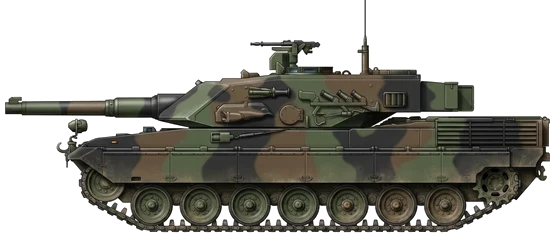
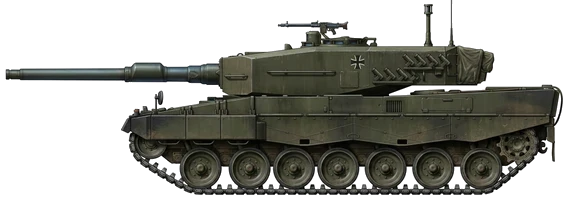
| Ariete 1 | Leopard 2 | |
|---|---|---|
| Origin country | 🇮🇹 Italy | 🇩🇪 Germany |
| Category | Main Battle Tank | Main Battle Tank |
| Type | Heavy Main Battle Tank | Heavy Main Battle Tank |
| Manufacturer | Consorzio Iveco-Fiat | Krauss-Maffei |
| Number produced | 200 units | 3,600 units |
| Estimated unit price | $2.9 million | $29 million |
| Combat weight | 54.0 tons | 62.5 tons |
| Maximum speed | 65 km/h | 70 km/h |
| Operational range | 500 km | 340 km |
| Length | 9.67 m | 9.97 m |
| Width | 3.61 m | 3.76 m |
| Height | 2.50 m | 3.00 m |
| Crew | 4 | 4 |
| Ariete 1 | Leopard 2 | |
|---|---|---|
| Main armament | 1 OTO-Breda 120mm smoothbore barrel (42 shells) gun | Rheinmetall 120 mm L/55 |
| Secondary weapon | 2 MG3 7.62mm machine guns (2500 rounds) | 7.62 mm MG3A1 or 7.62 mm FN MAG |
| Engine | Fiat V-12 MTCA Turbo-diesel engine with 1275 hp | MTU MB 873 MTCA Diesel Engine with 1500 hp |
Detailed Comparison
The C1 Ariete is a third-generation main battle tank manufactured by the Consorzio Iveco Oto Melara for the Italian Army, while the Leopard 2 is a German-produced platform by Krauss-Maffei with over 3,600 units built and wide international distribution. Both vehicles utilize 120 mm smoothbore armaments and composite armor arrays, yet they differ significantly in combat weight, engine output, and combat history. The Leopard 2 entered service in 1979, preceding the Ariete, which saw initial deliveries in 1994.
Development and Design
The Ariete was developed to provide Italy with an independent armored capability. The design follows a conventional layout with the driver forward, fighting compartment central, and engine rear. Recent C2 modernization contracts aim to extend its service life through modular armor packages and mine protection upgrades. The Leopard 2 evolved from the failed international MBT-70 project and national experimental developments. While early models featured vertical turret armor, variants from the A5 onwards incorporated wedge-shaped spaced armor to defeat kinetic penetrators. The Leopard 2 design prioritizes modularity, evidenced by the disparity between the earlier A4 and modern A7/A8 configurations.
Protection and Firepower
The Leopard 2 features spaced multilayer armor, with turret ammunition stored in a bustle separated by blast-proof doors and blow-off panels to enhance crew survivability. The Ariete utilizes a steel and composite blend, with ammunition distributed between the turret and a hull rack. Both tanks mount 120 mm smoothbore guns. The Ariete uses the OTO Breda L/44, stabilized via the TURMS fire-control system which provides hunter-killer capabilities. The Leopard 2 utilizes Rheinmetall 120 mm cannons, evolving from the L/44 to the longer L/55 in later variants, allowing for higher muzzle velocity. Both systems employ thermal imaging and laser rangefinders, though the Ariete's modernization involves converting hydraulic turret drives to electric to reduce fire risk.
Mobility and Logistics
The Leopard 2 possesses a superior power-to-weight ratio. Despite a heavier combat weight of 62.5 tons, its 1,500 hp MTU V12 engine propels it to 70.0 km/h. The Ariete, weighing 54.0 tons, is powered by a 1,275 hp Fiat V-12, reaching speeds of 65.0 km/h. However, the Ariete offers a greater operational range of 500 km compared to the Leopard 2's 340 km. The Leopard 2 utilizes a torsion bar suspension capable of deep-water fording with preparation. The Ariete C2 upgrade program addresses mobility deficits by installing a new Iveco Vector 12 engine and wider tracks.
Deployment and Combat Record
The Ariete is operated exclusively by the Italian Army, assigned to units such as the Bersaglieri Brigade "Garibaldi" and the Armored Brigade "Ariete." The provided data does not list active combat engagements for the vehicle. In contrast, the Leopard 2 has a documented combat history. It was deployed by German forces in Kosovo and by Canadian and Danish contingents in Afghanistan (ISAF), where it faced IED threats. Turkish Armed Forces utilized the Leopard 2A4 in the Syrian Civil War. Since 2023, the platform has been employed by Ukrainian forces in high-intensity combat operations against Russia.
Conclusion
The Leopard 2 is a heavier, more powerful platform that has defined the NATO standard for main battle tanks through widespread export and combat validation. Its superior engine output and compartmentalized ammunition storage offer advantages in survivability and kinetic performance. The Ariete represents a lighter, indigenous solution tailored to Italian logistics and specific operational ranges. While the Ariete's fire control system allows for effective target engagement, the Leopard 2's continuous upgrade path and heavier armor profile make it better suited for high-threat armored warfare environments.