Leclerc vs Leopard 2
Leclerc vs Leopard 2 at a glance — weight 57,400 vs 62,500 kg, top speed 71 vs 70 km/h, range 650 vs 340 km, crew 3 (Commander, gunner, driver) vs 4.
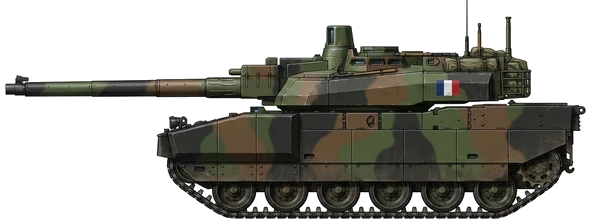
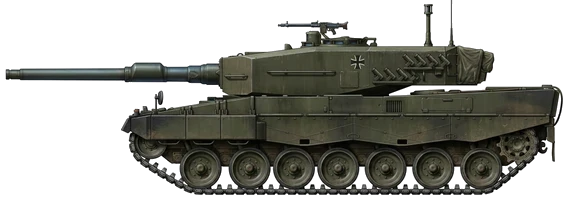
| Leclerc | Leopard 2 | |
|---|---|---|
| Origin country | 🇫🇷 France | 🇩🇪 Germany |
| Category | Main Battle Tank | Main Battle Tank |
| Type | Heavy Main Battle Tank | Heavy Main Battle Tank |
| Manufacturer | KNDS | Krauss-Maffei |
| Number produced | 862 units | 3,600 units |
| Estimated unit price | $17 million | $29 million |
| Combat weight | 57.4 tons | 62.5 tons |
| Maximum speed | 71 km/h | 70 km/h |
| Operational range | 650 km | 340 km |
| Length | 9.87 m | 9.97 m |
| Width | 3.60 m | 3.76 m |
| Height | 2.53 m | 3.00 m |
| Crew | 3 (Commander, gunner, driver) | 4 |
| Leclerc | Leopard 2 | |
|---|---|---|
| Main armament | GIAT CN120-26/52 120mm tank gun | Rheinmetall 120 mm L/55 |
| Secondary weapon | 12.7 mm coaxial M2HB machine gun (1,100 rounds) | 7.62 mm MG3A1 or 7.62 mm FN MAG |
| Engine | V8X SACM (Wärtsilä) 8-cylinder diesel engine 1,100 kW (1,500 hp) | MTU MB 873 MTCA Diesel Engine with 1500 hp |
Detailed Comparison
The German Leopard 2 and French Leclerc constitute the primary heavy armor capabilities for numerous European and international armies. Entering service in 1979 and 1992 respectively, both platforms emerged from Cold War requirements for a 120 mm-armed main battle tank (MBT) capable of engaging Soviet armor. While the Leopard 2 evolved through a traditional four-man crew configuration and heavy passive armor, the Leclerc integrated an autoloader and compact design to reduce mass and crew size.
Development and Design
The Leopard 2 succeeded a canceled 1960s joint development and subsequent national prototyping, achieving series production by Krauss-Maffei in 1979. It retains a conventional layout where a human loader services the main gun. Conversely, the Leclerc originated from the "EPC" program following the failure of the Franco-German "Napoléon I" initiative. Entering service with the French Army in 1992, the KNDS-manufactured vehicle utilizes a three-man crew. This design choice allowed for a smaller turret profile and reduced combat weight (57.4 tons) compared to the Leopard 2 (62.5 tons).
Protection and Firepower
The Leopard 2 mounts a Rheinmetall 120 mm smoothbore gun, upgraded from L/44 to L/55 in later variants, manually loaded by the fourth crew member. Protection consists of spaced multilayer armor, with wedge-shaped appliqué modules added to the turret face from the A5 variant onwards. The Leclerc employs a GIAT CN120-26/52 52-calibre smoothbore gun. Its autoloader enables a high sustained rate of fire and hunter-killer engagements via the commander's panoramic sight. Protection relies on modular composite armor, with SXXI batches integrating titanium and semi-reactive layers. The Leclerc's 52-caliber barrel offered higher muzzle velocity than the L/44 fitted to earlier Leopard 2 models.
Mobility and Logistics
Both vehicles utilize 1,500 hp diesel powerplants but differ in execution. The Leopard 2 uses an MTU MB 873 V12 with torsion bar suspension, achieving 70 km/h and a 340 km range. The lighter Leclerc utilizes a compact SACM V8X-1500 Hyperbar engine with a gas turbine element and hydropneumatic suspension. This configuration yields a higher power-to-weight ratio and extends operational range to 650 km with external drums. The Leclerc's complex Hyperbar system contrasts with the conventional engineering of the Leopard 2's powerpack.
Deployment and Combat Record
With over 3,600 units built, the Leopard 2 sees widespread use across Europe, Canada, and Asia. Combat deployments range from ISAF operations in Afghanistan, where it faced IED threats, to Turkish incursions in Syria and high-intensity warfare in Ukraine since 2023. The Leclerc, with 862 units produced, serves France, the UAE, and Jordan. UAE forces deployed the platform in the Yemeni Civil War against Houthi insurgents, sustaining damage from mines and ATGMs without complete hull losses. French units currently support NATO's Mission Aigle in Romania.
Conclusion
The Leopard 2 provides a standard heavy armor solution with extensive logistics networks and protection focused on mass and armor volume, suitable for defensive operations and coalition interoperability. The Leclerc offers an agile, offensive-oriented platform with extended operational range and automated firepower. While the Leopard 2 benefits from a broader user base and modular upgrade path, the Leclerc prioritizes mobility and reduced target profile through higher mechanical complexity.