Challenger 2 vs M1A1 Abrams
Challenger 2 vs M1A1 Abrams at a glance — weight 75,000 vs 63,000 kg, top speed 59 vs 66 km/h, range 550 vs 465 km, crew 4 (commander, gunner, loader–operator, driver) vs 4.
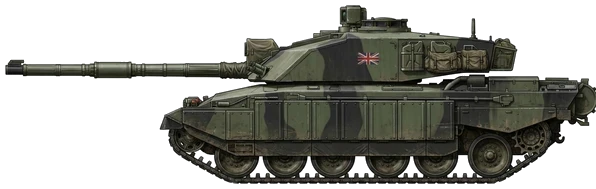
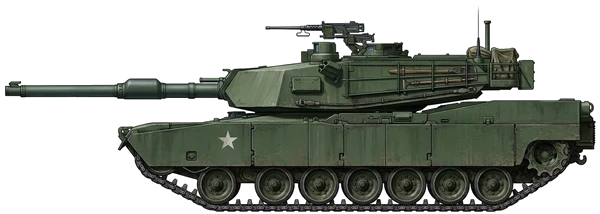
| Challenger 2 | M1A1 Abrams | |
|---|---|---|
| Origin country | 🇬🇧 United Kingdom | 🇺🇸 United States |
| Category | Main Battle Tank | Main Battle Tank |
| Type | Heavy Main Battle Tank | Heavy Main Battle Tank |
| Manufacturer | Vickers Defense Systems | General Dynamics Corp. |
| Number produced | 447 units | 9,200 units |
| Estimated unit price | $5.3 million | $4.3 million |
| Combat weight | 75.0 tons | 63.0 tons |
| Maximum speed | 59 km/h | 66 km/h |
| Operational range | 550 km | 465 km |
| Length | 13.50 m | 9.83 m |
| Width | 4.20 m | 3.65 m |
| Height | 2.49 m | 2.43 m |
| Crew | 4 (commander, gunner, loader–operator, driver) | 4 |
| Challenger 2 | M1A1 Abrams | |
|---|---|---|
| Main armament | L30A1 120 mm rifled gun | 1 M256 120mm smoothbore barrel (40 shells) gun |
| Secondary weapon | 7.62 mm coaxial L94A1 chain gun | 1 M-2HB 12.7mm machine gun (1000 rounds) |
| Engine | Perkins CV-12 Condor 12-Cylinder Diesel Engine with 1200 hp | AGT-1500 Turbine with 1500 hp |
Detailed Comparison
Vickers produced 447 Challenger 2s for the British Army, creating a bespoke, 75-ton platform with non-standard ammunition requirements. In contrast, General Dynamics manufactured over 9,200 M1A1 Abrams tanks, standardizing its 63-ton design across U.S., allied, and export armor formations.
Development and Design
The M1A1 was developed following the termination of the MBT-70 program. Chrysler Defense designed the Abrams around crew survivability and high mobility, integrating a gas turbine engine and ammunition blowout panels. Vickers developed the Challenger 2 as a private venture to replace the Chieftain and Challenger 1. The British design prioritized frontal armor thickness and long-duration crew endurance—evidenced by the internal boiling vessel—over mechanical agility or exportability.
Protection and Firepower
The M1A1 mounts the M256 120mm smoothbore gun, firing standardized NATO ammunition. Late M1A1 variants incorporate depleted uranium mesh in their composite armor arrays. The Challenger 2 utilizes the L30A1 120mm rifled gun. This permits the use of High-Explosive Squash Head (HESH) rounds, but strictly isolates the UK from allied ammunition supply lines.
The Abrams provides better post-penetration survivability. Its turret bustle isolates ammunition behind armored doors; if struck, blowout panels vent the explosion outward. The Challenger 2 stores its two-part ammunition in armored bins within the fighting compartment, increasing the risk of catastrophic internal detonation if the main Dorchester armor arrays are breached.
Mobility and Logistics
The M1A1 utilizes a 1,500 hp AGT-1500 gas turbine, yielding 23.8 hp/ton and a top speed of 66.0 km/h. The Challenger 2 relies on a 1,200 hp Perkins diesel. This creates distinct operational profiles:
- At 75 tons, the Challenger 2 manages just 16 hp/ton, restricting acceleration and tactical mobility in soft soil conditions.
- The Challenger 2's excess weight limits transportability and exceeds the load classifications of many standard military bridges.
- The Abrams' gas turbine consumes fuel at a much higher rate, requiring a denser logistical supply chain.
Deployment and Combat Record
During the 1991 Gulf War, M1A1s destroyed Iraqi T-72s at standoff ranges without a single loss to enemy tank fire. The Challenger 2 operated during the 2003 invasion of Iraq, primarily engaging forces around Basra. Both platforms are currently deployed with Ukrainian Ground Forces. Combat in the Russo-Ukrainian War confirms both tanks are vulnerable to top-attack munitions, FPV drones, and modern anti-tank guided missiles, forcing Ukrainian crews to weld field-expedient slat armor and drone screens onto both chassis.
Conclusion
The M1A1 Abrams is the strictly better combat system for high-intensity warfare. Its integration of the NATO-standard 120mm smoothbore gun guarantees ammunition interoperability, and its blowout-panel architecture maximizes crew survivability in modern threat environments. The Challenger 2 is an evolutionary dead end. Its rifled main gun complicates logistics, and its 75-ton mass overburdens a 1,200 hp engine. The Abrams’ global supply chain and power-to-weight ratio make it a functional maneuver asset, while the Challenger 2 remains an overweight, isolated platform.