IAV Stryker vs Patria AMV
IAV Stryker vs Patria AMV at a glance — weight 17,263 vs 32,000 kg, top speed 97 vs 100 km/h, range 500 vs 1,000 km, crew 2 vs —.
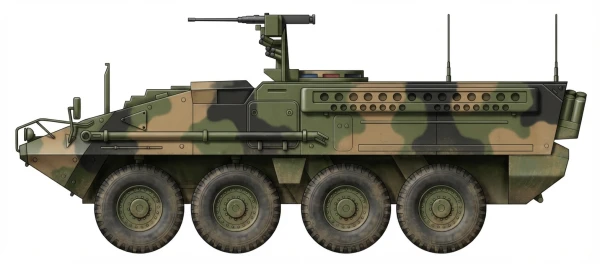
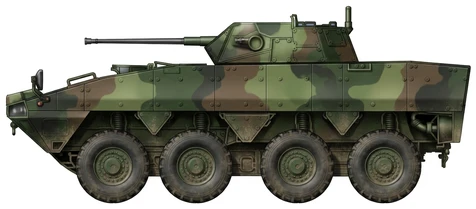
| IAV Stryker | Patria AMV | |
|---|---|---|
| Origin country | 🇺🇸 United States | 🇫🇮 Finland |
| Category | Armored Personnel Carrier | Armored Personnel Carrier |
| Type | 8x8 Armored Personnel Carrier | Armoured personnel carrier |
| Manufacturer | General Motors | Patria |
| Number produced | 1,000 units | 1,315 units |
| Estimated unit price | $4.9 million | $5 million |
| Combat weight | 17.3 tons | 32.0 tons |
| Maximum speed | 97 km/h | 100 km/h |
| Operational range | 500 km | 1,000 km |
| Length | 6.99 m | 7.70 m |
| Width | 2.72 m | 2.80 m |
| Height | 2.64 m | 2.30 m |
| Crew | 2 | 2–3 (commander, driver, optional gunner) |
| IAV Stryker | Patria AMV | |
|---|---|---|
| Main armament | 1 M-2 HB 12.7mm machine gun | Up to 105 mm gun or twin 120 mm mortars in turret |
| Secondary weapon | 1 Mk-19 40mm grenade launcher | Protector RWS |
| Engine | Diesel Engine with 350 hp | DI 12 Scania Diesel or DC 12 Scania Diesel or DC 13 Scania Diesel |
Detailed Comparison
Developed just two years apart, the US IAV Stryker and the Finnish Patria AMV were engineered for diverging strategic mandates. The Stryker emerged from the US Army's 1999 "Objective Force" requirement to rapidly deploy medium-weight brigades globally via C-130 aircraft. The Patria AMV was designed to replace the 6x6 Sisu Pasi with a high-capacity, heavy modular chassis tailored for European mechanized warfare and native survivability.
Development and Design
The Stryker is an evolution of the Canadian LAV III and Swiss Mowag Piranha. General Dynamics constrained its baseline combat weight to 17.2 tons to meet the strict C-130 air mobility mandate, dictating a relatively light base hull. Patria engineered the AMV from the ground up in a virtual 3D environment, prioritizing modularity over air transport limits. At 32 tons, the AMV chassis accommodates three distinct platform variants—basic, high-roof, and heavy weapon—without requiring the structural redesigns that complicated the Stryker program when integrating the retired 105mm Mobile Gun System.
Protection and Firepower
The 15-ton weight disparity directly dictates survivability and payload metrics.
- The Stryker provides 14.5mm all-around protection with bolt-on ceramics. Its original flat-bottomed hull proved vulnerable to improvised explosive devices in Iraq, forcing the US Army to manufacture a Double V-Hull (DVH) retrofit.
- The AMV withstands 30mm APFSDS rounds on the frontal arc and 10 kilograms of TNT under the hull in its factory configuration.
Most baseline Strykers mount a 12.7mm machine gun or 40mm grenade launcher on a remote weapon station, though the M1296 Dragoon variant carries a 30mm autocannon. The AMV’s higher payload capacity routinely supports heavier integrated systems, including twin 120mm mortars or 105mm tank guns.
Mobility and Logistics
Both vehicles utilize 8x8 configurations, but the AMV achieves greater operational reach. Powered by Scania diesels, the AMV operates up to 1,000 kilometers with a top speed of 100 km/h. The Stryker’s 350 hp Caterpillar engine yields a 500-kilometer range and 97 km/h maximum speed. The Stryker maintains a logistical advantage in theater due to its lower weight, easing bridge weight restrictions and tactical airlift requirements. The AMV demands heavier strategic lift assets like the A400M or C-17.
Deployment and Combat Record
The Stryker debuted in Iraq in 2003 with the 3rd Brigade, 2nd Infantry Division. Faced with RPG and IED threats, US forces required emergency application of slat armor. Polish AMVs (KTO Rosomak) deployed to Afghanistan in 2007, where their steel-composite armor repeatedly defeated RPG-7 strikes without external cage retrofits. Both vehicles entered combat in Ukraine in 2023. The 82nd Air Assault Brigade operates the Stryker in Zaporizhzhia, utilizing its mobility for infantry insertion. Ukrainian forces deploy Polish-supplied AMVs in mechanized assaults, relying on the heavier armor to absorb artillery fragmentation.
Conclusion
The Patria AMV provides a decisive tactical advantage in conventional mechanized warfare. By discarding the C-130 transportability constraint, Patria built a 32-ton chassis that natively defeats 30mm cannon fire and supports heavier organic firepower. The Stryker fulfills its original expeditionary mandate—moving infantry rapidly across paved or semi-paved terrain—but its 17.2-ton base weight required a reactionary DVH redesign and bolt-on kits to survive modern threats. For border defense and high-intensity conflicts against peer adversaries, the AMV's baseline armor and modularity make it the more capable combat platform.