M109 Paladin vs PzH 2000
M109 Paladin vs PzH 2000 at a glance — weight 38,000 vs 55,800 kg, top speed 61 vs 60 km/h, range 300 vs 420 km, crew 4 (section chief/commander, driver, gunner, ammunition handler/loader) vs 5 (commander, driver, gunner, and two loaders).
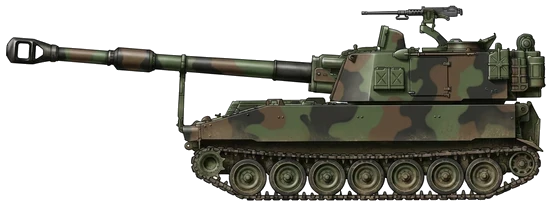
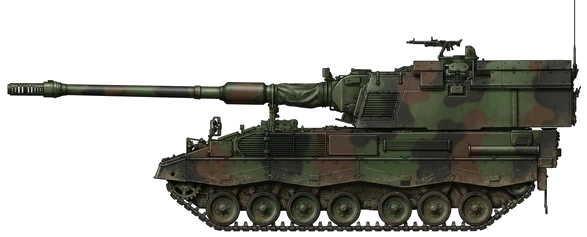
| M109 Paladin | PzH 2000 | |
|---|---|---|
| Origin country | 🇺🇸 United States | 🇩🇪 Germany |
| Category | Self-Propelled Artillery | Self-Propelled Artillery |
| Type | Self-propelled howitzer | Self-Propelled Howitzer |
| Manufacturer | BAE Systems | Krauss-Maffei Wegmann / Rheinmetall |
| Number produced | 7,000 units | 362 units |
| Estimated unit price | $14.4 million | $4.5 million |
| Combat weight | 38.0 tons | 55.8 tons |
| Maximum speed | 61 km/h | 60 km/h |
| Operational range | 300 km | 420 km |
| Length | 9.75 m | 11.67 m |
| Width | 3.15 m | 3.58 m |
| Height | 3.25 m | 3.06 m |
| Crew | 4 (section chief/commander, driver, gunner, ammunition handler/loader) | 5 (commander, driver, gunner, and two loaders) |
| M109 Paladin | PzH 2000 | |
|---|---|---|
| Main armament | 155 mm M284 Cannon | 155mm L/52 rifled howitzer |
| Secondary weapon | .50 caliber (12.7 mm) M2 machine gun | 7.62mm MG3 machine gun |
| Engine | Detroit Diesel 8V71T diesel, 440 hp | MTU 881 Ka-500 V8 diesel, 1,000 hp |
Detailed Comparison
The United States’ M109 Paladin and Germany’s Panzerhaubitze (PzH) 2000 are the primary tracked 155 mm self-propelled howitzers for NATO ground forces. The M109, introduced in 1963, relies on continuous iterative upgrades to maintain battlefield relevance across a production run of 7,000 units. The PzH 2000, fielded in 1998 with 362 units built, was designed around automation and range, replacing the canceled trilateral SP70 program.
Development and Design
BAE Systems’ M109 platform reflects a Cold War requirement for mass-produced, standardized mechanized artillery. The current M109A7 variant discards the original chassis in favor of Bradley Fighting Vehicle components, including the engine and tracks, to streamline armored brigade combat team supply chains. A 600-volt onboard electrical architecture replaces legacy hydraulic turret drives. KNDS and Rheinmetall developed the PzH 2000 using Leopard 2 chassis components to meet Joint Ballistic Memorandum of Understanding (JBMOU) standards. The German system prioritizes burst-fire rates through a complex automated loading and replenishment mechanism, reducing the physical burden on its crew compared to the Paladin’s largely manual operation.
Protection and Firepower
The PzH 2000 holds a distinct ballistic advantage. Its 155 mm L/52 chromium-lined barrel outranges the Paladin’s 39-caliber M284 cannon. Using base-bleed or rocket-assisted projectiles, the PzH 2000 reaches beyond 40 km, whereas the Paladin reaches 30 km. The German platform's autoloader enables Multiple Round Simultaneous Impact (MRSI) for up to five shells. The Paladin requires manual loading, though the A7 introduces an automatic rammer for velocity consistency.
Protection levels scale with vehicle mass:
- The 55.8-ton PzH 2000 integrates base armor rated for heavy counter-fire, with modular roof add-ons defeating top-attack mortar fragments.
- The 38-ton M109A7 provides standard fragmentation and small-arms protection, prioritizing weight savings over direct survivability.
Mobility and Logistics
The Paladin’s 38-ton combat weight allows transport via C-17 aircraft and standard heavy equipment transporters. Its Detroit Diesel 440 hp engine limits output, but the Bradley suspension integration in the A7 resolves historical cross-country mobility deficits. The 55.8-ton PzH 2000 utilizes a 1,000 hp MTU diesel, achieving 60 km/h with an operational range of 420 km—outpacing the Paladin’s 300 km range. However, the German vehicle's weight restricts bridge classification and rail transport options across Eastern Europe.
Deployment and Combat Record
The M109 operated in Vietnam, the Yom Kippur War, Desert Storm, and Iraq. In Ukraine, donated M109s function as attrition-warfare workhorses, valued for straightforward field maintenance despite shorter ranges exposing them to Russian loitering munitions.
The PzH 2000 deployed to Afghanistan in 2006 for precision fire support. In Ukraine, firing over 100 rounds daily induced loading mechanism failures, requiring depot-level repair in Lithuania and Slovakia. Conversely, its L/52 barrel demonstrated extreme durability, with Ukrainian crews pushing some tubes to 20,000 rounds against a manufacturer rating of 4,500.
Conclusion
The PzH 2000 dictates the terms of engagement in counter-battery duels. Its L/52 barrel and automated burst fire allow it to strike deeper and displace before return fire arrives, making it the superior tactical asset for peer-on-peer artillery warfare. However, its maintenance footprint is brittle. For sustained campaigns where supply lines are strained and depot access is limited, the M109A7 is the optimal system. Its lower weight, cross-platform parts commonality with the Bradley, and mechanical simplicity guarantee higher daily operational readiness when complex autoloaders fail.