T-80 vs T-90
T-80 vs T-90 at a glance — weight 46,000 vs 48,000 kg, top speed 70 vs 60 km/h, range 415 vs 550 km, crew 3 vs 3.
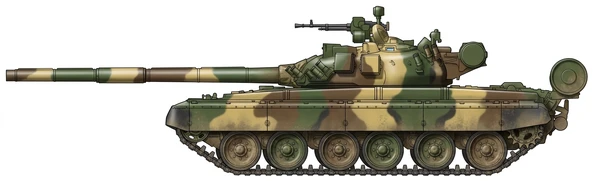
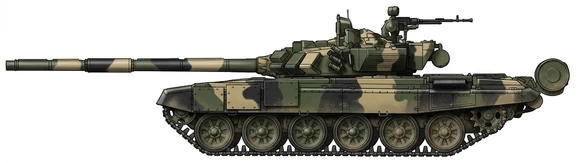
| T-80 | T-90 | |
|---|---|---|
| Origin country | 🇷🇺 Ex-USSR | 🇷🇺 Russia |
| Category | Main Battle Tank | Main Battle Tank |
| Type | Medium Main Battle Tank | Medium Main Battle Tank |
| Manufacturer | Malyshev HMB Plant | Malyshev HMB Plant |
| Number produced | 5,500 units | 4,000 units |
| Estimated unit price | $2.5 million | $4.5 million |
| Combat weight | 46.0 tons | 48.0 tons |
| Maximum speed | 70 km/h | 60 km/h |
| Operational range | 415 km | 550 km |
| Length | 9.65 m | 9.63 m |
| Width | 3.60 m | 3.78 m |
| Height | 2.20 m | 2.22 m |
| Crew | 3 | 3 |
Detailed Comparison
The T-80 and T-90 are Soviet-lineage main battle tanks that share a 125mm autoloader armament and three-man crew layout but diverge significantly in propulsion systems and design origins. While the T-80 (entered service 1976) introduced gas turbine technology to Soviet armor as a successor to the T-64, the T-90 (entered service 1992) originated as a modernization of the T-72 platform, prioritizing diesel reliability and survivability upgrades.
Development and Design
Designed by Nikolay Popov, the T-80 (Object 219-2) utilized elements of the T-64 chassis and became the first production tank to use a gas turbine as its primary powerplant. It evolved through the Omsktransmash-built T-80B and the Ukrainian diesel-powered T-80UD. Conversely, the T-90 (Object 188) was developed by the Kartsev-Venediktov Design Bureau. Adopted in 1992, it retained the mass-production philosophy of the T-72 family, integrating fire control advancements from the T-80U into a platform that reverted to diesel propulsion to reduce cost and complexity.
Protection and Firepower
Both tanks employ a 125mm smoothbore gun (2A46 series) capable of firing APFSDS, HEAT, HE-frag, and guided missiles. The T-80 uses a Korzina automatic loader holding 28 ready rounds, firing 9M119 Refleks missiles. The T-90 fires similar munitions, including the AT-11 Sniper missile.
- T-80: Protection evolved from composite armor to Kontakt-5 and Relikt Explosive Reactive Armor (ERA) on later models like the T-80BVM.
- T-90: Features a welded turret (on T-90A/M variants) with composite armor, supported by Kontakt-5 or Relikt ERA and the Shtora active protection system. The T-90M introduces enhanced thermal imaging and data exchange capabilities superior to legacy T-80 systems.
Mobility and Logistics
The T-80 is defined by its GTD-1250 gas turbine (in T-80U variants), providing a high power-to-weight ratio and a maximum speed of 70 km/h. This performance comes at the cost of high fuel consumption, limiting the operational range to 415 km. The T-90 relies on a V-92S2F diesel engine, which restricts maximum speed to 60 km/h but extends the operational range to 550 km. While the T-80 offers superior acceleration and cold-weather starting, the T-90 imposes a lower logistical burden regarding fuel supply and maintenance.
Deployment and Combat Record
The T-80 experienced significant losses during urban combat in the First Chechen War due to tactical misuse and armor vulnerabilities, influencing a shift in Russian procurement. Both platforms have been deployed extensively during the 2022 invasion of Ukraine, sustaining documented losses to modern anti-tank weapons and loitering munitions. The T-90 has also seen action in Dagestan, Syria, and Nagorno-Karabakh. While the T-80 secured exports to South Korea and Cyprus, the T-90 achieved wider commercial adoption, with India manufacturing the T-90S Bhishma under license.
Conclusion
The T-80 remains a high-mobility platform, with its turbine engine offering kinetic advantages in specific climates and tactical situations, albeit with higher sustainment requirements. The T-90 represents a consolidation of Soviet tank design, offering a balance of updated protection systems and diesel-engine logistics, establishing it as the primary export standard and the backbone of modern Russian armored formations.