T-62 / TR-580 / Tiran vs T-64
T-62 / TR-580 / Tiran vs T-64 at a glance — weight 40,000 vs 38,000 kg, top speed 50 vs 70 km/h, range 450 vs 500 km, crew 4 vs —.
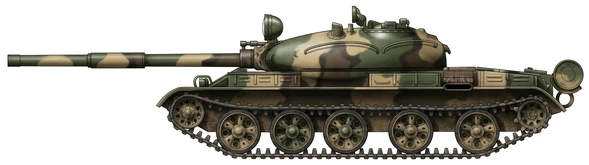
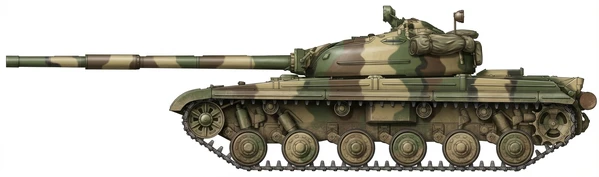
| T-62 / TR-580 / Tiran | T-64 | |
|---|---|---|
| Origin country | 🇷🇺 Ex-USSR | 🇷🇺 Ex-USSR |
| Category | Main Battle Tank | Main Battle Tank |
| Type | Medium Main Battle Tank | Medium Main Battle Tank |
| Manufacturer | Malyshev HMB Plant | Malyshev HMB Plant |
| Number produced | 6,142 units | 13,000 units |
| Estimated unit price | $0.3 million | $-- million |
| Combat weight | 40.0 tons | 38.0 tons |
| Maximum speed | 50 km/h | 70 km/h |
| Operational range | 450 km | 500 km |
| Length | 9.00 m | 9.22 m |
| Width | 3.30 m | 3.60 m |
| Height | 2.39 m | 2.17 m |
| Crew | 4 | 3 (driver, commander, gunner) |
| T-62 / TR-580 / Tiran | T-64 | |
|---|---|---|
| Main armament | 1 2A20 Sheksna 115mm smoothbore barrel (40 shells) gun | 1 2A46 125mm smoothbore barrel gun |
| Secondary weapon | 1 PKT 7.62mm coaxial machine gun (2500 rounds) | 1 DShK 12.7mm machine gun |
| Engine | V-55-5 V-12 Diesel Engine with 580 hp | 5TDFM multi-fuel diesel engine 850 hp |
Detailed Comparison
Soviet armor development diverged in the 1960s, yielding the T-62 as an iterative upgrade and the T-64 as a clean-sheet technological baseline. The T-62 stretched the existing T-55 chassis to field a 115mm smoothbore gun, maintaining a conventional four-man layout. Five years later, the T-64 eliminated the human loader, introducing a three-man crew, an autoloader, and composite armor.
Development and Design
Developed by Uralvagonzavod and introduced in 1961, the T-62 was conceived strictly to penetrate the frontal armor of Western tanks like the Centurion and M48. It utilized a stretched hull and a cast steel, egg-shaped turret. In contrast, the Morozov Design Bureau’s T-64, fielded in 1966, was the first Soviet tank to integrate an automatic loader. This permitted a smaller turret ring and reduced the combat weight to 38 tons, compared to the T-62's 40 tons. The Soviet military hoarded the T-64 for elite formations in East Germany, while mass-producing the cheaper T-62 ($0.3 million) for export and lower-tier units.
Protection and Firepower
The T-62 relies on homogeneous cast and rolled steel armor, which proved highly vulnerable to anti-tank guided missiles (ATGMs) during the 1973 Yom Kippur War. Its 115mm U-5TS smoothbore requires the gunner to elevate the barrel after firing to eject spent casings, breaking the line of sight and slowing the manual fire rate.
The T-64 introduced composite armor—layers of steel, fiberglass, and ceramics—offering vastly higher protection per ton against shaped charges. Its 125mm 2A46 smoothbore delivers higher kinetic energy and fires barrel-launched ATGMs. Modernized Ukrainian T-64BVs integrate thermal imaging and explosive reactive armor (ERA), widening the lethality gap over reactivated Russian T-62Ms, which are largely limited to outdated BDD appliqué armor and obsolete optics.
Mobility and Logistics
Uralvagonzavod equipped the T-62 with the V-55V 580 hp V-12 diesel. This direct descendant of the T-34’s engine yields a top speed of 50 km/h and requires minimal specialized training, making it suitable for conscript armies. The T-64 utilizes the compact 5TDF multi-fuel opposed-piston engine. Upgraded to 850 hp in variants like the T-64BM, it pushes the tank to 70 km/h. However, the 5TDF is mechanically complex and sensitive to dust, requiring a heavier logistical footprint and specialized mechanic training compared to the ubiquitous V-12.
Deployment and Combat Record
The T-62 has fought in nearly every post-war conflict involving Soviet-aligned states, from the Iran-Iraq War to Angola. The T-64 remained unexported and untested until the 1992 Transnistria War. Today, the T-64 forms the armored backbone of the Ukrainian Armed Forces. Concurrently, Russian forces, facing extreme materiel attrition, have reactivated thousands of stored T-62s. In direct engagements in Donbas and Kherson, the T-62’s lack of modern fire control and inferior base armor frequently result in catastrophic crew loss against drone-spotted artillery and modern ATGMs like the Javelin.
Conclusion
The T-64 is the superior main battle tank for peer-level mechanized warfare. Its base architecture provides the necessary foundation for modern combat, specifically:
- A 125mm autoloader system that outpaces the manual 115mm gun.
- Composite armor capable of mounting heavy modern ERA arrays.
- A smaller physical profile (38 tons, 2.17m height) that increases battlefield survivability.
The T-62 is obsolete for frontline tank-on-tank engagements. Its steel armor and manual loading cycle restrict its utility to direct-fire infantry support or as a mobile assault gun in low-intensity environments.