2A36 Giatsint-B
The 2A36 Giatsint-B is a Soviet-developed 152mm towed field gun introduced in 1976, used for long-range artillery bombardment and distinguished by its high muzzle velocity. Key figures: weight 9.8 t, top speed 80 km/h, unit cost $0.55M, built 1,500. In service with 9 armies — Iraq (200), Russia (150), Uzbekistan (140) and 6 others.
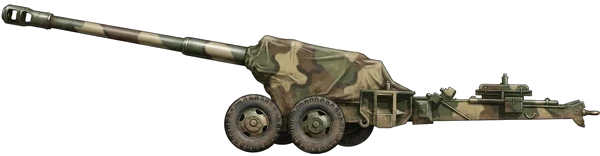
| Sub-type | Towed field gun |
| Crew | 8 personnels |
| Mass | 9.8 tons |
| Height | 2.76 m (9.1 ft) |
| Width | 2.788 m (9.1 ft) |
| Length | 12.3 m (40.4 ft) |
| Max. speed | 80 km/h (50 mph) |
| Weapon 1 | 152 mm 49-caliber gun |
| Weapon 2 | High-explosive fragmentation (HE-FRAG) shells |
| Weapon 3 | Armour-piercing tracer (AP-T) shells |
| Weapon 4 | Rocket-assisted projectiles (RAP) |
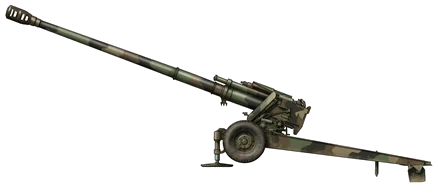
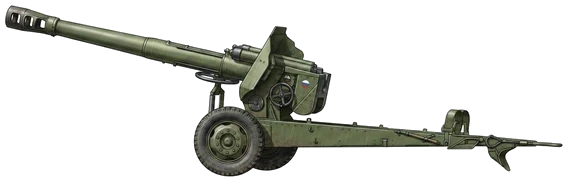
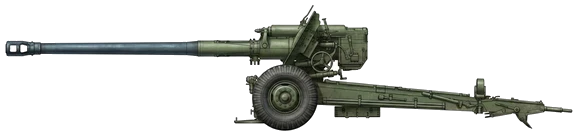
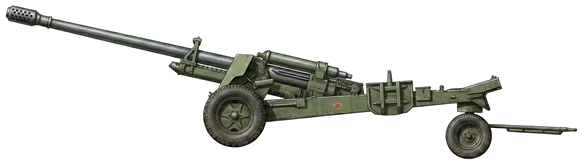
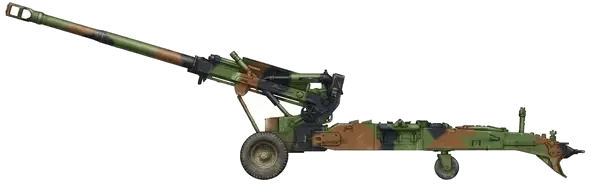
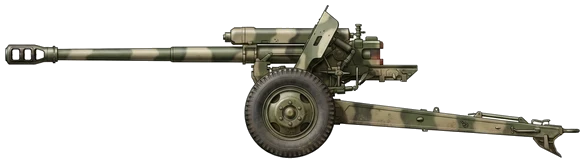
Description
The 2A36 Giatsint-B ("Hyacinth") is a Soviet 152 mm towed field gun that entered service in 1976 as a replacement for the 130 mm M-46. Development began in December 1968 at the Motovilikha Plants in Perm following a Soviet Army requirement for a 152 mm weapon to succeed the M-46. Two prototypes were completed in early 1971, and serial production began in 1976. Western intelligence initially designated the weapon the 152 mm gun M1976 before its Russian designation became known. The gun was first shown publicly during a Moscow parade in May 1985. A self-propelled variant, the 2S5 Giatsint-S, was developed in parallel; the two share identical ballistics but use different shells.
The primary role assigned to the Giatsint-B is counter-battery fire, along with suppression of troop and vehicle concentrations and destruction of fortified positions. The 49-calibre barrel is fitted with a multislotted muzzle brake, and the recoil system incorporates a buffer and recuperator. The breech is a semi-automatic horizontal sliding-block type. A hydropneumatic loading assist system, powered by recoil energy, drives a chain rammer for both the projectile and the cased propellant charge; manual loading remains possible if the rammer fails, at a reduced rate of fire. Russian figures give a rate of six rounds per minute.
The gun uses a split-trail carriage with a shield protecting the crew against shrapnel and shell fragments. Walking-beam suspension with four rubber-tyred braked roadwheels provides off-road mobility. The standard prime mover is the KrAZ-260 6×6 truck; the KrAZ-255B, Ural-4320, and the AT-T, ATS-59 and AT-S tracked artillery tractors can also tow the weapon.
Ammunition is separate-loading and includes HE-fragmentation, armour-piercing tracer for direct fire against armoured vehicles, rocket-assisted projectiles, smoke, concrete-piercing, and incendiary shells. United States Marine Corps intelligence assessments credit the gun with the ability to fire chemical, nuclear, and Krasnopol laser-guided projectiles. Rocket-assisted rounds give the 2A36 the longest range of any Soviet or Russian 152 mm artillery piece fielded since the mid-20th century, exceeded only by the 203 mm 2S7 Pion firing rocket-assisted ammunition. Trials confirmed firing across a temperature range of −50 to 50 °C. The ammunition is not interchangeable with that of earlier 152 mm systems such as the 2S3 Akatsiya.
Exports went to Finland, where the gun is designated 152 K-89, and to Iraq; at least six guns were delivered to Lebanon in 1982. Russia offered the system for export in the early 1990s, but United Nations reporting records no known transfers between 1992 and 2009. The bulk of surviving guns serve with former Soviet republics, including Armenia, Azerbaijan, Russia, Ukraine, Uzbekistan, Moldova, Georgia and Turkmenistan.
Most Iraqi guns were destroyed or captured during the 1991 Gulf War. The type was used in the 2020 Second Nagorno-Karabakh War, where Armenian batteries lost guns largely to Bayraktar TB2 strikes. Russian forces employed it during the War in Donbas alongside self-propelled systems, and both sides have used it since the 2022 invasion of Ukraine, including Finnish-donated 152 K-89 guns in Ukrainian service.
Frequently Asked Questions
What type of vehicle is the 2A36 Giatsint-B?
What is the weight of the 2A36 Giatsint-B?
What is the maximum speed of the 2A36 Giatsint-B?
How many crew members does the 2A36 Giatsint-B require?
How many 2A36 Giatsint-B have been built?
What weapons does the 2A36 Giatsint-B carry?
- AUG 152026 Created 2A36 Giatsint-B page created (specifications, overview, 13 operators)