URO VAMTAC
Introduced in 1998, the URO VAMTAC is a Spanish four-wheel drive military light utility vehicle developed to replace Land Rovers, performing a role similar to the American Humvee. Key figures: top speed 135 km/h, range 600 km, built 4,500. In service with 4 armies — Spain (2,900), Morocco (1,200), Portugal (139) and 1 other.
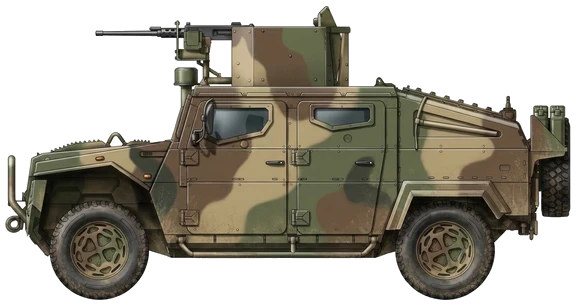
| Sub-type | Multi-purpose armored vehicle |
| Crew | 1+3 personnels |
| Range | 600 km |
| Height | 1.9 m (6.2 ft) |
| Width | 2.175 m (7.1 ft) |
| Length | 4.845 m (15.9 ft) |
| Max. speed | 135 km/h (84 mph) |
| Engine | Steyr 6.7L 6-cylinder turbocharged diesel |
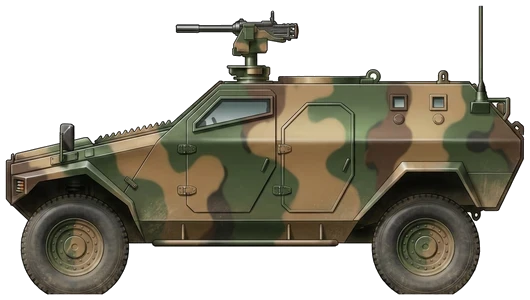
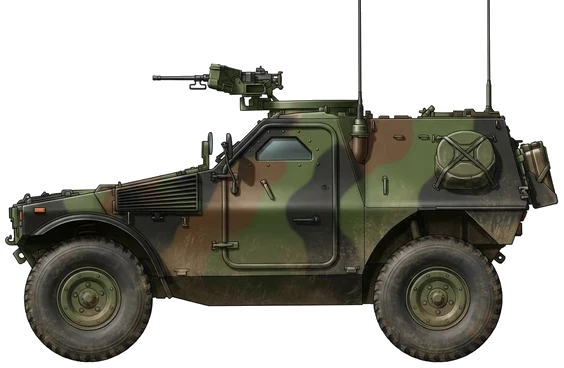
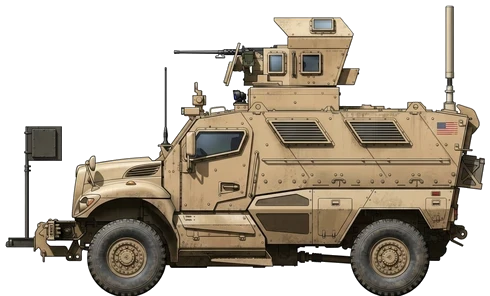
Description
The URO VAMTAC (Vehículo de Alta Movilidad Táctico) is a Spanish four-wheel drive military light utility vehicle produced by UROVESA. Development began in 1995 following a Spanish Ministry of Defence competition to replace the military's Land Rover fleet with a multipurpose, air-portable off-road vehicle. Designed around requirements similar to the American HMMWV, the vehicle entered production in 1998 under an initial five-year contract. Subsequent revisions introduced the I3 and S3 models in 2004, followed by the ST5 in 2013, when the platform was selected as the standardized light tactical vehicle across all branches of the Spanish Armed Forces. Specialized developments include the ST5 BN3 with STANAG Level 3 armor in 2015, the SK95 light artillery tractor, and the Light Tactical Vehicle (LTV) variant in 2018.
The VAMTAC features a four-wheel drive system, four-wheel independent double-wishbone suspension with coil springs, and an automatic transmission powered by a Steyr six-cylinder turbocharged diesel engine. It is air-portable and capable of negotiating 70 percent gradients and 50 percent side slopes. The vehicle is produced in command-and-control, pick-up, and chassis-cab body styles, with options for two-door, four-door, or reduced rear-space four-door cabs. The chassis accepts hardtops, shelter units, van bodies, or open beds. Protection options range from add-on ballistic kits and Composhield armor packages to integrated STANAG Level 3 ballistic protection.
Armament options include roof-mounted machine guns, automatic grenade launchers, M40 recoilless rifles, and 81 mm mortars. Anti-tank variants integrate BGM-71 TOW, MILAN, or Spike guided missiles. Air defense variants mount Mistral, Starstreak, 9K38 Igla, or Lightweight Multirole Missiles. Specialized configurations include Type 63 and M-63 Plamen artillery rocket launchers, Cardom mortar platforms, command and communications vehicles with shelter masts, ambulances, PSYOPS loudspeaker platforms, and fast attack vehicles equipped for special forces reconnaissance.
The VAMTAC entered operational service with Spanish forces in 1998, serving with the Spanish Armed Forces, National Police Corps, and Guardia Civil. Spanish units have deployed the vehicle in operations in Afghanistan, Congo, Lebanon, and Syria. The vehicle is widely exported, operating in several countries including the Dominican Republic, Indonesia, Iraq, Malaysia, Mali, Morocco, Oman, Portugal, Romania, Saudi Arabia, Singapore, and Ukraine. Orders have also been placed by New Zealand and the United Kingdom, while trials were conducted in Brazil and Paraguay.
Frequently Asked Questions
What type of vehicle is the URO VAMTAC?
What is the maximum speed of the URO VAMTAC?
What is the operational range of the URO VAMTAC?
How many crew members does the URO VAMTAC require?
How many URO VAMTAC have been built?
- AUG 292026 Updated Re-filed as a protected mobility vehicle (was Light)
- AUG 112026 Created Page created: URO VAMTAC