ATF Dingo
Introduced in 2000, the German ATF Dingo is an armored infantry mobility vehicle featuring a V-shaped hull designed for mine protection. Key figures: weight 11.9 t, top speed 90 km/h, range 1,000 km, unit cost $0.5M, built 1,200. In service with 8 armies — Germany (586), Belgium (218), Tunisia (100) and 5 others.
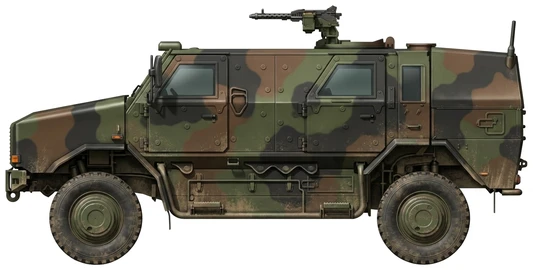
| Sub-type | Infantry mobility vehicle |
| Crew | 2 crew (driver and remote weapon station operator) plus 8 passengers personnels |
| Range | 1000 km |
| Mass | 11.9 tons |
| Height | 2.5 m (8.2 ft) |
| Width | 2.3 m (7.5 ft) |
| Length | 6.08 m (19.9 ft) |
| Max. speed | 90 km/h (56 mph) |
| Engine | Diesel engine, 160 kW power output |
| Weapon 1 | 1x Rheinmetall MG3 7.62mm light machine gun |
| Weapon 2 | 1x M2 Browning .50 BMG machine gun |
| Weapon 3 | 1x Heckler & Koch HK GMG 40mm automatic grenade launcher |
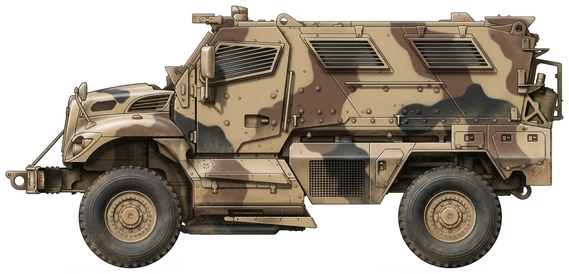
Description
The ATF Dingo (Allschutz-Transport-Fahrzeug) is a German armored infantry mobility vehicle produced by KNDS Deutschland, formerly Krauss-Maffei Wegmann. Developed on a Unimog chassis with a V-hull design, the vehicle was created to protect occupants from land mines, rifle fire, artillery fragments, and NBC threats. The first prototype was completed in 1995, and the Dingo 1 entered service with the German Army in 2000. An upgraded version, the Dingo 2, entered service in late 2004 following trials conducted between November 2003 and May 2004. Textron held exclusive rights to produce and market the design in the United States, though it ultimately offered a different vehicle for the American MRAP competition.
The vehicle utilizes a modular structure consisting of five elements: chassis, protection cell, storage space, engine compartment, and bottom mine blast deflector. To reduce weight compared to standard monocoque MRAP hulls, the design employs an armored chassis fitted with a blast pan, layered MEXAS composite armor, angled blast-deflecting glass, and a tarpaulin storage cover over the rear section. The Dingo 2 incorporates the updated Unimog U 5000 chassis.
Standard armament features a remote-controlled weapon station derived from the Fennek, fitted with a Rheinmetall MG3 7.62 mm machine gun controlled from inside the vehicle using an electro-optical sight with night vision. The Bundeswehr later adopted fully remote-controlled FLW 100 and FLW 200 weapon stations, allowing integration of the Heckler & Koch MG4, .50 BMG heavy machine guns, or the HK GMG 40 mm automatic grenade launcher, operated via an internal monitor display.
The Dingo is operated by several nations, including Germany, Belgium, Luxembourg, Austria, the Czech Republic, Qatar, and Serbia, as well as Iraqi Kurdistan Peshmerga forces, which received vehicles in 2014. Roles across these militaries include troop transport, patrol, command post, ambulance, and NBC reconnaissance. During the Russian invasion of Ukraine, Germany and Norway transferred Dingo vehicles to the Ukrainian Ground Forces, where the type saw combat deployment.
Frequently Asked Questions
What type of vehicle is the ATF Dingo?
What is the weight of the ATF Dingo?
What is the maximum speed of the ATF Dingo?
What is the operational range of the ATF Dingo?
How many crew members does the ATF Dingo require?
How many ATF Dingo have been built?
What weapons does the ATF Dingo carry?
- AUG 292026 Updated Re-filed as a protected mobility vehicle (was Light)
- AUG 42026 Updated Number built added
- AUG 22026 Created Page created: ATF Dingo