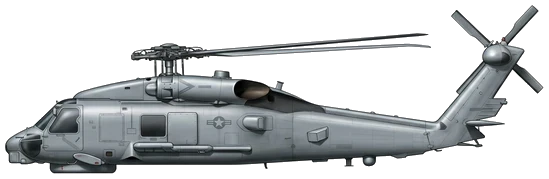
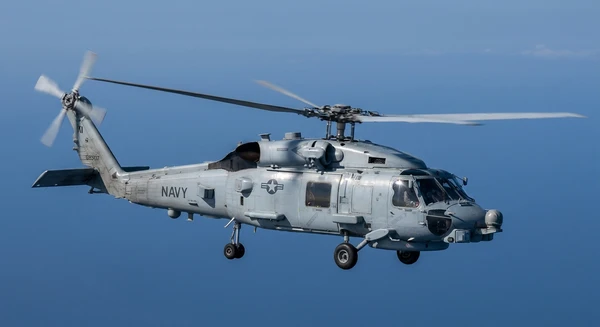
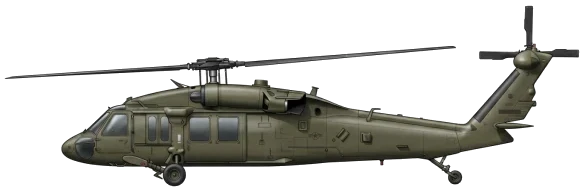
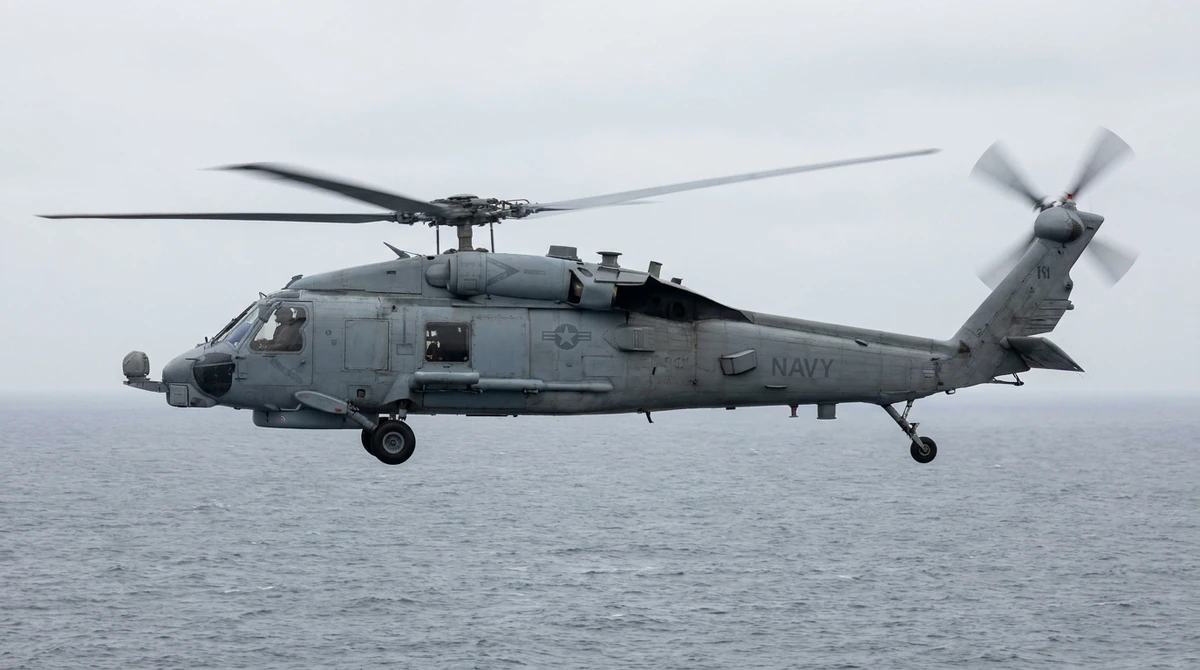
The Sikorsky SH-60 Seahawk is a twin-turboshaft, multi-mission naval helicopter based on the U.S. Army UH-60 Black Hawk. Developed under the U.S. Navy's Light Airborne Multi-Purpose System (LAMPS) Mk III program, the Navy selected Sikorsky’s S-70B design in 1978. IBM served as the prime systems integrator, and Sikorsky manufactured the airframe, maintaining 83% commonality with the UH-60A. Structural modifications for shipboard storage include folding main rotor blades, a folding tail pylon, and shifting the tail landing gear 13 feet forward. The YSH-60B prototype first flew on 12 December 1979, and the first production SH-60B flew on 11 February 1983. Power is provided by two General Electric T700-GE-401C turboshaft engines. Avionics and sensors vary by model, with the SH-60B using the APS-124 search radar and a 25-tube pneumatic sonobuoy launcher, while the newer MH-60R and S models feature an integrated glass cockpit with four digital displays.
Armament
The Seahawk carries weapons on designated pylons and cabin mounts. Offensive armaments include up to two Mk 46, Mk 50, or Mk 54 lightweight torpedoes, and AGM-114 Hellfire missiles (up to four on the SH-60B, HH-60H, and MH-60R, and eight on the MH-60S). Defensive systems include cabin-door-mounted M60, M240, GAU-16, or GAU-17/A machine guns. The helicopter has a maximum slung load capacity of 6,000 lb (2,700 kg).
Operational History
The U.S. Navy received its first production SH-60B in 1983, with operational deployment beginning in 1985. During the 1991 Gulf War, SH-60Bs performed surface surveillance, tracked Iraqi naval assets, and directed coalition air and surface strikes. The U.S. Navy formally retired the SH-60B in 2015, followed by the SH-60F and HH-60H in 2016. Export operators include Australia, Spain, Denmark, Japan, India, Singapore, Greece, South Korea, Turkey, Brazil, Taiwan, Saudi Arabia, and Norway.
Variants
- SH-60B Seahawk: Anti-submarine and anti-surface warfare variant equipped with the APS-124 search radar and a 25-tube pneumatic sonobuoy launcher.
- SH-60F "Oceanhawk": Carrier-borne anti-submarine variant equipped with the AQS-13F dipping sonar.
- HH-60H "Rescue Hawk": Combat search-and-rescue and special warfare support helicopter equipped with defensive infrared countermeasures.
- MH-60R Seahawk: Multi-mission variant combining SH-60B and SH-60F roles, featuring a glass cockpit, AAS-44 electro-optical system, and AN/AQS-22 dipping sonar.
- MH-60S "Knighthawk": Vertical replenishment and mine countermeasures variant featuring a UH-60 main fuselage with double sliding doors and an aft-mounted tail wheel.