F27 Friendship
Summary
| Category | Military Transport Aircraft |
| Origin country | 🇳🇱 Netherlands |
| Manufacturer | Fokker |
| First flight | 24 November 1955 |
| Year introduced | 1958 |
| Number produced | 586 units |
| Average unit price | $3.5 million |
Technical specifications
| Version: F27-200MAR | |
|---|---|
| Operational range | 2,600 km (1,616 mi) |
| Maximum speed | 509 km/h (316 mph) |
| Wing area | 70 m² (753.5 sqft) |
| Wingspan | 29 m (95.1 ft) |
| Height | 8.5 m (27.9 ft) |
| Length | 23.6 m (77.3 ft) |
| Service ceiling | 8,992 m (29,501 ft) |
| Empty weight | 12,148 kg (26,782 lbs) |
| Max. takeoff weight | 20,410 kg (44,996 lbs) |
| Powerplant | 2 x turboprops Rolls-Royce Dart Mk 536-7R delivering 1529 kW each |
Current operating countries
| Country | Units | ||
|---|---|---|---|

|
Iran | 12 | |

|
Bolivia | 2 | |

|
Thailand | 2 | |

|
Philippines | 1 | |
All operators
Description
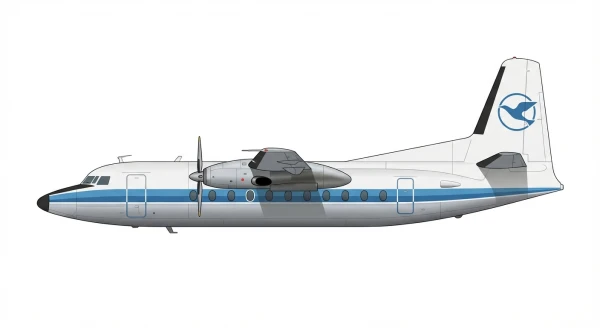
The F27 was developed during the early 1950s as a successor to piston-engine airliners like the Douglas DC-3. A key innovation was the adoption of the Rolls-Royce Dart turboprop engine, which produced substantially less vibration and noise and provided improved conditions for passengers. Another major comfort feature was cabin pressurisation. Innovative manufacturing techniques were also employed in the aircraft's construction. On 24 November 1955, the F27 made its maiden flight; on 19 November 1958, the type was introduced to revenue service. Under a licensing arrangement reached between Fokker and the U.S. aircraft manufacturer Fairchild, the F27 was manufactured in the United States by the latter; Fairchild went on to independently develop a stretched version of the airliner, which was designated as the Fairchild FH-227. During the 1980s, Fokker developed a modernised successor to the F27, the Fokker 50, which eventually replaced it in production.
The F27 incorporated several innovative design features for its time. Fokker selected a high-mounted wing, which provided a higher lift coefficient and easier ground loading due to a lower floor level, as well as offering passengers unfettered external views. The aircraft was powered by a pair of Rolls-Royce Dart turboprop engines. In its construction, Fokker used an innovative metal-to-metal bonding technique known as Redux, a method that enhanced fatigue life, improved aerodynamics, and reduced structural weight, making Fokker only the second company after de Havilland to employ this technique.
The F27 experienced a relatively slow start in sales before rapidly gaining popularity in 1960 due to its superior efficiency, faster flight times, enhanced passenger comfort, and higher reliability compared to its piston-engine predecessors like the DC-3. Several military transport and dedicated maritime reconnaissance models were produced. Payload capacity varied among the different models, with passenger capacities ranging from 44 to 52 depending on the configuration and fuselage length. By the conclusion of its production in 1987, Fokker had built 592 units, surpassing any other Western European civil turboprop airliner at the time; Fairchild also manufactured 207 F-27s and FH-227s in the United States. In later service, many aircraft were converted from passenger to cargo or express-package freighter configurations, with FedEx Express being a major cargo user in the United States until their retirement in 2009. As of July 2018, 10 aircraft remained in service operated by 7 airlines.
Main Variants:
-
F27-100: The initial production model, designed to carry 44 passengers.
-
F27-200: This variant was equipped with the more powerful Rolls-Royce Dart Mk 532 engine.
-
F27-300 Combiplane: A versatile version configured for combined civil passenger and cargo operations.
-
F27-300M Troopship: A military transport variant tailored for the Royal Netherlands Air Force.
-
F27-400: A "Combi" passenger/cargo aircraft, with two Rolls-Royce Dart 7 turboprop engines and large cargo door.