Ka-26
Soviet light utility helicopter with co-axial rotors, developed in the mid-20th century, primarily used for agricultural crop dusting and light military transport. Key figures: top speed 170 km/h, range 400 km, service ceiling 3,000 m, max takeoff weight 3,250 kg, built 816.
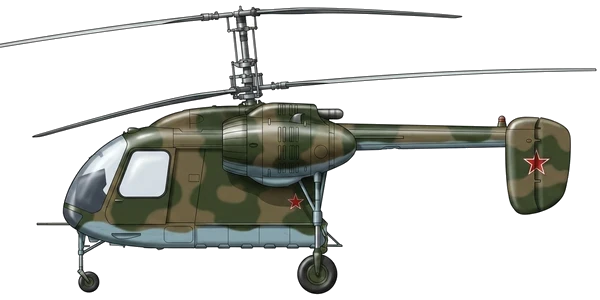
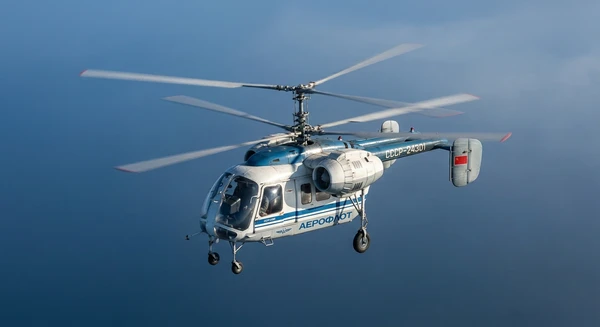
| Crew | 1–2 |
| Length | 7.8 m (25.4 ft) |
| Wingspan | 13 m (42.7 ft) |
| Height | 4.1 m (13.3 ft) |
| Empty weight | 1,950 kg (4,299 lbs) |
| Max. takeoff weight | 3,250 kg (7,165 lbs) |
| Powerplant | 2 × Vedeneyev M-14V-26 242 kW each |
| Maximum speed | 170 km/h (106 mph) |
| Operational range | 400 km (249 mi) |
| Endurance | 3 hours |
| Service ceiling | 3,000 m (9,843 ft) |

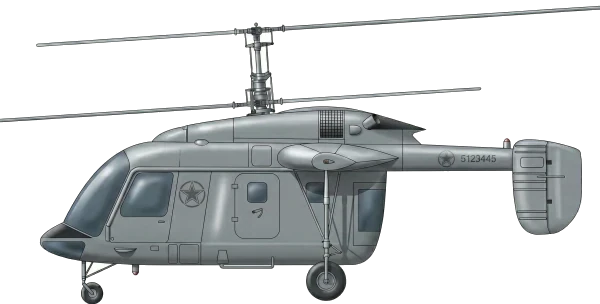
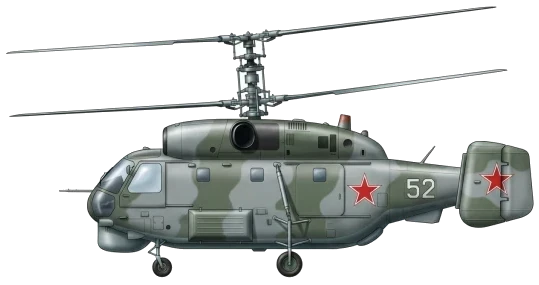
Description
The Kamov Ka-26 (NATO reporting name "Hoodlum") is a Soviet light utility helicopter with coaxial rotors, produced by Kamov. Designed for utility and agricultural missions, it is best known for its modular fuselage and its extensive use in agricultural spraying.
Development
Production of the Ka-26 began in 1969 and 816 examples were built. The programme gave rise to several turbine-powered derivatives: the single-turboshaft Ka-126, developed and built by Industria Aeronautică Română in Romania and first flown in 1986, and the twin-engine Ka-226. All Ka-26/126/128/226 versions share the same NATO reporting name "Hoodlum". On 30 June 2020, Moldovan police and prosecutors shut down a clandestine factory producing unlicensed copies of the Ka-26; the line held ten airframes at various stages of completion, intended for customers in former Soviet countries.
Design
The fuselage consists of a fixed bubble cabin housing the pilot and co-pilot, complemented by a removable module available in medical, passenger transport and agricultural spraying versions. The aircraft can fly with or without this module. Power is provided by two Vedeneyev M-14V-26 nine-cylinder air-cooled radial engines of 242.5 kW (325 hp) each, mounted in side nacelles. The two coaxial rotors have a diameter of 13 m; fuselage length is 7.75 m and maximum take-off weight 3,250 kg. Payload reaches 900 kg of passengers or liquid products, 1,065 kg in dusting configuration and 1,100 kg as an external load. Maximum speed is 170 km/h, range 400 km with seven passengers and ferry range 1,200 km with auxiliary tanks.
Operational History
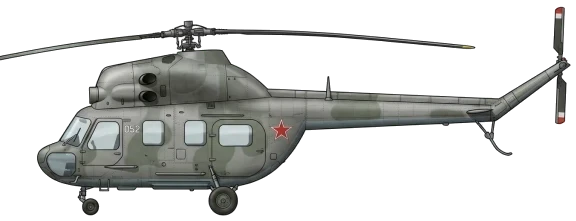
The Ka-26 is used mainly for civil agricultural work, in particular crop treatment. The coaxial configuration produces a symmetrical downwash beneath the aircraft, without the lateral airflows induced by a tail rotor, giving an even distribution of products and making it easier to avoid adjacent areas. It is used over Hungarian vineyards, where the downwash of conventional helicopters would damage or uproot the vines; Hungarian operators report that atomised pesticides remain suspended longer and settle more beneath the leaves. In some Warsaw Pact armed forces, the Ka-26 was used solely for transporting light paratroops. Its cruise speed of 150 km/h, below the Mi-2's 220 km/h, limits its general military use, but its shorter length (7.75 m against 11.9 m) and smaller rotor diameter (13 m against 14.6 m) suit it to operations in urban areas. Users have included the Soviet Militsiya, the Bulgarian Air Force, the East German Volkspolizei, the Mongolian Air Force, the Hungarian Air Force, the Sri Lanka Air Force and the Lithuanian border guard service; Gazpromavia in Russia and West Copter in Romania still operate it.
Variants
- Ka-26 Hoodlum-A: Light utility version with a crew of one or two, powered by two 325 hp M-14V-26 radial engines.
- Ka-26SS: NOTAR technology test bed for the Ka-118, fitted with tail-boom jets.
- Ka-126 Hoodlum-B: Version with a single 720 hp TVD-100 turboshaft, built in Romania as 2 prototypes and 15 production examples.
- V-60: Prototype light armed escort helicopter derived from the Ka-126.
- Ka-128: Single prototype powered by a 722 hp Turbomeca Arriel 1D1.
Frequently Asked Questions
What type of aircraft is the Ka-26?
What is the maximum speed of the Ka-26?
What is the range of the Ka-26?
When did the Ka-26 first fly?
How many Ka-26 have been built?
Which countries operate the Ka-26?
What is the service ceiling of the Ka-26?
- AUG 302026 Updated Description updated
- JUL 232026 Updated Sources and cross-references refreshed
- JUL 12026 Created Page created: Ka-26