Mil Mi-14 Haze
Summary
| Category | Military Helicopters |
| Origin country | 🇨🇳 Ex-USSR |
| Manufacturer | Mil |
| First flight | 1 August 1967 |
| Year introduced | 1975 |
| Number produced | 273 units |
Technical specifications
| Version: Mi-14PL Haze-A | |
|---|---|
| Crew | 4 members |
| Operational range | 1,135 km (705 mi) |
| Maximum speed | 230 km/h (143 mph) |
| Wingspan | 21.3 m (69.8 ft) |
| Height | 6.9 m (22.7 ft) |
| Length | 18.4 m (60.3 ft) |
| Service ceiling | 3,500 m (11,483 ft) |
| Empty weight | 11,750 kg (25,904 lbs) |
| Max. takeoff weight | 14,000 kg (30,865 lbs) |
| Powerplant | 2 x turboprops Klimov TV3-117MT delivering 1454 kW each |
Current operating countries
| Country | Units | ||
|---|---|---|---|

|
Syria | 10 | |

|
North Korea | 8 | |

|
Ukraine | 4 | |

|
Georgia | 2 | |

|
Pakistan | 2 | |

|
Poland | 2 | |

|
Yemen | 2 | |

|
Congo | 1 | |
All operators
1 recent event involving the Mi-14 Haze
| Date | Air Force | Aircraft | Active Δ | Ordered Δ |
|---|---|---|---|---|
| 7 May 2022 | 🇺🇦 Ukrainian Navy | Mi-14 | -1 | — |
| Shot down by a Russian aircraft near Odesa after returning from a Snake Island mission. Details → | ||||
Armament
Bombs payload:
- Anti-Submarine PLAB-250-120
Description
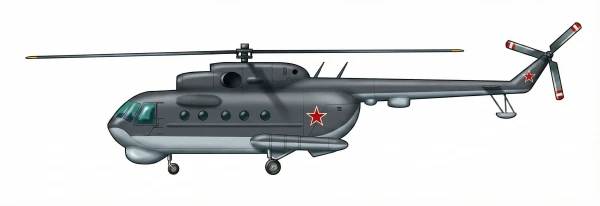
Formal development of an anti-submarine warfare (ASW) version of the Mil Mi-8 transport helicopter was authorized in April 1965, with the objective of replacing the Mil Mi-4 in the short-range, shore-based anti-submarine role. Designated as V-14 internally, the new design differed from the Mi-8 by featuring a boat-like hull, enabling it to operate off the water, and a retractable four-point undercarriage. Power was provided by two Klimov TV3-117MT turboshaft engines. The first prototype V-14, converted from a Mi-8, flew on 1 August 1967. Development was slowed by problems with the avionics and reliability issues with the TV3-117 engines. Production at Kazan started in 1973, and the helicopter, now designated Mi-14, entered service on 11 May 1976. Between 1973 and 1986 almost 300 Mi-14s were produced at Kazan Helicopters.
The Mil Mi-14 features a distinctive boat-like hull, enabling amphibious operation. This design is complemented by a retractable four-point undercarriage, with mainwheels that retract into large sponsons located on the rear fuselage. Power is supplied by two Klimov TV3-117MT turboshaft engines. The helicopter is equipped with a watertight weapons bay along the fuselage's center line, facilitating the internal carriage of a single torpedo or up to eight depth charges. A radome, which houses a search radar, is situated beneath the nose, enhancing its detection capabilities. The Mi-14PL anti-submarine version includes specialized equipment such as a retractable Type 12-M search radar, a dipping sonar, a towed APM-60 Magnetic Anomaly Detector (MAD), and OKA-2 sonobuoys to locate underwater targets. For engaging detected submarines, it could be armed with either a single AT-1 or APR-2 torpedo, or a single Skat nuclear depth bomb, or up to eight conventional depth charges. One Mi-14PL was experimentally fitted to carry the Kh-23 air-to-surface missile, though this modification was not adopted for operational service.
The Mi-14 saw operational use across various theaters and with numerous air forces. By 1991, approximately 230 units had been delivered to countries including Bulgaria, Cuba, East Germany, Libya, Poland, and Syria. Syrian Navy Mi-14 helicopters were deployed during the Syrian civil war from 2013 onwards, being employed to drop naval mines and barrel bombs. One such helicopter crashed in March 2015, resulting in the pilot's death and the capture of the remaining crew. A Ukrainian Mi-14PS was shot down by a Russian Su-35 in May 2022, leading to the death of Colonel Ihor Bedzay, the deputy head of the Ukrainian Navy.
Main Variants:
-
V-14: This was the prototype of the Mi-14 helicopter.
-
Mi-14PL (NATO Haze-A): This anti-submarine warfare helicopter was equipped with towed APM-60 MAD, OKA-2 sonobuoys, and a retractable Type 12-M search radar, and was armed with torpedoes, depth bombs, or depth charges.
-
Mi-14PLM: This improved anti-submarine warfare version featured the Os'minog ASW suite, which included a new search radar, dipping sonar, and digital computer, though it saw only limited use.
-
Mi-14BT (NATO Haze-B): This mine sweeping helicopter had its ASW systems removed and was equipped for towing Mine Countermeasures sleds.
-
Mi-14PS (NATO Haze-C): This was a search and rescue version equipped with search lights and sliding doors with a hoist.