F-15 Eagle vs MiG-31 Foxhound
F-15 Eagle vs MiG-31 Foxhound at a glance — top speed 2,655 vs 3,000 km/h, range 3,971 vs 3,000 km, max takeoff weight 30,844 vs 46,200 kg, built 1,198 vs 519 units.
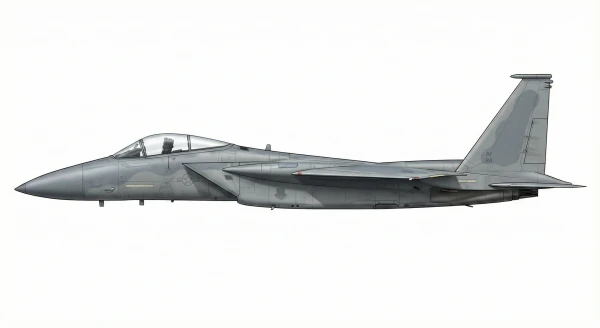
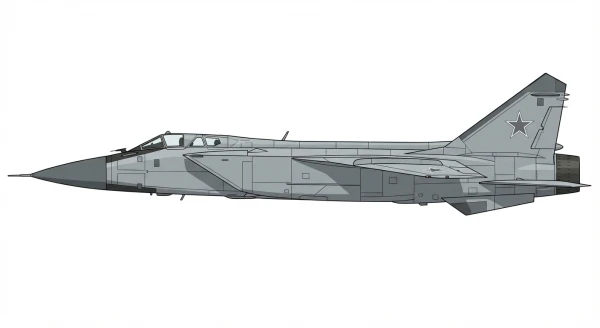
| F-15 Eagle | MiG-31 Foxhound | |
|---|---|---|
| Origin country | 🇺🇸 United States | 🇷🇺 Ex-USSR |
| Category | Combat Aircraft | Combat Aircraft |
| Manufacturer | McDonnell Douglas | Mikoyan |
| First flight | 27 July 1972 | 16 September 1975 |
| Year introduced | 1976 | 1981 |
| Number produced | 1198 units | 519 units |
| Average unit price | $29 million | $55 million |
| Wing area | 56.5 m² | 61.6 m² |
| Wingspan | 13.1 m | 13.5 m |
| Height | 5.6 m | 6.2 m |
| Length | 19.4 m | 22.7 m |
| Maximum speed | 2655 km/h | 3000 km/h |
| Operational range | 3,971 km | 3,000 km |
| Service ceiling | 19,812 m | 20,600 m |
| Max. takeoff weight | 30,844 kg | 46,200 kg |
| Empty weight | 12,701 kg | 21,830 kg |
| Total thrust | 2 x 10,782 kgf | 2 x 15,500 kgf |
Detailed Comparison
Conceived in the shadows of the Vietnam War and the MiG-25's shock effect, the McDonnell Douglas F-15 Eagle and Mikoyan MiG-31 Foxhound attack the air-to-air mission from opposite ends of the aerodynamic spectrum. The F-15 materialized from energy-maneuverability theory, demanding a 1:1 thrust-to-weight ratio to dominate within visual range and beyond. The MiG-31 accepted a 46,200 kg maximum takeoff weight to serve as an airborne radar picket and high-speed interceptor, built to network with ground control and shoot down penetrating bombers over the Russian tundra.
Development and Design
U.S. developers built the F-15 under the strict mandate of "not a pound for air-to-ground," correcting the F-4 Phantom's over-reliance on heavy missiles. The airframe utilizes a semi-monocoque titanium and aluminum structure to keep empty weight at 12,701 kg, pairing low wing loading with two Pratt & Whitney F100 turbofans for maximum agility. Mikoyan engineers took the opposite route. The MiG-31 is a heavy evolution of the MiG-25, structurally reinforced to survive low-altitude supersonic flight. Rather than prioritizing turn rates, Mikoyan introduced the first electronically scanned array radar on a combat aircraft—the Zaslon-A. Paired with a Weapons Systems Officer and APD-518 data links, a four-ship MiG-31 flight can autonomously cover a 900-kilometer front, operating as a distributed early warning network.
Specifications and Performances
The MiG-31 leverages raw thrust to achieve a top speed of Mach 2.8, outpacing the F-15's Mach 2.5 limit. However, the Foxhound's mass—nearly 16,000 kg heavier than a fully loaded Eagle—renders it completely unsuited for maneuvering combat. The F-15 extracts a 254 m/s climb rate from its lighter airframe, allowing it to control altitude and kinetic energy in a dogfight. The Eagle's armament optimizes for fighter-to-fighter kills using the AIM-120 AMRAAM. The Foxhound relies on heavy, long-range munitions like the 120-km range R-33 and R-37M, designed for standoff interception. Recently, Russia adapted the MiG-31K variant to carry the Kh-47M2 Kinzhal hypersonic aero-ballistic missile, utilizing the aircraft's speed and 20,600 m service ceiling as an initial booster stage.
Deployment and usage
The F-15 possesses a combat record of over 100 aerial victories with zero losses in air-to-air engagements. Israeli pilots proved the airframe over Lebanon in 1982, downing 41 Syrian aircraft, while USAF Eagles dominated Iraqi airspace in 1991. This operational monopoly secured massive export contracts with Japan, Saudi Arabia, and Israel. The MiG-31 has zero export customers and saw no conventional air-to-air combat during the Cold War. Today, the Russian Aerospace Forces employ the modernized MiG-31BM in the Ukraine conflict. Flying combat air patrols near the border, Foxhounds use R-37M missiles to target Ukrainian fighters from beyond 100 kilometers, scoring confirmed kills while remaining shielded from surface-to-air networks.
Conclusion
The F-15 is the superior air superiority fighter, backed by an unblemished combat record. Its aerodynamic design dictates engagements against other fighters, a role the heavy Russian interceptor cannot perform. However, operational utility depends entirely on the mission profile:
- The F-15 wins outright in offensive counter-air missions, where its climb rate, agility, and AMRAAM integration allow it to dismantle adversary fighter screens.
- The MiG-31 dictates the engagement in territorial defense and standoff strike, where its Mach 2.8 speed, 46-ton mass, and phased-array radar enable it to launch extreme-range missiles while remaining outside enemy threat rings.
The Eagle wins the dogfight; the Foxhound ensures the dogfight never happens.