DH.112 Venom
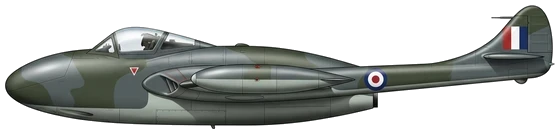
British twin-boom jet fighter-bomber and night fighter derived from the Vampire, in RAF service from 1952; the naval Sea Venom served British, Australian and French navies. Key figures: top speed 1,030 km/h, range 1,738 km, service ceiling 12,009 m, max takeoff weight 6,985 kg, built 1,431.
| Crew | 1 |
| Length | 9.7 m (31.8 ft) |
| Wingspan | 12.7 m (41.7 ft) |
| Height | 1.9 m (6.2 ft) |
| Wing area | 25.9 m² (278.8 sqft) |
| Empty weight | 4,174 kg (9,202 lbs) |
| Max. takeoff weight | 6,985 kg (15,399 lbs) |
| Powerplant | 1 × turbojet de Havilland Ghost 103 2,200 kgf each |
| Maximum speed | 1030 km/h (640 mph) |
| Operational range | 1,738 km (1,080 mi) |
| Service ceiling | 12,009 m (39,400 ft) |
| Climb rate | 45.7 m/s (149.9 ft/s) |
- Unguided Bomb 1,000 lb MC bomb
- Rocket Pod RP-3 60 lb rocket
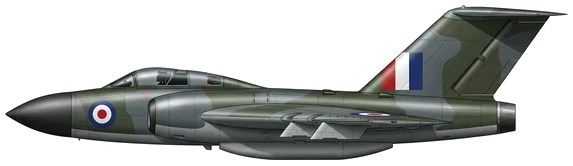
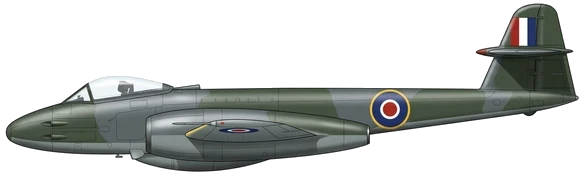
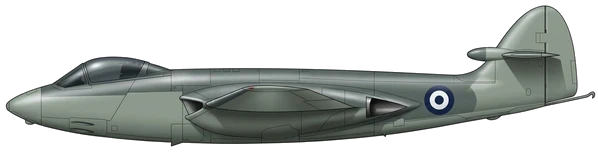
Description
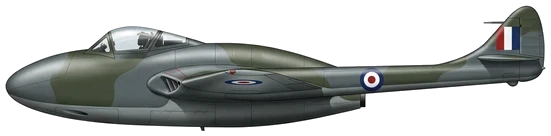
The de Havilland DH.112 Venom is a British single-engined jet fighter-bomber and night fighter developed and manufactured by the de Havilland Aircraft Company. It was derived from the Vampire and initially designated Vampire FB 8. The de Havilland Venom entered RAF service in 1952 as an interim type between the first straight-wing jet fighters and later swept-wing designs such as the Hawker Hunter. It flew operations in Malaya, Suez and Aden and was exported to Iraq, New Zealand, Sweden, Switzerland and Venezuela. The Swiss Air Force retired its last examples in 1983.
Development
In 1948 de Havilland proposed a Vampire development with a thinner wing and a more powerful engine. It evolved into the DH 112 to meet Specification F.15/49 for a fighter-bomber to replace RAF Vampires. The first prototype, VV612, was converted from a Vampire FB.5 and flew at Hatfield on 2 September 1949. It went to the A&AEE at Boscombe Down in May 1950. The NF.2 night fighter flew on 22 August 1950, the NF 3 in 1953, and the FB.4 on 29 December 1953.
After 15 aircraft were built at Hatfield, production moved to Hawarden. Fairey Aviation also built aircraft at Ringway. A Swiss consortium began licence production in 1953 and built 136 ground-attack aircraft and their Ghost engines.
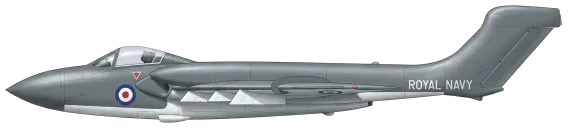
The navalised Sea Venom, based on the NF.2, flew in 1951. It added folding wings, a tailhook, long-stroke undercarriage and a canopy permitting underwater ejection. France licensed it as the Aquilon, built by SNCASE with Fiat-built engines.
Design
The DH.112 Venom kept the Vampire's twin-boom tail and composite wood/metal structure. Its wing had 17.6 degrees of leading-edge sweep and a thickness/chord ratio of 10 per cent, down from 14 per cent. The Ghost 103 turbojet produced 4,850 lbf (21.6 kN) and was started by Coffman cartridges. Optional 75 imp gal tip tanks could not be jettisoned but improved roll rate. Early aircraft suffered rear spar weakness and fuel-ingestion flash fires. The FB.4 introduced ejection seats, redesigned tail surfaces and hydraulically powered ailerons.
Night fighters seated two crew side by side with interception radar in an extended nose. The NF 3 used the AI.21 (AN/APS-57). In the 1970s Swiss aircraft received an extended nose housing a UHF radio, an IFF transponder and a SAAB BT-9K ballistic computer.
Armament
The FB 1 carried four 20 mm Hispano Mk V cannon with 150 rounds per gun. It could also carry two 1,000 lb bombs or eight RP-3 rockets. Some Sea Venom FAW.22s were fitted with Firestreak air-to-air missiles. The ECM.21 replaced its cannon with electronic countermeasures equipment.
Operational History
No. 11 Squadron converted in August 1952, and early deliveries went to overseas units. In Malaya, Nos. 45 and 60 Squadrons flew more than 300 strikes under Operation Firedog before withdrawal on 15 November 1957. During Suez in 1956, Nos. 6, 8 and 249 Squadrons operated from RAF Akrotiri and lost one aircraft. Sea Venoms flew from HMS Albion and HMS Eagle in the same campaign. From 1956, Venoms supported counterinsurgency operations in Aden and Oman.
The Gloster Javelin replaced RAF night fighters from 1957, and front-line RAF use ended in 1962. Sweden operated three night-fighter squadrons from 1955. The Sea Vixen replaced the Sea Venom from 1959, and second-line use ended in 1970. The Royal Australian Navy flew Sea Venoms from HMAS Melbourne between 1956 and 1967. French Aquilons flew counter-insurgency operations in Algeria from 1957 to 1961.
Variants
- FB.1: Initial single-seat fighter-bomber, entering service in 1952; 375 built.
- NF.3: Two-seat night fighter with ejector seats, a Ghost 104 engine and AI.21 radar; 123 produced.
- FB.4: Final RAF single-seat fighter-bomber with ejector seats and powered ailerons; 250 built.
- NF.51 (J33): Swedish night-fighter export version with licence-built engines, operated by F 1 at Västerås.
- Sea Venom FAW.21: Naval all-weather fighter equivalent to the NF.3, with a Ghost 104 and AI Mk 21 radar; 167 built.
Frequently Asked Questions
What type of aircraft is the DH.112 Venom?
What is the maximum speed of the DH.112 Venom?
What is the range of the DH.112 Venom?
When did the DH.112 Venom first fly?
How many DH.112 Venom have been built?
Which countries operate the DH.112 Venom?
What is the service ceiling of the DH.112 Venom?
- SEP 302026 Created Page created: DH.112 Venom