Westland Whirlwind
British licence-built development of the Sikorsky S-55 helicopter, flown from 1953 and used by naval and air forces for anti-submarine warfare and search and rescue until 1982. Key figures: top speed 175 km/h, range 538 km, service ceiling 3,962 m, max takeoff weight 3,538 kg, built 364.
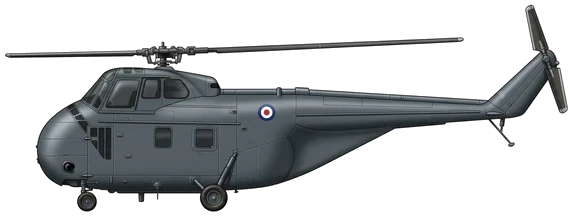
| Crew | 2 |
| Length | 12.7 m (41.7 ft) |
| Wingspan | 16.2 m (53.0 ft) |
| Height | 4.8 m (15.6 ft) |
| Wing area | 204.9 m² (2205.5 sqft) |
| Empty weight | 2,718 kg (5,992 lbs) |
| Max. takeoff weight | 3,538 kg (7,800 lbs) |
| Powerplant | 1 × radial piston engine Alvis Leonides Major 755 560 kW each |
| Maximum speed | 175 km/h (109 mph) |
| Operational range | 538 km (334 mi) |
| Service ceiling | 3,962 m (12,999 ft) |
| Climb rate | 4.6 m/s (15.1 ft/s) |
- Anti-Submarine Mark 30 torpedo
- Anti-Submarine Mark 44 torpedo
- Anti-Submarine depth charges
Description
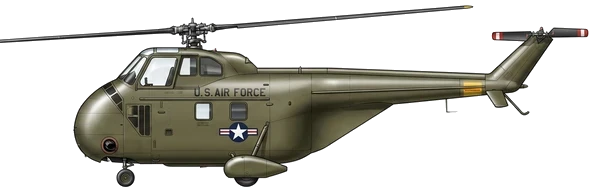
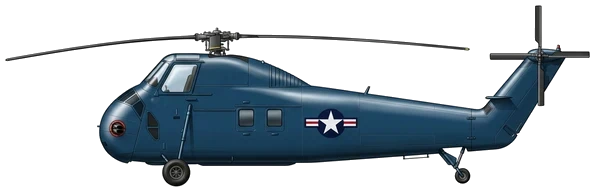
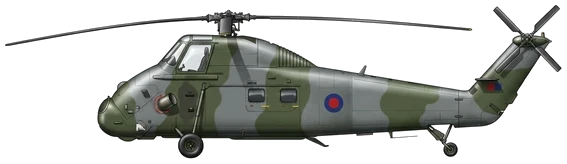
The Westland Whirlwind is a British licence-built version of the American Sikorsky S-55/H-19 Chickasaw helicopter, manufactured by Westland Aircraft. It served mainly with the Royal Navy's Fleet Air Arm in anti-submarine and search and rescue roles from 1954, and also with the Royal Air Force and export customers. It was produced in many variants with radial piston and turbine engines. Turbine-powered examples served until the early 1980s. The Whirlwind was succeeded by the turbine-powered Westland Wessex, which was based on the Sikorsky H-34.
Development
In 1950 Westland Aircraft, which was already building the Sikorsky S-51 under licence, bought the rights to manufacture and sell the larger S-55. Westland flew a Sikorsky-built pattern aircraft in June 1951. Converting the design to British standards included a revised main-rotor gearbox and took longer than expected. The first British prototype, G-AMJT, was powered by a 600 hp Pratt & Whitney R-1340-40 Wasp and did not fly until August 1953. Ten HAR.1s followed. The HAR.3 used a 700 hp Wright R-1300-3 Cyclone 7.
The American engines limited performance. In 1955 the HAR.5 flew with the Alvis Leonides Major. The similarly powered HAS.7 entered service in 1957 as the first British helicopter designed for front-line anti-submarine warfare. In 1960 Westland introduced a version powered by the 1,000 hp Bristol Siddeley Gnome turboshaft, and aircraft converted to this engine were redesignated HAR.9. Westland built more than 360 Whirlwinds, nearly 100 of them for export.
Design
The HAS.7 had a crew of two pilots and was powered by a 750 hp (560 kW) Alvis Leonides Major 755/1 14-cylinder two-row radial engine. It was 12.71 m long, with a 16.15 m main rotor, an empty weight of 2,718 kg and a maximum takeoff weight of 3,538 kg. Maximum speed was 175 km/h, range was 538 km at a cruising speed of 138 km/h, service ceiling was 4,000 m and hovering ceiling was 2,900 m. The HAR.5 introduced a 3-degree droop of the tail boom to increase main rotor clearance. The Gnome turboshaft had an early computer-controlled fuel system that removed variations in engine power and simplified handling for the pilot.
Armament
The HAS.7 carried one Mark 30 or Mark 44 torpedo or depth charges in place of its dipping sonar. Because it could not carry sonar and weapons at the same time, sonar-equipped "Hunters" directed torpedo-armed "Killers".
Operational History
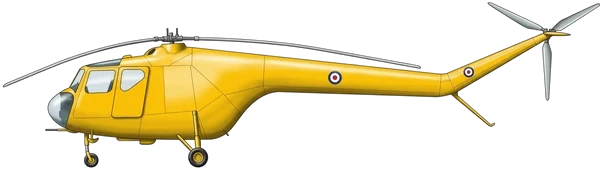
848 Naval Air Squadron was the first unit to receive HAR.1s. From July 1954 they replaced Sikorsky-built HAR.21s in utility and search and rescue service. The Whirlwind then entered service with the Royal Air Force and the French Navy, which received 37 HAR.2s between 1954 and 1957. RAF Air Sea Rescue Services flew overall-yellow Whirlwinds around the UK coast until Wessex and later Sea King helicopters replaced them. Twelve HAS.7s were used as Royal Marine transports. Two HCC.8s joined the Queen's Flight in 1959 and were later replaced by the Wessex. Military operators included Austria, Brazil, Brunei, Cuba, France, Ghana, Iran, Italy, Kuwait, Nigeria, Qatar, the United Kingdom and Yugoslavia, which had 19 aircraft. The last HAR.10 was retired in 1981 and the last Whirlwind in 1982.
Variants
- HAR.1: Ten built for Royal Navy search and rescue duties.
- HAR.3: Twenty-five built for the Royal Navy with the Wright R-1300 Cyclone 7 engine.
- HAS.7: Eighty-nine built for Royal Navy anti-submarine duties with a single torpedo.
- HAR.9: Twelve HAS.7 and HAR.7 conversions with the Bristol Siddeley Gnome replacing the Leonides Major.
- HAR.10: Sixty-eight built with the Gnome turboshaft for RAF transport and air-sea rescue.
Frequently Asked Questions
What type of aircraft is the Westland Whirlwind?
What is the maximum speed of the Westland Whirlwind?
What is the range of the Westland Whirlwind?
How many Westland Whirlwind have been built?
Which countries operate the Westland Whirlwind?
What is the service ceiling of the Westland Whirlwind?
- OCT 12026 Created Page created: Westland Whirlwind