T-6 Texan II
Summary
| Category | Military Training Aircraft |
| Origin country | 🇺🇸 United States |
| Manufacturer | Beechcraft |
| First flight | 23 December 1992 |
| Year introduced | 2001 |
| Number produced | 850 units |
| Average unit price | $4.3 million |
Technical specifications
| Version: T-6A Texan II | |
|---|---|
| Operational range | 1,700 km (1,056 mi) |
| Maximum speed | 585 km/h (364 mph) |
| Wing area | 16.3 m² (175.2 sqft) |
| Wingspan | 10.2 m (33.4 ft) |
| Height | 3.3 m (10.7 ft) |
| Length | 10.2 m (33.3 ft) |
| Service ceiling | 9,449 m (31,001 ft) |
| Empty weight | 2,135 kg (4,707 lbs) |
| Max. takeoff weight | 2,858 kg (6,301 lbs) |
| Climb rate | 16.0 m/s (52.5 ft/s) |
| Powerplant | 1 x turboprop Pratt & Whitney Canada PT6A-68 delivering 932 kW each |
| Ejection seat | Martin-Baker US16LA |
Current operating countries
| Country | Units | ||
|---|---|---|---|

|
United States | 740 (+29) | |

|
Mexico | 68 | |

|
Greece | 45 | |

|
Morocco | 24 | |

|
Canada | 22 | |

|
Israel | 20 | |

|
Thailand | 19 (+1) | |

|
Iraq | 15 | |

|
United Kingdom | 14 | |

|
Argentina | 12 | |

|
Vietnam | 12 | |

|
New Zealand | 11 | |

|
Colombia | 9 (+15) | |

|
Tunisia | 8 (+8) | |

|
Philippines | 6 | |

|
El Salvador | 2 | |
All operators
1 recent event involving the T-6 Texan II
| Date | Air Force | Aircraft | Active Δ | Ordered Δ |
|---|---|---|---|---|
| 29 Jan 2026 | 🇹🇭 Royal Thai Air Force | AT-6 | -1 | — |
| Crashed during combat SAR training in Chom Thong, Chiang Mai; both pilots killed. Details → | ||||

Description
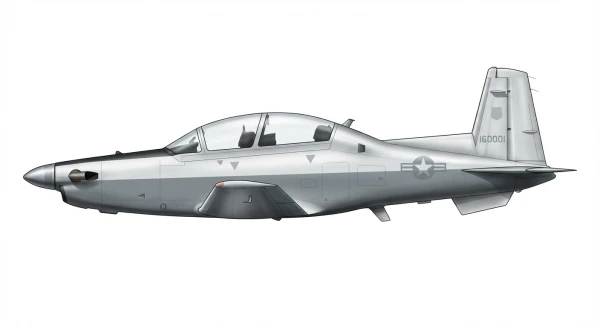
The T-6 Texan II is a single-engine turboprop aircraft primarily used for training pilots in the United States Air Force and Navy. It was developed by Raytheon Aircraft, now a part of Textron Aviation, and it first flew in 1998. It was officially introduced into service in 2001. The aircraft was designed to replace the aging T-37 Tweet and the T-34C Turbo Mentor in the training pipelines of the U.S. military.
The T-6 Texan II is designed with tandem seating, where the student and instructor sit one behind the other. It features a Pratt & Whitney Canada PT6A-68 turboprop engine, capable of delivering 1,100 shaft horsepower, which allows the aircraft to reach speeds up to 320 mph (or 515 km/h). The airframe is built for durability and high G-force maneuvers, accommodating up to +7 and -3.5 Gs, which is suitable for aerobatic and tactical training exercises. The aircraft is equipped with a glass cockpit, featuring a heads-up display (HUD) and multi-function displays (MFDs), which mirror the technology found in modern combat aircraft. This helps to familiarize trainees with the interfaces they will encounter in later stages of their careers.
The T-6 Texan II has a tricycle landing gear arrangement, aiding in easier takeoff and landing, as well as better ground handling. It's fitted with a Martin-Baker Mk.16 ejection seat for both the student and instructor, providing an additional layer of safety during emergency scenarios.
Operational history
The T-6 Texan II entered operational service in 2001 and has since become the primary training aircraft for the United States Air Force and Navy. It replaced the T-37 Tweet for the Air Force and the T-34C Turbo Mentor for the Navy. Since its introduction, it has been involved in the initial stages of training for thousands of pilots, teaching them the basics of flying, navigation, and even basic weapons employment.
Beyond the United States, the T-6 has also been adopted by other countries for military training, including Canada, Greece, Israel, and Morocco, among others. Different variants have been developed to meet the specific requirements of these international operators.
In the U.S., the aircraft is used in various training programs, including the Joint Primary Aircraft Training System (JPATS), which is a shared program between the U.S. Air Force and U.S. Navy. The aircraft is also used in the U.S. Air Force's Pilot Instructor Training (PIT) program.
The T-6 has proved reliable and effective as a training platform, but it has not been without issues. For example, there have been instances of unexplained physiological episodes affecting pilots, such as hypoxia-like symptoms. Investigations were carried out, and measures have been taken to mitigate such risks, but it remains a concern.
Variants
- T-6A: This is the standard version used by the U.S. Air Force for primary pilot training. It's equipped with a basic cockpit configuration and is used to teach fundamental flying skills.
- T-6B: Used by the U.S. Navy, this variant features an upgraded cockpit with integrated glass avionics, similar to what pilots would encounter in more advanced aircraft. This is aimed at providing a more seamless transition to next-level training and operational platforms.
- T-6C: This is an enhanced version that is available for export and is also used by some U.S. military branches. It comes with hardpoints under the wings for external fuel tanks or weapons, making it suitable for weapons training in addition to basic pilot training.
- AT-6 Wolverine: This is a light attack variant of the T-6, designed to serve in counter-insurgency, close air support, and reconnaissance roles. It is fitted with more advanced avionics and can carry a variety of weapons, including guided bombs and missiles.
- CT-156 Harvard II: This is a variant used by the Canadian Forces, and it's essentially a T-6A adapted to meet the specific training needs of the Canadian military.