T-50 Golden Eagle vs T-7 Red Hawk
T-50 Golden Eagle vs T-7 Red Hawk at a glance — top speed 1,840 vs 1,300 km/h, range 1,851 vs 1,830 km, max takeoff weight 13,472 vs 5,500 kg, built 200 vs 2 units.
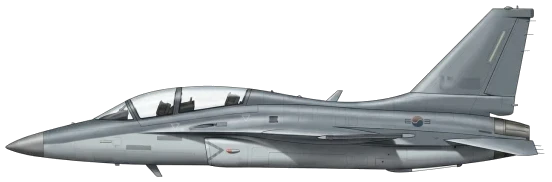
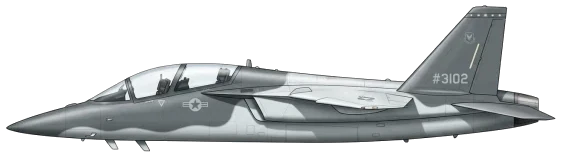
| T-50 Golden Eagle | T-7 Red Hawk | |
|---|---|---|
| Origin country | 🇰🇷 South Korea | 🇺🇸 United States |
| Category | Military Training Aircraft | Military Training Aircraft |
| Manufacturer | KAI | Boeing |
| First flight | 20 August 2002 | 20 December 2016 |
| Year introduced | 2005 | 2028 |
| Number produced | 200 units | 2 units |
| Average unit price | $25 million | $22 million |
| Wing area | 23.7 m² | -- m² |
| Wingspan | 9.2 m | 10.0 m |
| Height | 4.8 m | 4.0 m |
| Length | 13.0 m | 15.2 m |
| Maximum speed | 1840 km/h | 1300 km/h |
| Operational range | 1,851 km | 1,830 km |
| Service ceiling | 16,764 m | 15,240 m |
| Max. takeoff weight | 13,472 kg | 5,500 kg |
| Empty weight | 6,441 kg | 3,250 kg |
| Total thrust | 1 x 5,409 kgf | 1 x 8,029 kgf |
Detailed Comparison
The KAI T-50 Golden Eagle and the Boeing-Saab T-7 Red Hawk occupy the same market segment but address fundamentally different strategic requirements. The T-50 is a mature, combat-capable platform derived from legacy fourth-generation fighter DNA, while the T-7 is a clean-sheet design prioritizing low production costs, digital maintainability, and fifth-generation handling characteristics. While the T-50 offers immediate multirole utility, the T-7 represents a specialized, software-defined approach to pilot training.
Development and Design
KAI developed the T-50 with significant technical assistance from Lockheed Martin, resulting in an airframe that is effectively a scaled-down F-16. This lineage provides the T-50 with a robust, metal-heavy structure capable of sustaining high-G maneuvers and carrying substantial external stores. It integrates a mechanical (and recently AESA) radar and an internal 20mm cannon, signaling its intent as a dual-role Lead-In Fighter Trainer (LIFT) and Light Combat Aircraft (LCA).
Conversely, the T-7 Red Hawk utilizes "Digital Thread" engineering, allowing Boeing and Saab to move from concept to first flight in three years. The design focuses on high angle-of-attack (AoA) maneuverability to simulate the handling of the F-35 and F-22. The T-7 lacks the internal structural provisions for heavy combat loads or internal guns found in the T-50, positioning it strictly as a trainer with modular potential rather than inherent combat capability.
Specifications and Performance
The physical disparity between the two aircraft dictates their operational envelopes. The T-50 is a significantly heavier machine, with a Maximum Takeoff Weight (MTOW) of 13,472 kg, more than double the T-7’s 5,500 kg. This mass supports the T-50’s Mach 1.5 top speed and its ability to carry a wide array of ordnance.
Both aircraft utilize variants of the General Electric F404 engine. However, the T-50’s weight requires higher thrust usage, whereas the lightweight composite construction of the T-7 allows it to achieve high thrust-to-weight ratios for energy management training, despite a lower top speed of 1,300 km/h. The T-50’s service ceiling of 16,764 m exceeds the T-7’s 15,240 m, reflecting its interceptor lineage.
Deployment and Usage
The T-50 has an established operational footprint. The FA-50 variant saw actual combat with the Philippine Air Force during the 2017 Battle of Marawi, delivering guided munitions in urban close air support (CAS) roles. It has secured export contracts with Iraq, Indonesia, Thailand, and Poland, the latter purchasing 48 units to backfill MiG-29s transferred to Ukraine. It functions as a credible deterrent and patrol aircraft for air forces with limited budgets.
The T-7 remains in the testing phase, with its operational entry delayed by ejection system issues and flight control software refinement. While selected by the USAF to replace the T-38, it has zero operational sorties. Its "F/T-7" light attack variant remains a concept, unlike the field-proven FA-50.
Conclusion
The KAI T-50 is the superior choice for nations requiring an immediate, kinetic capability—an aircraft that trains pilots but can also police airspace and drop bombs. Its higher acquisition cost ($25m) and operating expenses are the trade-off for genuine multirole performance.
The T-7 Red Hawk will likely become the superior pure trainer for wealthy air forces operating fifth-generation fleets. Its "digital series" philosophy promises lower lifecycle costs ($22m unit cost), but until it clears development hurdles and demonstrates reliability, it cannot compete with the T-50 in the export market for armed light fighters.
-
 South Korea
103
South Korea
103
-
 Iraq
24
Iraq
24
-
 Indonesia
19
Indonesia
19
- All 4 operators →
