Z-10
Chinese attack helicopter, operational since 2010, notable for its various deployments in the People's Liberation Army. Key figures: top speed 300 km/h, range 1,120 km, service ceiling 6,400 m, max takeoff weight 7,000 kg, built 109. In service with 2 air forces as of 2026 — China (200), Pakistan (6).
| Crew | 2 |
| Length | 14.2 m (46.4 ft) |
| Wingspan | 13 m (42.7 ft) |
| Height | 3.9 m (12.6 ft) |
| Empty weight | 5,540 kg (12,214 lbs) |
| Max. takeoff weight | 7,000 kg (15,432 lbs) |
| Powerplant | 2 × turboshafts Zhuzhou WZ-9 1,000 kW each |
| Maximum speed | 300 km/h (186 mph) |
| Operational range | 1,120 km (696 mi) |
| Service ceiling | 6,400 m (20,997 ft) |
| Climb rate | 12.0 m/s (39.4 ft/s) |


Description
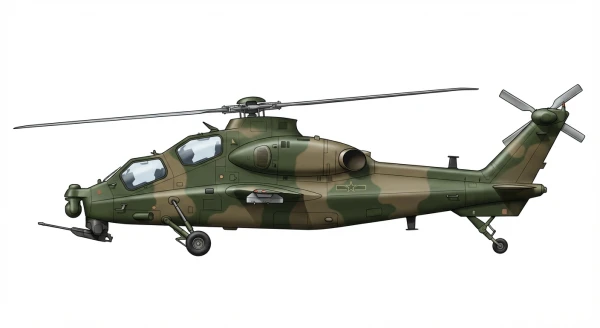
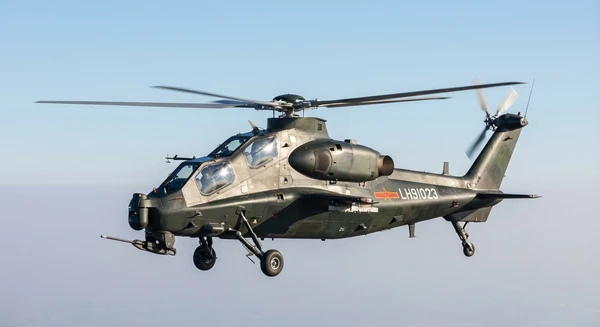
The Changhe Z-10 (直-10) is a medium-weight, twin-turboshaft attack helicopter built by Changhe Aircraft Industries Corporation for the People's Liberation Army Ground Force Aviation. It first flew on 29 April 2003 and entered service in 2009, becoming China's first purpose-designed dedicated attack helicopter. Intended primarily for anti-tank warfare with secondary air-to-air capability, it carries the PLA nickname Pi Li Huo (霹雳火, "Fierce Thunderbolt"), after the Water Margin character Qin Ming.
Development
The PLAGF formed its army aviation units in January 1988 using helicopters transferred from the PLAAF, and experience with the armed Z-9WA established the requirement for a dedicated platform. Preliminary planning began in 1992, and in 1994 the 602nd and 608th Research Institutes started the 6-ton China Helicopter Medium programme. In 1995 China commissioned the Kamov Design Bureau to produce a preliminary design, known internally as Project 941; Kamov took no part in subsequent development. Eurocopter France assisted with the rotor system and AgustaWestland with the transmission from 1997–1998, while Denel contributed flight stability work in 2000. Pratt & Whitney Canada and Hamilton Sundstrand supplied PT6C-67C engines and digital engine controls; in June 2012 the US charged United Technologies and both subsidiaries, which paid over $75 million in settlement. The 602nd Research Institute proposed the final design in 1998 as the Z-10. Loss of the P&WC engines forced a switch to the lower-rated indigenous WZ-9 and further weight reduction. Deck trials with a Type 072A landing ship began in March 2014.
Design
The airframe uses a blended fuselage with a hexagonal frontal profile, radar-absorbent material, and a stepped tandem cockpit. The rotor system comprises a five-blade semi-rigid main rotor with swept-tip 95KT blades and a four-blade scissor-type tail rotor, all carbon-fibre spars with honeycomb composite skin resistant to 12.7 mm rounds. The fuselage is mainly aluminium alloy with 30% composite mass; the canopy uses 38 mm bulletproof glass, with kevlar and aluminium protection around the cockpit floor, engine bays and self-sealing fuel tank. Later aircraft add graphene appliqué armour. The definitive powerplant is the WZ-9C turboshaft, 1,200 kW (1,600 shp) each, with a Hover Infrared Suppression System and upward-facing exhaust nozzles. Sensors include the WXG1006 nose-mounted electro-optical turret (FLIR, TV camera, laser rangefinder and designator), an optional mast-mounted Yu Huo millimetre-wave fire-control radar, and the YH-96 electronic warfare suite with MAWS, RWR, LWR and four countermeasure dispensers. Each crewman has two LCD MFDs and a helmet-mounted sight slaved to the sensors and cannon; the front pilot has a holographic HUD.
Armament
Weapons integration uses the GJV289A databus, the Chinese equivalent of MIL-STD-1553B. A chin-mounted 23 mm PX-10A revolver cannon has 180° traverse; 20 mm, 25 mm and 30 mm guns have been offered for export. Four stub-wing hardpoints carry 1,500 kg, each accepting four missiles for a maximum of 16. Missile options include HJ-8, HJ-9, AKD-9, AKD-10 and AKD-21 anti-tank missiles, CM-502KG and CM-501GA NLOS missiles, CM-501XA loitering munitions, SW6 air-launched drones, and TY-90 air-to-air missiles. Rocket pods range from 19-tube 57 mm to 7-tube 90 mm, including FS70 and FS90A guided rockets. Other stores are GB25 and GB50 guided bombs, ET60 324 mm torpedoes, KG300G jamming pods, and 280 kg drop tanks. Slung load capacity is about 3 tonnes.
Operational History
Z-10s were observed at PLAGF bases in 2011, and in September 2016 the PLA stated all army aviation units were equipped with the type. Aircraft are based in the Tibetan plateau and Taiwan Strait regions. The IISS listed 208 in Chinese service in 2022, including eight Z-10K with the PLAAF Airborne Corps Aviation Regiment. Pakistan took three Z-10s for trials in 2015 but rejected them over inadequate WZ-9 power at altitude; after the T129 ATAK deal collapsed, Pakistan ordered 40 Z-10ME, receiving a first batch in 2023 and holding an induction ceremony on 2 August 2025. A PLAGF Z-10 crashed in Fujian on 29 January 2017, killing both crew members.
Variants
- Z-10 Prototype: Test airframes of varying configuration, some with fenestron tails, differing gun mounts and nose- or mast-mounted electro-optical systems.
- Z-10H: Pre-production series powered by the Pratt & Whitney Canada PT6C-76 turboshaft.
- Z-10: Production baseline with domestic WZ-9 engines.
- Z-10K: Variant produced for the PLAAF Airborne Corps.
- Z-10ME: Export and upgrade standard first shown in 2018 with WZ-9C engines, graphene armour, intake filtration, upward-facing exhausts and, on the ME-02, AESA panels and DIRCM.
Identified in 5 sorties in the official China-Taiwan Tensions activity reports between 2021 and 2022 — a floor, not a census: only sorties the source identified by type are counted, and how much it disclosed varies by year.
Frequently Asked Questions
What type of aircraft is the Z-10?
What is the maximum speed of the Z-10?
What is the range of the Z-10?
When did the Z-10 first fly?
How many Z-10 have been built?
Which countries operate the Z-10?
What is the service ceiling of the Z-10?
- SEP 52026 Updated Overview rewritten: development, design, armament, variants and Pakistani export
- AUG 52026 Updated Powerplant updated in a site-wide editorial pass
- JUN 262026 Updated Missiles updated
- APR 72026 Updated Picture credits updated in a site-wide editorial pass
- FEB 72026 Updated Wingspan added
- JAN 122026 Updated Range updated in a site-wide editorial pass