AH-64 Apache vs Z-10
AH-64 Apache vs Z-10 at a glance — top speed 293 vs 300 km/h, range 480 vs 1,120 km, max takeoff weight 10,107 vs 7,000 kg, built 2,400 vs 109 units.
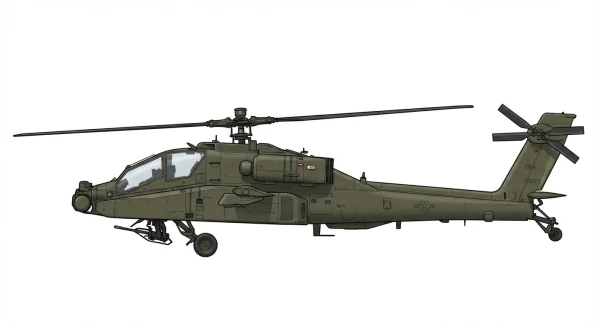
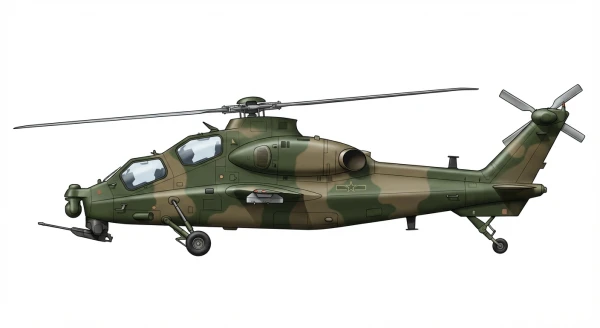
| AH-64 Apache | Z-10 | |
|---|---|---|
| Origin country | 🇺🇸 United States | 🇨🇳 China |
| Category | Military Helicopters | Military Helicopters |
| Manufacturer | Boeing | Changhe |
| First flight | 30 September 1975 | 29 April 2003 |
| Year introduced | 1984 | 2012 |
| Number produced | 2400 units | 109 units |
| Average unit price | $33 million | -- |
| Wingspan | 14.6 m | 13.0 m |
| Height | 5.0 m | 3.9 m |
| Length | 17.7 m | 14.2 m |
| Maximum speed | 293 km/h | 300 km/h |
| Operational range | 480 km | 1,120 km |
| Service ceiling | 5,670 m | 6,400 m |
| Max. takeoff weight | 10,107 kg | 7,000 kg |
| Empty weight | 5,352 kg | 5,540 kg |
| Total thrust | 2 x 1,208 kW | 2 x 1,000 kW |
Detailed Comparison
The Boeing AH-64 Apache is a 10,107 kg heavy attack platform engineered to dismantle mechanized columns, while the Changhe Z-10 is a 7,000 kg medium-weight airframe built to provide the People’s Liberation Army Ground Force (PLAGF) with organic close air support.
Development and Design
The AH-64 originated in the 1970s to replace the AH-1 Cobra, built around the AGM-114 Hellfire and a titanium bathtub for crew survivability against 23mm anti-aircraft fire. Its architecture prioritizes load-carriage and sensor integration, leading to the Longbow fire-control radar and the modern AH-64E's unmanned teaming capabilities. The Z-10, initiated in the late 1990s with covert design assistance from Russia’s Kamov bureau, required a lighter footprint. Early Z-10 production faced a U.S. embargo on Pratt & Whitney Canada PT6C engines, forcing a shift to indigenous 1,000 kW WZ-9 turboshafts. This power deficit required Changhe to strip armor and reduce base weight, fundamentally altering the aircraft's survivability profile compared to the Apache.
Specifications and Performances
The maximum takeoff weight (MTOW) discrepancy dictates their operational envelopes. Twin 1,208 kW GE T700-GE-701C engines allow the Apache to lift a heavy weapon complement, maxing out at 16 AGM-114 Hellfire missiles. The Z-10’s weaker WZ-9 engines restrict its payload, typically limiting loadouts to eight KD-10 anti-tank missiles. However, the Z-10's lighter airframe yields a 6,400 m service ceiling compared to the Apache's 5,670 m, a requirement for PLA operations in the high-altitude Tibetan Plateau. The Z-10 lists an unrefueled range of 1,120 km versus the Apache’s 480 km, indicating a clean-wing ferry configuration rather than a combat-loaded radius.
Deployment and usage
With over 2,400 units built, the Apache is the standard Western attack helicopter. Its operational record spans decades of high-intensity and asymmetric conflicts:
- Operation Desert Storm (1991), where Apaches destroyed Iraqi early-warning radar networks in the conflict's opening strikes.
- Operation Iraqi Freedom (2003), taking heavy battle damage during low-level urban combat in Fallujah.
- Broad export adoption, seeing combat with Israeli forces in Lebanon and Gaza, and Saudi forces in Yemen.
The Z-10 is confined almost exclusively to the PLAGF, conducting border patrols in Xinjiang and amphibious assault exercises near the Taiwan Strait. On the export market, the Z-10 failed to gain traction; Pakistan evaluated the platform but rejected it in favor of the Turkish T129 ATAK, citing the Z-10's inadequate power-to-weight ratio in high-altitude environments.
Conclusion
The AH-64 Apache holds a definitive edge in conventional armored warfare and contested airspace. Its heavy payload capacity, integrated Longbow radar, and heavy ballistic tolerance allow it to loiter and survive where the Z-10 cannot. The Z-10 is a localized solution tailored for specific altitude and border requirements. Until China fully integrates the up-rated WZ-16 engines across the Z-10 fleet to increase its payload and armor thresholds, the Apache remains the superior attack platform due to its kinetic capacity and three decades of iterative combat upgrades.