ATR-72
French-Italian regional turboprop, notable for its extensive use in civil and commercial aviation since the late 1980s. Key figures: top speed 565 km/h, range 1,404 km, service ceiling 7,620 m, max takeoff weight 22,500 kg, unit price $26M, built 1,000. In service with 4 air forces as of 2026 — Pakistan (5), Turkey (5), Italy (4) and 1 other.
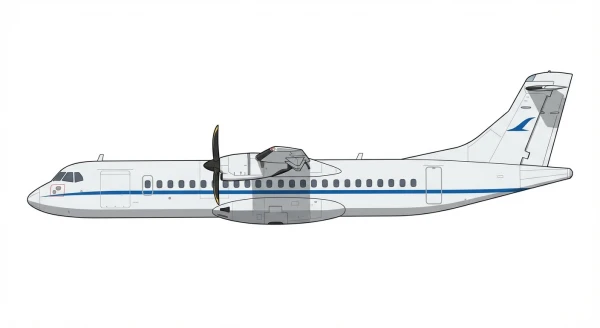
| Length | 27.2 m (89.1 ft) |
| Wingspan | 27.1 m (88.7 ft) |
| Height | 7.7 m (25.1 ft) |
| Wing area | 61 m² (656.6 sqft) |
| Empty weight | 12,950 kg (28,550 lbs) |
| Max. takeoff weight | 22,500 kg (49,604 lbs) |
| Powerplant | 2 × turboprops Pratt & Whitney Canada PW127F 2,051 kW each |
| Maximum speed | 565 km/h (351 mph) |
| Operational range | 1,404 km (872 mi) |
| Service ceiling | 7,620 m (25,000 ft) |
| Takeoff distance | 1,223 m (4,012 ft) |




Description
The ATR 72 is a twin-engine turboprop regional airliner developed and produced by ATR, a Franco-Italian joint venture between Aérospatiale (now Airbus) and Aeritalia (now Leonardo). It entered revenue service with Finnair on 27 October 1989 and is named for its standard 72-seat capacity. Beyond airline use, it has been adapted for corporate transport, cargo, and maritime patrol duties, and all examples are assembled at Toulouse.
Development
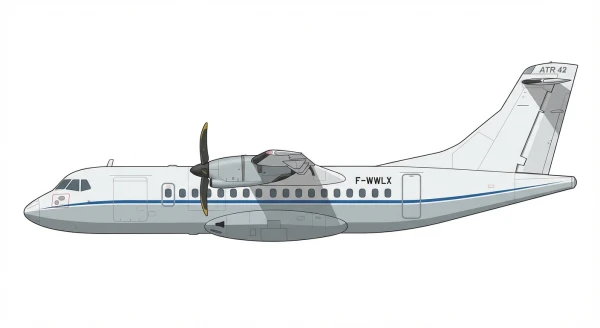
ATR was formed in the early 1980s to develop the ATR 42, which first flew on 16 August 1984. The stretched ATR 72 programme was launched on 15 January 1986, adding 4.5 m to the fuselage, increasing wingspan and fuel capacity by about 10 percent, and raising maximum seating from 48 to 78. The prototype flew on 27 October 1988 and received French DGAC certification on 25 September 1989. The -600 series was announced on 2 October 2007, with the prototype flying on 24 July 2009. By the end of 2014 ATR held 1,000 orders and had delivered 754. As of September 2018, 187 early variants, 365 -500s, and 444 -600s had been produced. The 2017 unit cost of the -600 was US$26 million.
Design
The ATR 72 is powered by two Pratt & Whitney Canada PW100 turboprops driving four- or six-bladed Hamilton Standard propellers. Early aircraft used the PW124B rated at 1,800 kW (2,400 shp); later aircraft use the PW127 rated at up to 2,050 kW (2,750 shp). Carbon fibre accounts for 30 percent of the wing by weight. No auxiliary power unit is fitted in standard configuration; most operators use a propeller brake on the No. 2 engine, known as Hotel Mode, for ground power. The -600 flight deck has five LCD screens, a multi-purpose computer, and Thales avionics with RNP capability. The ATR 72MP uses the Leonardo ATOS mission system with Seaspray 7300 AESA radar, an EO/IR turret, AIS, and an ASARS direction finder.
Armament
The ATR 72 ASW carries lightweight aerial torpedoes for anti-submarine and anti-surface warfare, using the Thales AMASCOS surveillance system with electronic warfare equipment. The Turkish TMPA variant was armed and developed with Turkish Aerospace Industries. The Italian P-72A contract was renegotiated in 2014 to exclude ASW and ASuW capability, though provisions were retained for later conversion.
Operational History
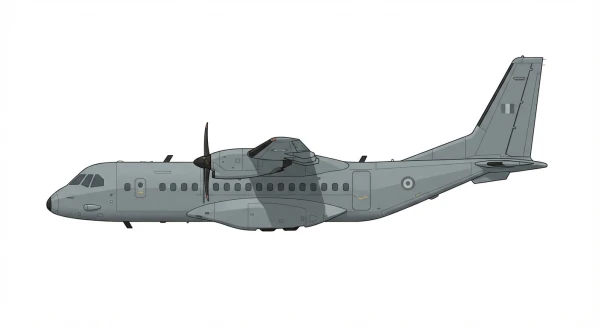
Military operators include the Italian Air Force, which received its first two P-72As in December 2016 and the last in February 2021, and the Guardia di Finanza, which ordered four P-72Bs in 2019. The Turkish Navy received two ATR 72-600 TMUA in 2013 and its first TMPA in December 2020. The Philippine Air Force operates two ATR 72-600 MAR aircraft with the Elbit ELI-3360 system. Iran Air ordered 20 ATR 72-600s in 2016; 13 were delivered before US sanctions resumed in August 2018. FedEx Express launched the -600F on 8 November 2017 with 30 firm orders and 20 options.
Variants
- ATR 72-100: Initial production series, comprising the -101 and -102 with PW124B engines, certified in 1989.
- ATR 72-200: Higher maximum take-off weight versions of the -101 and -102.
- ATR 72-210: PW127-powered -211 and -212 certified in December 1992 for hot-and-high performance.
- ATR 72-212A: Certified January 1997, marketed as the -500 and later the -600 with PW127M engines and glass cockpit.
- ATR 72MP: Leonardo maritime patrol and C4ISR derivative, with ASW and MAR sub-variants.
Frequently Asked Questions
What type of aircraft is the ATR-72?
What is the maximum speed of the ATR-72?
What is the range of the ATR-72?
When did the ATR-72 first fly?
How many ATR-72 have been built?
Which countries operate the ATR-72?
How much does a ATR-72 cost?
What is the service ceiling of the ATR-72?
- AUG 302026 Updated Description updated
- APR 72026 Updated Picture credits updated in a site-wide editorial pass
- JAN 242026 Updated Price updated
- JAN 122026 Updated Range updated in a site-wide editorial pass