F-100 Super Sabre vs MiG-19 Farmer
F-100 Super Sabre vs MiG-19 Farmer at a glance — top speed 1,390 vs 1,455 km/h, range 3,211 vs 2,200 km, max takeoff weight 15,800 vs 8,832 kg, built 2,294 vs 2,172 units.
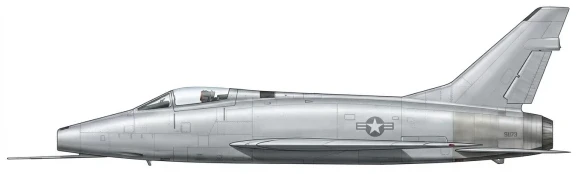
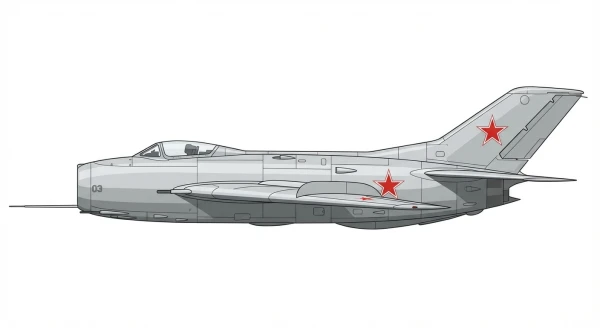
| F-100 Super Sabre | MiG-19 Farmer | |
|---|---|---|
| Origin country | 🇺🇸 United States | 🇷🇺 Ex-USSR |
| Category | Combat Aircraft | Combat Aircraft |
| Manufacturer | North American | Mikoyan-Gurevich |
| First flight | 25 May 1953 | 18 September 1953 |
| Year introduced | 1954 | 1955 |
| Number produced | 2294 units | 2172 units |
| Average unit price | $2 million | $2 million |
| Wing area | 37.0 m² | 25.2 m² |
| Wingspan | 11.8 m | 9.2 m |
| Height | 5.0 m | 3.9 m |
| Length | 15.2 m | 12.5 m |
| Maximum speed | 1390 km/h | 1455 km/h |
| Operational range | 3,211 km | 2,200 km |
| Service ceiling | 15,240 m | 17,500 m |
| Max. takeoff weight | 15,800 kg | 8,832 kg |
| Empty weight | 9,500 kg | 5,447 kg |
| Total thrust | 1 x 7,257 kgf | 2 x 3,243 kgf |
Detailed Comparison
The USAF’s F-100 Super Sabre and the Soviet VVS’s MiG-19 Farmer emerged in the early 1950s as their respective nations' first level-flight supersonic fighters. While both aircraft breached Mach 1, their underlying requirements dictated diverging architectures. North American produced a heavy, single-engine fighter-bomber geared for long-range tactical strike and nuclear delivery. Mikoyan-Gurevich designed a lightweight, twin-engine interceptor optimized for rapid climb rates to counter high-altitude bomber threats.
Development and Design
North American built the F-100 as a successor to the F-86, utilizing titanium and pioneering a stabilator (all-moving tailplane) to maintain pitch control through the transonic regime. Early models suffered from fatal yaw instability and inertia coupling, grounding the fleet in late 1954. The design stabilized with the F-100D, which added enlarged tail surfaces, avionics, and structural reinforcement for low-level strike missions. The MiG-19, hurried into production to counter Western bomber developments, initially suffered worse structural and safety defects, including poor fuel tank insulation that caused mid-air explosions. Mikoyan-Gurevich iterated rapidly through the MiG-19S with aerodynamic fixes and the MiG-19P, which added the Izumrud radar at the cost of forward visibility and aerodynamic efficiency.
Specifications and Performances
The MiG-19’s twin Tumansky RD-9B turbojets yield a thrust-to-weight advantage that dictates the performance delta between the two airframes. At a maximum takeoff weight of 8,832 kg, the MiG-19 is nearly half the weight of the F-100 (15,800 kg). This mass difference drives the operational profiles:
- The MiG-19 climbs at 180 m/s and reaches a 17,500 m ceiling rapidly.
- The F-100 manages a climb rate of 114 m/s and tops out at 15,240 m.
- The F-100 single J57-P-21 engine and internal volume grant a 3,211 km range, more than double the MiG-19’s 1,390 km limit.
The F-100 trades vertical agility for endurance and a 3,190 kg payload capacity, necessary for thermonuclear weapons and sustained strike missions.
Deployment and usage
In Vietnam, the USAF initially deployed the F-100 as a MiG combat air patrol escort before transitioning it almost entirely to close air support. Its endurance and payload capacity suited the CAS role, but low-altitude exposure resulted in 242 combat losses before replacement by the F-4 Phantom II and A-7 Corsair II. The MiG-19 had a truncated service life in the Soviet Union due to reliability issues and the advent of the Mach 2 MiG-21. However, as the license-built Shenyang J-6, it became the primary interceptor of the People's Liberation Army Air Force and saw combat in Vietnam and the Indo-Pakistani wars. North Vietnamese pilots utilized the MiG-19’s turn rate and heavy NR-30 cannons to ambush heavier American fighter-bombers.
Conclusion
The MiG-19 holds the edge in within-visual-range air-to-air combat. Its thrust-to-weight ratio, 180 m/s climb rate, and maneuverability allow it to dictate the terms of engagement against heavier adversaries in a dogfight, a fact validated by J-6 combat records in Southeast Asia. Conversely, the F-100 is the better tactical strike platform. Its 3,211 km range, payload capacity, and stability at low altitudes made it a functional fighter-bomber capable of enduring sustained combat deployments, a mission profile the short-legged, payload-restricted MiG-19 could not execute.