F-111 Aardvark vs Su-24 Fencer
F-111 Aardvark vs Su-24 Fencer at a glance — top speed 2,655 vs 1,654 km/h, range 5,940 vs 2,775 km, max takeoff weight 45,359 vs 39,700 kg, built 563 vs 1,400 units.
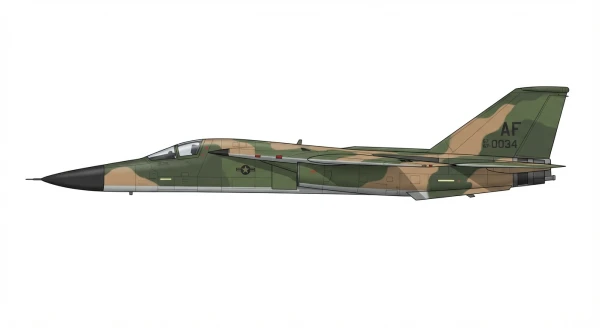
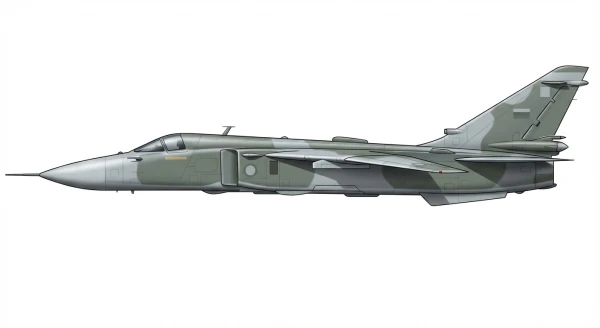
| F-111 Aardvark | Su-24 Fencer | |
|---|---|---|
| Origin country | 🇺🇸 United States | 🇷🇺 Ex-USSR |
| Category | Combat Aircraft | Combat Aircraft |
| Manufacturer | General Dynamics | Sukhoi |
| First flight | 21 December 1964 | 2 July 1967 |
| Year introduced | 1967 | 1974 |
| Number produced | 563 units | 1400 units |
| Average unit price | $15 million | $25 million |
| Wing area | 61.1 m² | 46.4 m² |
| Wingspan | 19.2 m | 17.6 m |
| Height | 5.0 m | 6.2 m |
| Length | 22.4 m | 24.5 m |
| Maximum speed | 2655 km/h | 1654 km/h |
| Operational range | 5,940 km | 2,775 km |
| Service ceiling | 20,117 m | 16,500 m |
| Max. takeoff weight | 45,359 kg | 39,700 kg |
| Empty weight | 21,400 kg | 22,320 kg |
| Total thrust | 2 x 11,385 kgf | 2 x 11,196 kgf |
Detailed Comparison
General Dynamics' F-111 Aardvark and Sukhoi's Su-24 Fencer share a variable-geometry aerodynamic configuration dictated by a Cold War requirement: penetrating contested airspace at low altitude to deliver heavy ordnance. The American platform pioneered terrain-following radar (TFR) and swing-wing mechanics in the 1960s, while the Soviet design bureau used the F-111 as a benchmark to replace its fixed-wing Su-7 and Su-17 fleets a decade later.
Development and Design
The F-111 emerged from Robert McNamara’s TFX program, an attempt to force a common airframe on the US Air Force and Navy. The Navy’s F-111B was canceled in 1968 due to excessive weight (45,359 kg max takeoff weight), but the USAF acquired a platform built around a complex side-by-side escape capsule and the first operational TFR, enabling automated low-level flight. Sukhoi developed the Su-24 in response, observing the F-111's aerodynamics but opting for conventional Zvezda K-36DM ejection seats and a lighter airframe (39,700 kg max takeoff weight). Both utilize side-by-side seating to facilitate pilot and weapon systems officer (WSO) crew coordination during high-workload, low-altitude ingress.
Specifications and Performances
The F-111 outpaces the Su-24 in kinematic reach and payload capacity, driven by twin Pratt & Whitney TF30 engines (16,238 kgf of thrust) versus the Su-24's AL-21F3 turbojets (15,574 kgf).
- The Aardvark reaches 2,655 km/h, carries 11 tons of ordnance, and has a 5,940 km range.
- The Su-24 is restricted to 1,654 km/h, hauls approximately 8 tons, and operates with a 615 km combat radius.
The F-111 incorporates an internal weapons bay, reducing drag during deep penetration profiles. Sukhoi omitted this design choice, forcing the Su-24 to rely entirely on external pylons, degrading its low-altitude fuel efficiency.
Deployment and usage
Early F-111A deployments to Vietnam in 1968 resulted in high loss rates due to TFR software faults, but the F-111F later executed precision strikes during Operation Desert Storm, using the Pave Tack FLIR for laser-guided armor interdiction. In 1986, F-111s flew from the UK to Libya, requiring six aerial refuelings. The Su-24 debuted in the Soviet-Afghan War, operating from high-altitude bases, and later executed unguided bombing in Chechnya and Syria. While the F-111 was exported only to Australia (24 F-111C units), Sukhoi exported the Su-24MK to Algeria, Iran, and Libya. The Su-24 currently operates in contested Ukrainian airspace, taking heavy attrition from modern surface-to-air missiles but remaining active as a launch platform for standoff cruise missiles.
Conclusion
The F-111 holds the definitive edge in strategic, deep-penetration strike. Its internal weapons bay, longer range, and earlier integration of advanced targeting pods (Pave Tack) made it a precision platform capable of surviving heavily defended airspace at night. The Su-24 is a tactical battlefield bomber, prioritized for mass production (1,400 units vs 563) and rough-field operations, relying heavily on unguided munitions or standoff weapons rather than penetrating deep to deliver precision strikes. For long-range, high-speed interdiction, the Aardvark is the more capable airframe.