F-15 Eagle vs F-4 Phantom II
F-15 Eagle vs F-4 Phantom II at a glance — top speed 2,655 vs 2,370 km/h, range 3,971 vs 2,699 km, max takeoff weight 30,844 vs 28,030 kg, built 1,198 vs 5,195 units.
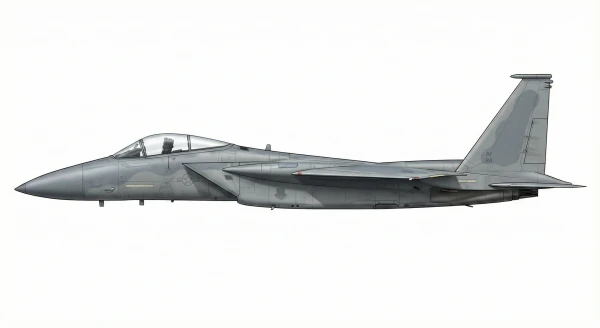
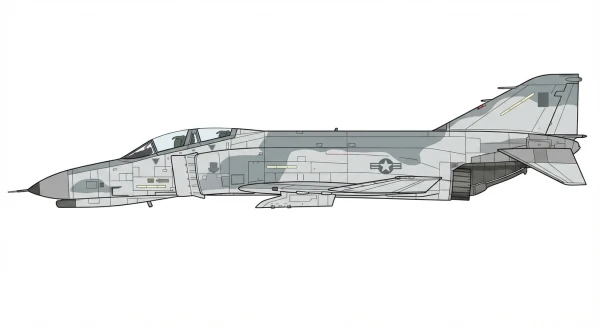
| F-15 Eagle | F-4 Phantom II | |
|---|---|---|
| Origin country | 🇺🇸 United States | 🇺🇸 United States |
| Category | Combat Aircraft | Combat Aircraft |
| Manufacturer | McDonnell Douglas | McDonnell |
| First flight | 27 July 1972 | 27 May 1958 |
| Year introduced | 1976 | 1962 |
| Number produced | 1198 units | 5195 units |
| Average unit price | $29 million | $2.4 million |
| Wing area | 56.5 m² | 49.2 m² |
| Wingspan | 13.1 m | 11.7 m |
| Height | 5.6 m | 5.0 m |
| Length | 19.4 m | 19.0 m |
| Maximum speed | 2655 km/h | 2370 km/h |
| Operational range | 3,971 km | 2,699 km |
| Service ceiling | 19,812 m | 18,288 m |
| Max. takeoff weight | 30,844 kg | 28,030 kg |
| Empty weight | 12,701 kg | 13,757 kg |
| Total thrust | 2 x 10,782 kgf | 2 x 8,094 kgf |
Detailed Comparison
McDonnell Douglas designed the F-15 Eagle to solve the air-combat deficiencies exposed by the McDonnell F-4 Phantom II over Vietnam. Where the F-4 relied on raw thrust and beyond-visual-range (BVR) missiles at the expense of agility, the F-15 was built around energy-maneuverability theory. The Phantom forced its crews to adapt a heavy fleet-defense interceptor to a close-in dogfighting environment; the Eagle was purpose-built to dominate that exact regime with a thrust-to-weight ratio exceeding 1:1 and a high-visibility bubble canopy.
Development and Design
The F-4 originated in 1954 as a fleet defense interceptor for the U.S. Navy, requiring a second crew member to operate the complex APQ-72 radar. Dictated by the era's missile-centric doctrine, early variants omitted an internal cannon, relying entirely on AIM-7 Sparrow and AIM-9 Sidewinder missiles. The airframe's lateral instability forced engineers to add 12° of dihedral to the outer wings and a 23° anhedral to the tailplane. The F-15 "F-X" program, initiated in 1965, prioritized kinematic performance over multirole utility. Driven by the emergence of the Soviet MiG-25 and Vietnam kill ratios, the USAF mandated a maximum takeoff weight of 40,000 lbs and single-seat operation. The F-15 integrates 25.8% titanium in its structure to withstand high-G stresses and retains an internal 20mm M61 Vulcan cannon—a direct mandate derived from F-4 combat data.
Specifications and Performances
The F-15’s twin Pratt & Whitney F100 turbofans generate 15,830 kgf of thrust, pushing a 12,701 kg empty airframe to a climb rate of 254 m/s. The F-4’s J79-GE-17A turbojets produce slightly more total thrust at 16,186 kgf, but must propel a heavier 13,757 kg base airframe. Consequently, the F-4 climbs at a slower 210 m/s and operates with a lower service ceiling (18,288 m compared to the F-15's 19,812 m). The Eagle claims a kinematic advantage in maximum speed, reaching 2,655 km/h against the Phantom’s 2,370 km/h. However, the Phantom maintains a payload advantage in the ground-attack role, carrying up to 8,480 kg of munitions across nine hardpoints, whereas the baseline F-15A/C prioritizes four fuselage and two wing stations specifically for air-to-air missiles.
Deployment and usage
The F-4 executed the bulk of U.S. tactical air operations in Vietnam. USAF and Navy Phantoms engaged lighter, tighter-turning MiG-17s and MiG-21s, exposing the F-4's vulnerabilities in turning engagements and the unreliability of early AIM-7s. In contrast, the F-15 holds a 104-0 air-to-air combat record. The Israeli Air Force debuted the Eagle in 1979, using it to shoot down Syrian aircraft during the 1982 Lebanon War. During the 1991 Gulf War, USAF F-15Cs accounted for 34 of 37 fixed-wing Iraqi shootdowns. During the same 2026 Iran campaign, three F-15E Strike Eagles were lost to Kuwaiti friendly fire while conducting combat operations; all six crew members ejected safely. The F-15's air-to-air record remains unbroken. The F-4 eventually transitioned into the Wild Weasel (F-4G) and strike roles, serving until 1996 in U.S. inventory, and remaining active in Iran, Greece, and Turkey. In the opening days of the 2026 US-Israeli strikes on Iran (Operation Epic Fury), Israeli aircraft destroyed F-4s preparing to take off at Tabriz airbase, while US strikes hit F-4D/E aircraft at multiple Iranian installations. Decades of sanctions have left Iran unable to replace these losses, making each destroyed Phantom a permanent reduction in its dwindling strike capability.
Conclusion
The F-15 holds the edge in air superiority. Its aerodynamic design, high thrust-to-weight ratio, and look-down/shoot-down radar specifically correct the F-4’s dogfighting limitations. For air-to-air combat, the F-15C outperforms the F-4 in every kinematic and sensory metric. The F-4 Phantom II retains the edge as a high-payload strike platform for export operators willing to absorb high maintenance hours. It succeeded as a multirole fighter-bomber through brute force, making it lethal for mass deployment in the 1960s and 1970s, but obsolete against the maneuverability and BVR standards established by the F-15.