F-15 Eagle vs F-16 Fighting Falcon
F-15 Eagle vs F-16 Fighting Falcon at a glance — top speed 2,655 vs 2,178 km/h, range 3,971 vs 4,217 km, max takeoff weight 30,844 vs 19,200 kg, built 1,198 vs 4,604 units.
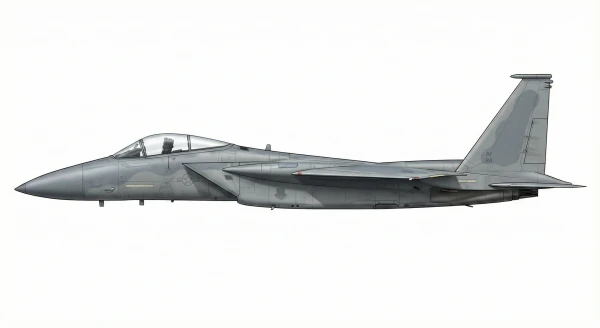
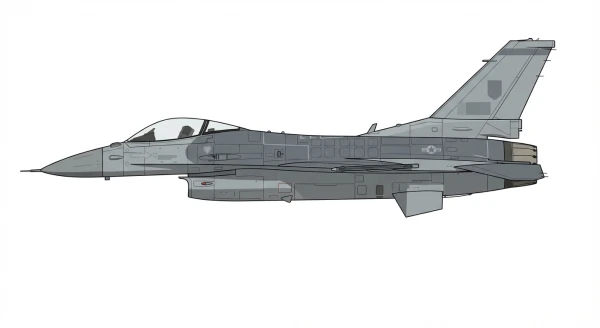
| F-15 Eagle | F-16 Fighting Falcon | |
|---|---|---|
| Origin country | 🇺🇸 United States | 🇺🇸 United States |
| Category | Combat Aircraft | Combat Aircraft |
| Manufacturer | McDonnell Douglas | General Dynamics |
| First flight | 27 July 1972 | 2 February 1974 |
| Year introduced | 1976 | 1979 |
| Number produced | 1198 units | 4604 units |
| Average unit price | $29 million | $18.8 million |
| Wing area | 56.5 m² | 27.9 m² |
| Wingspan | 13.1 m | 10.0 m |
| Height | 5.6 m | 4.9 m |
| Length | 19.4 m | 15.1 m |
| Maximum speed | 2655 km/h | 2178 km/h |
| Operational range | 3,971 km | 4,217 km |
| Service ceiling | 19,812 m | 15,240 m |
| Max. takeoff weight | 30,844 kg | 19,200 kg |
| Empty weight | 12,701 kg | 8,570 kg |
| Total thrust | 2 x 10,782 kgf | 1 x 12,701 kgf |
Detailed Comparison
The McDonnell Douglas F-15 Eagle was conceived as a dedicated, high-performance air superiority fighter to counter the threat of the Soviet MiG-25, while the General Dynamics F-16 Fighting Falcon emerged from a program seeking a more affordable, agile, and lightweight multirole aircraft. The F-15 was engineered with a "no-compromise" philosophy for air-to-air combat, resulting in a large, powerful twin-engine platform. In contrast, the F-16 was a revolutionary single-engine design focused on cost-effectiveness and maneuverability, being one of the first aircraft to incorporate a relaxed static stability/fly-by-wire control system for enhanced agility.
Development and Design
The F-15's design reflects its mission: air dominance. Its twin Pratt & Whitney F100 engines, large wing area (56.5 m²), and robust structure were designed for high-altitude, high-speed interception and sustained combat. The airframe's composition, with a significant percentage of titanium (25.8%), underscores its design for performance over cost. The cockpit provides excellent visibility, but the overall design is conventional for its era.
The F-16's development was a reaction against the high cost and complexity of fighters like the F-15. Its key innovations were intended to maximize performance while minimizing size and expense. It features a blended wing-body to improve lift, a frameless bubble canopy for unparalleled pilot visibility, and a side-mounted control stick. Its single-engine design and lighter empty weight (8,570 kg vs. the F-15's 12,701 kg) make it a more economical aircraft to procure and operate.
Specifications and Performances
The F-15’s performance specifications highlight its role as a pure interceptor and air superiority fighter. It possesses a higher maximum speed (2655 km/h vs. 2410 km/h), a higher service ceiling (19,812 m vs. 18,288 m), and a substantially greater maximum takeoff weight (30,844 kg vs. 19,200 kg). This allows it to carry a heavier fuel and munitions load for its primary air-to-air mission. The F-16, while slower and with a lower ceiling, has a remarkable thrust-to-weight ratio and agility, enhanced by its advanced flight control system. Notably, both aircraft share an identical listed climb rate of 254.0 m/s, a testament to the F-16's powerful engine relative to its mass.
Deployment and usage
Operational histories reflect their design origins. The F-15 has served primarily as an air superiority fighter, establishing an exceptional combat record, particularly with the Israeli and U.S. Air Forces, achieving numerous air-to-air victories during the 1982 Lebanon War and the 1991 Gulf War without a single loss in air combat. Its armament, as listed for the A/C variants, is focused on air-to-air missiles like the AIM-7 Sparrow and AIM-120 AMRAAM.
The F-16, with over 4,600 units built and operated by more than 25 nations, is a ubiquitous multirole workhorse. Its operational use spans air superiority, ground attack, and Suppression of Enemy Air Defenses (SEAD). It has been deployed extensively in conflicts from the Balkans to Afghanistan and Iraq. Its capacity to carry a vast array of munitions—including Paveway bombs, AGM-88 HARM anti-radiation missiles, and AGM-65 Maverick missiles—demonstrates its designed-in versatility.
Conclusion
The F-15 Eagle and F-16 Fighting Falcon represent two distinct and highly successful design philosophies. The F-15 was built to be an uncompromising air dominance fighter, a mission it has executed with near-perfect results. The F-16 was conceived as a cost-effective, adaptable combatant, becoming one of history's most successful and versatile multirole fighters. While the F-15 ensures control of the skies, the F-16 provides the flexible, day-to-day combat capability that forms the backbone of many modern air forces.