F-15 Eagle Variants: F-15A/C, F-15E Strike Eagle, F-15EX and the Export Eagles
How to read an F-15 designation: the A to D Eagles, the F-15E Strike Eagle and its exports, the fly-by-wire F-15EX, upgrades and who flies what in 2026.
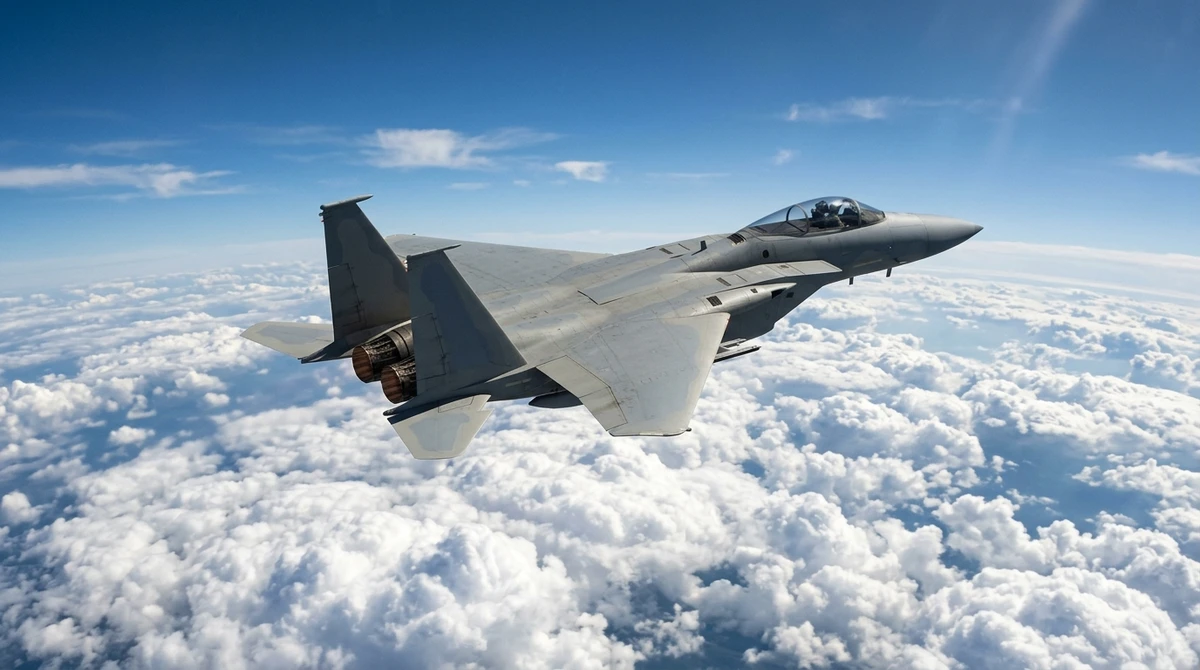
On 29 September 2026 the US Air Force ordered 22 more F-15EX Eagle IIs, taking the aircraft under contract to 120; the fiscal 2027 budget request would grow the planned fleet to 267. The same airframe flies as the F-15QA in Qatar and the F-15SA in Saudi Arabia, Israel has ordered it as the F-15IA, Japan is rebuilding part of its F-15J fleet, and the last active-duty US F-15C made its final flight at Kadena on 24 January 2025 while 21 Air National Guard F-15C/Ds are to be kept until 2030. The F-15 Eagle first flew on 27 July 1972 and is still in production in St. Louis.
The letters after "F-15" say which of two lines an aircraft belongs to and, on exports, which customer it was built for. A to D are the air-superiority Eagle, single-seat (A, C) and two-seat (B, D), under the US series-letter rule (how it works). E is the two-seat Strike Eagle; every strike derivative since is built on it, with a customer code in place of a series letter: I for Israel, S for Saudi Arabia, K for Korea, SG for Singapore, then SA, QA, EX and IA for the Advanced Eagle, the fly-by-wire generation begun with the Saudi F-15SA in 2013. Japan's F-15J/DJ are licence-built F-15C/Ds. This page is as of 3 October 2026.
- Two lines: the air-superiority F-15A/B/C/D, with Japan's F-15J/DJ and the Israeli and Saudi fleets, and the two-seat Strike Eagle F-15E and its exports; the Advanced Eagle (SA, QA, EX, IA) is the Strike Eagle with fly-by-wire, a 20,000-hour structure and eleven weapon stations.
- Upgrades keep the letter: an F-15C with the APG-63(V)3 radar is still an F-15C, an F-15E with the APG-82 and EPAWSS still an F-15E. The exceptions are customer renames: Saudi F-15S rebuilt to the SA standard became F-15SR, Japan calls its upgraded jets F-15JSI.
- Scale: GMN's F-15 Eagle page counts 1,198 A-to-D airframes; 236 F-15Es were built for the US Air Force; the Advanced Eagle line has delivered 84 F-15SAs, 36 F-15QAs and, by August 2026, 22 F-15EXs.
| Line | Customer | Built or ordered | Defining hardware | |
|---|---|---|---|---|
| F-15A / F-15B | Air superiority | USAF, Israel | 384 / 61, 1972–1979 | APG-63, F100-PW-100 |
| F-15C / F-15D | Air superiority | USAF, Israel, Saudi Arabia | 483 / 92, 1979–1985 | APG-63 with PSP, conformal tank provisionsMSIP from 1985; APG-63(V)1 and (V)3 retrofits |
| F-15J / F-15DJ | Air superiority | Japan (licence) | 163 / 36, 1981–1997 | F-15C/D with Japanese EW; J-MSIP from 1985 |
| F-15E | Strike Eagle | USAF | 236, 1985–2001 | APG-70, conformal tanks, F100-PW-220 then -229APG-82(V)1 and EPAWSS retrofits |
| F-15I Ra'am | Strike Eagle | Israel | 25, 1996–1998 | APG-70I, Israeli EW and helmet sight, F100-PW-229 |
| F-15S (F-15SR) | Strike Eagle | Saudi Arabia | 72, 1996–1998 | Downgraded APG-70; rebuilt to SA standard as F-15SR |
| F-15K Slam Eagle | Strike Eagle | South Korea | 61 (40 + 21), from 2005 | APG-63(V)1, AAS-42 IRST, SLAM-ERBatch 1 F110-GE-129, batch 2 F100-PW-229 |
| F-15SG | Strike Eagle | Singapore | 40, from 2009 | APG-63(V)3 AESA, F110-GE-129 |
| F-15SA | Advanced Eagle | Saudi Arabia | 84 new + 68 F-15S kits, 2013–2020 | First fly-by-wire Eagle; APG-63(V)3, DEWS, IRST |
| F-15QA Ababil | Advanced Eagle | Qatar | 36, 2021–2023 | APG-82(V)1, large-area display, ADCP II, 20,000-hour wing |
| F-15EX Eagle II | Advanced Eagle | USAF | 120 under contract, 267 planned | F-15QA with APG-82(V)1, EPAWSS, Legion IRST pod |
| F-15IA | Advanced Eagle | Israel | 25 contracted, 25 more announced | F-15EX with Israeli systems; deliveries from 2031 |
| F-15ID | Advanced Eagle | Indonesia (proposed) | 0; up to 36 approved 2022, 24 in a 2023 MoU | Campaign dropped by Boeing in February 2026 |
The air-superiority line: F-15A/B and C/D
The first F-15A flew on 27 July 1972, the two-seat F-15B in July 1973, and the type entered service in 1976. The F-15C and F-15D followed from 1979 with more internal fuel, conformal-tank provisions and a digital central computer; 483 C and 92 D models were built through 1985, against 384 A and 61 B.
MSIP and the radar retrofits
The Multi-Stage Improvement Program (MSIP) began in February 1983 and the first MSIP F-15C was built in 1985: a new central computer, the APG-63 with a programmable signal processor, AIM-120 provisions, a larger electronic warfare suite and the F100-PW-220 engine. The final 43 F-15Cs got the APG-70 developed for the F-15E, and the Air National Guard ran its own MSIP on the F-15As it inherited from fiscal 1994.
Two radars followed without changing the letter. The APG-63(V)1, a rebuild for reliability with APG-70-class performance, went to most of the MSIP fleet from 2001, 180 radars. The APG-63(V)3 AESA rolled out on its first F-15C, a Guard jet under the "Golden Eagle" program, on 12 April 2010; the same antenna equips the F-15SG and F-15SA and, on the APG-79's processor, became the APG-82(V)1 of the F-15E and F-15EX.
Retirement: Kadena and the Guard
The active-duty F-15C/D force ended at Kadena Air Base in Japan, home to 48 Eagles. The divestment began in November 2022, and on 3 July 2024 the Department of Defense announced that 36 F-15EXs would replace them. The 67th flew its last F-15C sortie on 15 August 2024; the last active-duty F-15C made its final flight on 24 January 2025 and became a maintenance trainer.
The Guard fleet was to follow by fiscal 2026. Instead, as of November 2025 the Air Force will keep 42 F-15C/Ds through 2028 and the last 21, the "Platinum Eagles" of the California Guard's 144th Fighter Wing at Fresno, through 2030 for homeland air defense. Portland, Fresno and New Orleans convert to the F-15EX, Barnes and Jacksonville to the F-35A.
The Strike Eagle line: F-15E
The F-15E first flew on 11 December 1986, entered service in 1989 and 236 were built through 2001: a two-seater with a weapon systems officer, conformal tanks as standard, the APG-70 radar and a strengthened structure. Two engines split the fleet, the early 23,450 lb-thrust F100-PW-220 and the later 29,000 lb F100-PW-229, and that split now decides which aircraft survive.
APG-82 and EPAWSS
The Radar Modernization Program replaced the APG-70 with the Raytheon APG-82(V)1, called the APG-63(V)4 until 2009; flight tests began in January 2010, the radar was operational in 2014 and by March 2023 every F-15E carried it. The Eagle Passive/Active Warning Survivability System (EPAWSS), BAE Systems' AN/ALQ-250 integrated by Boeing, is a digital self-defense suite for radar warning, geolocation and jamming. The first retrofitted F-15E was delivered in 2022; the Air Force cleared full-rate production in January 2025 for a plan of 99 F-15Es and 98 F-15EXs, though either number could change. Boeing received nearly $616 million on 6 January 2025 for 45 F-15E kit sets.
Retiring half the fleet
In March 2023 the Air Force set out an intention to retire 119 of 218 F-15Es by fiscal 2028 and keep the 99 F100-PW-229 aircraft, the only ones to get EPAWSS. Congress has slowed it every year: the fiscal 2024 authorization act capped retirements through fiscal 2029 at 68, the House blocked the 26 requested for fiscal 2025 pending a fighter study, and the fiscal 2026 act allows none in fiscal 2026, up to 21 in fiscal 2027 and up to 30 in fiscal 2028, 51 in all, for a fleet of about 230.
The export Eagles
F-15J and F-15DJ: Japan
Japan is the largest Eagle operator outside the United States: Mitsubishi Heavy Industries built the F-15J/DJ under licence from 1981 to 1997, 163 F-15Js and 36 F-15DJs. The pre-MSIP aircraft are giving way to the F-35. The Japan Super Interceptor (JSI) adds the APG-82(V)1, the ADCP II mission computer, EPAWSS and the JASSM-ER. Tokyo confirmed it for 68 aircraft on 4 February 2022 at ¥646.5 billion over 30 years. On 30 September 2026 Janes reported that the first 20 F-15JSIs, originally due by the end of fiscal 2027, are now to be fielded by the end of fiscal 2029.
F-15I Ra'am and F-15IA: Israel
Israel has flown the F-15A to D, called Baz, since 1977, with 71 in service as of 2022. After the 1991 Scud attacks it bought a long-range striker: 25 F-15Is, authorized in May 1994 and built from 1996 to 1998 for 69 Squadron at Hatzerim. An AESA upgrade of the F-15I Ra'am was approved in January 2016 and the APG-82(V)1 selected in 2017; in November 2024 an "F-15I+" rebuild to a near-IA standard remained an option whose status the ministry did not detail.
The F-15IA is an F-15EX with Israeli systems. Israel's Ministry of Defense signed for 25 on 6 November 2024 at $5.2 billion from US aid, with an option for 25 more and deliveries from 2031 at four to six a year, and Boeing's $8.6 billion production contract followed on 29 December 2025. On 3 May 2026 the ministry announced a second squadron of 25 F-15IAs alongside 25 more F-35s.
F-15S and F-15SA: Saudi Arabia
Saudi Arabia flies both lines, F-15C/Ds and the Strike Eagle in two generations. The F-15S, 72 built from 1996 to 1998, was an F-15E with a lower-resolution APG-70. The F-15SA created the Advanced Eagle: contracted on 29 December 2011 for $29.4 billion with 84 new aircraft plus 68 kits, ordered in June 2012, to rebuild the F-15S as the F-15SR; first flight on 20 February 2013, first deliveries in December 2016 and the last new-build in December 2020.
F-15K Slam Eagle: South Korea
South Korea chose the F-15K in 2002; 40 were delivered from 2005, 21 more were ordered on 25 April 2008 with F100-PW-229 engines where the first batch had the F110-GE-129, and 59 remain after two losses. An upgrade of all 59 with the APG-82(V)1, EPAWSS and the ADCP II was approved in December 2022; the US cleared a $6.2 billion package in November 2024 and Boeing received a $2.8 billion contract in early 2026 with work through 31 December 2037.
F-15SG: Singapore
Singapore selected the F-15SG over the Rafale on 6 September 2005, ordered 12 in December 2005 and built the fleet up in batches to 40 by 2018; deliveries began in 2009. It carries the APG-63(V)3 AESA. No upgrade has been contracted: the air force chief said in February 2024 that the service would "evaluate the need for an upgrade" as the first jets passed 15 years.
F-15QA Ababil: Qatar
Qatar signed for 36 F-15QAs in June 2017 for $12 billion. The QA is the direct predecessor of the F-15EX: it added the large-area cockpit display and the ADCP II computer to the SA's fly-by-wire airframe, with the APG-82(V)1, F110-GE-129 engines and outer-wing weapon stations. The first flew on 14 April 2020, the type was rolled out and named on 25 August 2021 and the final five arrived in August 2023.
F-15ID: Indonesia
The F-15ID never got past paper. The State Department approved up to 36 in February 2022, Boeing and Jakarta signed a memorandum of understanding for 24 in August 2023 with no price or schedule, and in February 2026 Boeing said the F-15 was "no longer an active campaign" for Indonesia, which has since signed for Turkish KAAN fighters.
The F-15EX Eagle II
The F-15EX is the F-15QA with American mission systems. From the Advanced Eagle it takes the digital fly-by-wire controls that replaced the original hybrid system, removed flutter limits and unlocked two wing stations; the structure rated for 20,000 hours; the large-area display and ADCP II computer; and the F110-GE-129 engines. Unique to the US version are the APG-82(V)1, EPAWSS in place of the export DEWS suite and the Legion infrared pod. Boeing rates the payload at 29,500 lb and up to twelve AMRAAMs. It is a two-seater that can be flown by a pilot alone, with the rear cockpit equipped for a weapon systems officer.
Eight aircraft were ordered in July 2020 for $1.2 billion; the first flew on 2 February 2021 and reached Eglin on 11 March 2021. The planned total has moved with every budget: 144 at the start, 80 in the fiscal 2023 request, 104 in 2024, 98 in 2025, 129 after Congress added aircraft for 2026 and 267 in the fiscal 2027 request of 21 April 2026, which also makes the EX the start of the F-15E's replacement. The Oregon Guard's 142nd Wing at Portland received the first operational jet on 5 June 2024, and Air Combat Command declared initial operational capability on 10 July 2024 once the eight Lot 1 aircraft were in.
Production is the problem. Nine aircraft had been delivered by May 2025; a machinists' strike at St. Louis that began in August 2025 stopped the line, and by October only six of the twelve Lot 2 jets were in. The Pentagon's selected acquisition report of August 2026 moves the start of Lot 4 deliveries from 2026 to 2028, says Boeing must reach two aircraft a month; full operational capability has slipped to February 2028. Boeing delivered the 22nd aircraft in August 2026 and, with the 29 September Lot 7 award of 22 aircraft for $2.38 billion, has 120 under contract. The first Kadena-bound jet left St. Louis on 28 August 2026, and the base now expects its Eagle IIs in fiscal 2027 rather than spring 2026.
Abroad, the F-15IA is the only firm EX derivative. A $131.23 billion Air Force framework contract of 25 August 2026, "F-15 Eagle Crest", listed Poland among possible foreign customers alongside Japan, Israel, Saudi Arabia, South Korea, Singapore and Indonesia; Poland's defense ministry replied that its armed forces "do not plan to acquire F-15EX aircraft".
| Aircraft | Dates | Content | Changes the designation? | |
|---|---|---|---|---|
| MSIP II | USAF F-15C/D; Japan's J-MSIP on 103 F-15J/DJ | From 1983; first MSIP F-15C 1985 | New central computer, APG-63 PSP, AMRAAM provisions, ALR-56C and ALQ-135 EW; F100-PW-220 | No |
| ANG MSIP | Guard F-15A | From FY1994 | Same package as MSIP II; aircraft retired 2011 | No |
| APG-63(V)1 | Most USAF F-15C/D (180 radars); F-15J under licence; F-15K | From March 2001 | Rebuilt mechanically scanned radar, APG-70-class performance | No |
| APG-63(V)2 / (V)3 | 18 F-15C (V2); Guard F-15C/D "Golden Eagle" (V3) | 2000; first (V)3 jet April 2010 | AESA antenna; the (V)3 array became the APG-82's | No |
| Radar Modernization Program | All USAF F-15E | Flight test Jan 2010; IOC 2014; fleet complete by 2023 | APG-82(V)1 AESA, wideband radome, cooling | No |
| EPAWSS (ALQ-250) | 99 F-15E planned; standard on F-15EX; sold to Japan and Korea | Contracts 2015; first retrofit 2022; full-rate production Jan 2025 | Digital radar warning, geolocation, jamming, dispensers | No |
| F-15SA conversion | 68 Saudi F-15S | Kits ordered June 2012 | Fly-by-wire, APG-63(V)3, DEWS, IRST | Yes: F-15SR |
| JSI | 68 Japanese F-15J confirmed; first 20 funded | Approved Oct 2019; first 20 by end FY2029 | APG-82(V)1, ADCP II, EPAWSS, JASSM-ER | Yes: F-15JSI |
| F-15K upgrade | 59 Korean F-15K | Approved Dec 2022; Boeing contract early 2026; to Dec 2037 | APG-82(V)1, EPAWSS, ADCP II, missile warning | No |
| F-15I upgrade | 25 Israeli F-15I | Approved Jan 2016; "F-15I+" option 2024, status not detailed | APG-82(V)1 selected 2017, structure, avionics | Not yet |
| F-15EX production | 120 under contract, Lots 1–7; 267 planned | First flight Feb 2021; IOC July 2024; Lot 4 from 2028 | New-build Advanced Eagle, two a month targeted | New model |
Who flies which version
Seven air forces fly the Eagle. GMN files the F-15K and F-15SG with the F-15E Strike Eagle, the F-15I Ra'am on its own page, the F-15SA and F-15QA with the F-15EX Eagle II whose airframe they share, and the air-superiority models on the F-15 Eagle page. The fleet figures below come from published sources, not from GMN inventory data.
| Versions | Status | |
|---|---|---|
| United States | F-15C/D (Guard), F-15E, F-15EX | About 230 F-15E, 51 retirements allowed through FY2028; 42 C/D through 2028, 21 through 2030; 22 EX delivered, 120 on contract, 267 planned |
| Japan | F-15J/DJ | 156 F-15J in inventory; pre-MSIP jets giving way to the F-35; first 20 JSI by end FY2029 |
| Saudi Arabia | F-15C/D, F-15S/SR, F-15SA | 46 C and 16 D (2024); 84 SA delivered 2016–2020; 68 F-15S kits to SR standard |
| Israel | F-15A/B/C/D Baz, F-15I Ra'am, F-15IA on order | 71 Baz (2022); 25 F-15I; 25 F-15IA contracted for 2031–2035, 25 more announced May 2026 |
| South Korea | F-15K Slam Eagle | 59 of 61; all to be upgraded by 2037 under a $2.8 billion Boeing contract |
| Singapore | F-15SG | 40 delivered 2009–2018; upgrade under evaluation |
| Qatar | F-15QA Ababil | 36 delivered 2021–2023 |
What comes next
For the US Air Force the calendar is set by two documents in tension: a budget that wants 267 F-15EXs, enough to start replacing F-15Es as well as F-15C/Ds, and an acquisition report that says the line delivers at half the needed rate, with Lot 4 not before 2028. Congress, which added F-15EXs for 2026 and capped F-15E retirements at 51 through fiscal 2028, decides how fast the Strike Eagles leave. The first strike-role conversion is already planned: F-15EXs from the fiscal 2027 budget go to Seymour Johnson Air Force Base to replace part of its F-15Es, 24 of which move to the reserve 442nd Fighter Wing at Whiteman to replace A-10s.
For the export fleets the next decade is upgrades, not new letters: Japan's first 20 F-15JSIs by fiscal 2029, Korea's 59 F-15Ks through 2037, Israel's F-15IAs from 2031 with the F-15I+ rebuild undecided, and a Singaporean decision on the F-15SG still to come. The F-16 is still adding customers to its Block 70/72 line and the F-35 is working through Block 4; the Eagle's growth now runs through the single F-15EX line in St. Louis.