F-22 Raptor vs Su-35 Flanker-E
F-22 Raptor vs Su-35 Flanker-E at a glance — top speed 2,414 vs 2,400 km/h, range 3,000 vs 4,500 km, max takeoff weight 38,000 vs 34,500 kg, built 195 vs 151 units.
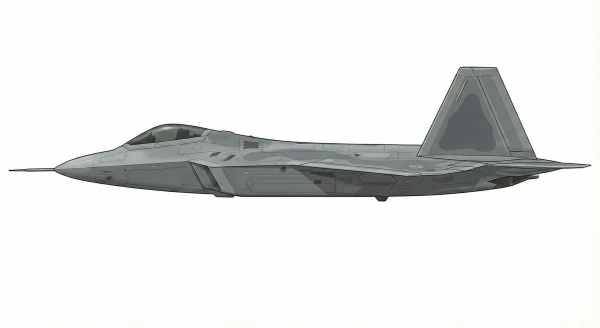
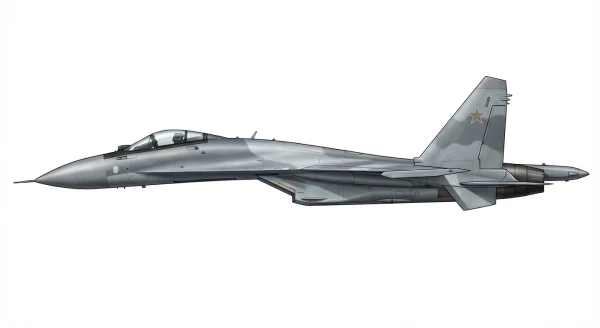
| F-22 Raptor | Su-35 Flanker-E | |
|---|---|---|
| Origin country | 🇺🇸 United States | 🇷🇺 Russia |
| Category | Combat Aircraft | Combat Aircraft |
| Manufacturer | Lockheed Martin | Sukhoi |
| First flight | 7 September 1997 | 19 February 2008 |
| Year introduced | 2005 | 2014 |
| Number produced | 195 units | 151 units |
| Average unit price | $150 million | $83 million |
| Wing area | 78.0 m² | 62.0 m² |
| Wingspan | 13.6 m | 15.3 m |
| Height | 5.1 m | 5.9 m |
| Length | 18.9 m | 21.9 m |
| Maximum speed | 2414 km/h | 2400 km/h |
| Operational range | 3,000 km | 4,500 km |
| Service ceiling | 19,812 m | 18,000 m |
| Max. takeoff weight | 38,000 kg | 34,500 kg |
| Empty weight | 19,700 kg | 19,000 kg |
| Total thrust | 2 x 15,876 kgf | 2 x 14,000 kgf |
Detailed Comparison
Lockheed Martin’s F-22 Raptor relies on very low observability (VLO) and sensor fusion to engage targets beyond visual range. Sukhoi’s Su-35S Flanker-E relies on an opposing doctrine: prioritizing kinematic agility, heavy external payload, and a high-power passive electronically scanned array (PESA) radar to detect adversaries before stealth profiles dictate the engagement.
Development and Design
The F-22 originated from the 1981 Advanced Tactical Fighter (ATF) program, built to penetrate Soviet air defense networks. Production halted at 195 airframes in 2009 due to $150.0 million per-unit costs and defense budget realignments. The Su-35S emerged later as a modified Su-27 derivative, acting as a stopgap before the Su-57. Sukhoi integrated AL-41F1S thrust-vectoring engines and the Irbis-E radar, resulting in an $83.0 million unit cost. The Raptor’s design mandates internal weapon bays to maintain its VLO profile, limiting its ordnance. The Su-35S carries weapons externally across 12 hardpoints, increasing its radar cross-section (RCS). The F-22 utilizes an active electronically scanned array (AESA) radar (AN/APG-77), granting a low probability of intercept (LPI) advantage over the Su-35’s older PESA technology.
Specifications and Performances
The Su-35 reaches a maximum speed of 2,500 km/h, 86 km/h faster than the F-22, and flies an unrefueled range of 3,600 km compared to the F-22’s 3,000 km. However, the Raptor maintains a sustained Mach 1.5 supercruise without afterburners, reducing its infrared signature and fuel burn during combat transit. The Su-35 compensates for its lack of stealth with an 8,000 kg external payload, accommodating heavy standoff munitions like the R-37M air-to-air missile. The F-22 carries a maximum of eight internal air-to-air missiles (six AIM-120s and two AIM-9s). The F-22 operates at a service ceiling of 19,812 m, 1,812 m higher than the Su-35, providing its kinetic weapons with higher potential energy at launch.
Deployment and usage
During Operation Inherent Resolve over Syria, the USAF used the F-22 as an airborne sensor node, leveraging its electronic intelligence to deconflict airspace rather than executing kinetic engagements. The Su-35S saw combat in Syria and the invasion of Ukraine. In Ukraine, the Russian Aerospace Forces use the Su-35S for combat air patrols, downing Ukrainian fighters using R-37M missiles. However, Ukrainian ground-based air defenses (GBAD) have destroyed multiple Su-35s, exposing the aircraft's vulnerability in contested airspace. On the export market, US law prohibits F-22 foreign sales. The Su-35 faced canceled procurements from Egypt, Indonesia, and Algeria, driven by US CAATSA sanctions and the aircraft's reliance on PESA radar architecture.
Conclusion
The F-22 has the edge in beyond-visual-range (BVR) combat and operations inside contested airspace defended by integrated air defense systems (IADS). Its combination of AESA radar, VLO, and supercruise allows it to launch AIM-120s before the Su-35’s Irbis-E radar can establish a track. The Su-35 has the edge in permissive environments requiring high payload capacities, extended loiter times, and standoff ground strikes. In a peer-level air-to-air engagement, the F-22 dictates the engagement parameters, negating the Su-35’s thrust-vectoring maneuverability through first-shot BVR kinematics.