F-16 Fighting Falcon vs Su-35 Flanker-E
F-16 Fighting Falcon vs Su-35 Flanker-E at a glance — top speed 2,178 vs 2,400 km/h, range 4,217 vs 4,500 km, max takeoff weight 19,200 vs 34,500 kg, built 4,604 vs 151 units.
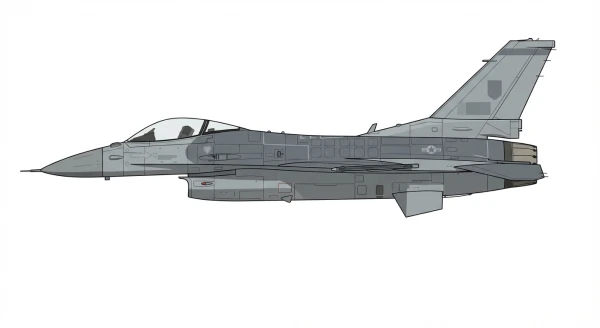
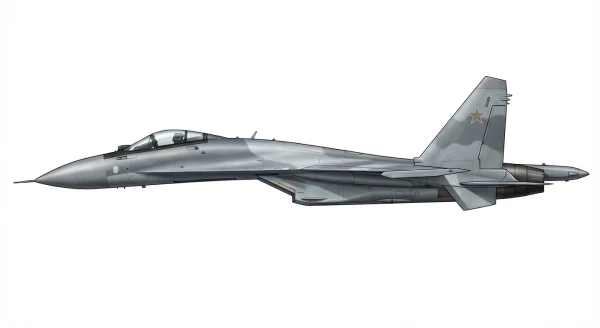
| F-16 Fighting Falcon | Su-35 Flanker-E | |
|---|---|---|
| Origin country | 🇺🇸 United States | 🇷🇺 Russia |
| Category | Combat Aircraft | Combat Aircraft |
| Manufacturer | General Dynamics | Sukhoi |
| First flight | 2 February 1974 | 19 February 2008 |
| Year introduced | 1979 | 2014 |
| Number produced | 4604 units | 151 units |
| Average unit price | $18.8 million | $83 million |
| Wing area | 27.9 m² | 62.0 m² |
| Wingspan | 10.0 m | 15.3 m |
| Height | 4.9 m | 5.9 m |
| Length | 15.1 m | 21.9 m |
| Maximum speed | 2178 km/h | 2400 km/h |
| Operational range | 4,217 km | 4,500 km |
| Service ceiling | 15,240 m | 18,000 m |
| Max. takeoff weight | 19,200 kg | 34,500 kg |
| Empty weight | 8,570 kg | 19,000 kg |
| Total thrust | 1 x 12,701 kgf | 2 x 14,000 kgf |
Detailed Comparison
The General Dynamics F-16 and Sukhoi Su-35 occupy completely different weight classes and doctrinal roles. At 19,200 kg maximum takeoff weight, the single-engine F-16 is a lightweight tactical multirole fighter built for high-volume sortie generation and mass production (4,604 units). Conversely, the 34,000 kg twin-engine Su-35 is a heavy air superiority platform designed to control vast airspace with high-kinematic missiles, produced in boutique numbers (151 units).
Development and Design
The F-16 emerged from the US Air Force's 1970s Lightweight Fighter Program. Driven by energy-maneuverability theory, engineers introduced a 30-degree reclined seat for high-G tolerance, a side-mounted control stick, and a relaxed static stability fly-by-wire system. Sukhoi derived the Su-35 from the Su-27 airframe to counter fourth-generation Western fighters without absorbing the development costs of a clean-sheet stealth airframe. Sukhoi integrated thrust-vectoring AL-41F1S engines to achieve post-stall maneuverability and installed the Irbis-E passive electronically scanned array (PESA) radar to detect targets at standoff ranges, a direct hardware response to Western low-observable platforms.
Specifications and Performances
The Su-35 carries an 8,000 kg payload across 12 hardpoints, outweighing the F-16’s ordnance limitations dictated by its single F110 engine. The Russian platform reaches 2,500 km/h compared to the F-16's 2,410 km/h, but its primary aerodynamic advantage is unrefueled reach. With a 3,600 km range, the Su-35 outlasts the F-16 (546 km combat radius) by a factor of six, allowing it to loiter and dictate the geometry of an engagement. Conversely, the Su-35's PESA radar lags a generation behind the AN/APG-83 Active Electronically Scanned Array (AESA) radar standard on F-16V upgrades. The AESA system provides the F-16 with better electronic counter-countermeasures (ECCM) and interleaved tracking modes.
Deployment and usage
F-16s have amassed millions of combat hours. From Desert Storm to the Balkans, the F-16 executed close air support and suppression of enemy air defenses (SEAD) missions. Israeli F-16s destroyed the Osirak nuclear reactor in 1981, and USAF units maintain a 72-0 air-to-air kill ratio over their lifespan. The Su-35 saw combat primarily over Syria and Ukraine. In Syria, it functioned as an air patrol escort. Over Ukraine, Su-35s utilize R-37M very-long-range air-to-air missiles to shoot down Ukrainian aviation from within Russian airspace. Export deals to Indonesia and Egypt collapsed due to CAATSA sanctions and subsystem integration issues, leaving the Su-35 heavily reliant on domestic supply chains.
Conclusion
The Su-35 holds a kinematic advantage for beyond-visual-range (BVR) engagements across vast geographic expanses. Its radar range, fuel fraction, and R-37M integration allow it to fire on opposing fourth-generation fighters long before a visual merge. The F-16 wins definitively in high-density, network-centric warfare environments. Its AESA radar, smaller radar cross-section, interoperability with NATO data links, and lower operating costs make it the optimal platform for sustained tactical operations and SEAD. Air forces needing an isolated long-range interceptor should deploy the Su-35; those building an integrated tactical fleet must procure the F-16.