Hermes 900 vs MQ-9 Reaper
Hermes 900 vs MQ-9 Reaper at a glance — top speed 220 vs 300 km/h, range 1,000 vs 1,850 km, max takeoff weight 1,400 vs 4,760 kg, built 200 vs 300 units.
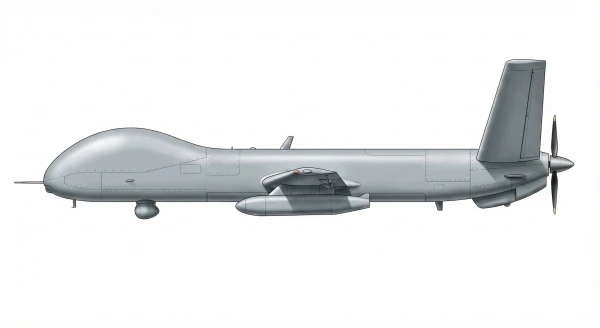
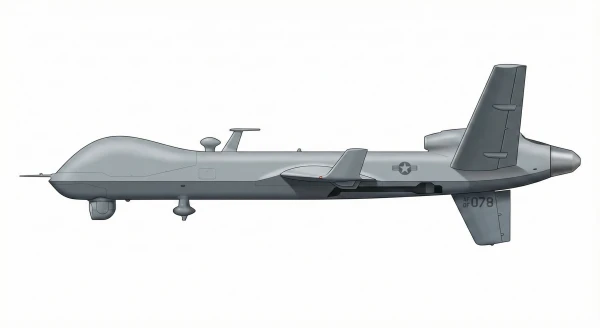
| Hermes 900 | MQ-9 Reaper | |
|---|---|---|
| Origin country | 🇮🇱 Israel | 🇺🇸 United States |
| Category | Military Drones | Military Drones |
| Manufacturer | Elbit | General Atomics |
| First flight | 9 December 2009 | 1 February 2001 |
| Year introduced | 2012 | 2007 |
| Number produced | 200 units | 300 units |
| Average unit price | $6.8 million | $30 million |
| Wingspan | 15.0 m | 20.0 m |
| Length | 8.3 m | 11.0 m |
| Maximum speed | 220 km/h | 300 km/h |
| Operational range | 1,000 km | 1,850 km |
| Service ceiling | 9,100 m | 15,000 m |
| Max. takeoff weight | 1,400 kg | 4,760 kg |
| Empty weight | 950 kg | 2,223 kg |
| Total thrust | 1 x 160 kW | -- |
Detailed Comparison
The Israeli Hermes 900 and American MQ-9 Reaper are both Medium-Altitude Long-Endurance (MALE) UAVs, yet they represent different operational priorities. The Hermes 900 is an evolution of a surveillance platform, optimized for long-endurance Intelligence, Surveillance, and Reconnaissance (ISR) with a secondary light-strike capability. In contrast, the MQ-9 Reaper was developed from its predecessor specifically as a hunter-killer aircraft, emphasizing a heavy weapons payload and robust strike capabilities over maximum endurance.
Development and Design
Elbit's Hermes 900 is a direct successor to the Hermes 450, designed to increase payload, endurance, and altitude for tactical ISR missions. Its development prioritized multi-payload flexibility, powered by a 160 kW Rotax piston engine. This iterative approach resulted in a cost-effective platform adaptable for various customers, as seen in the Indian and Swiss variants. The MQ-9 Reaper's design, by General Atomics, was a more significant departure from the MQ-1 Predator. The primary driver was the need for greater offensive power. This was achieved by incorporating a much more powerful Honeywell TPE331 turboprop engine, which fundamentally changed the aircraft's size, weight, and mission profile, enabling it to carry a substantial ordnance load.
Specifications and Performances
The performance differences are stark and directly reflect their design philosophies. The Reaper is substantially larger, with a Max Takeoff Weight of 4,760 kg compared to the Hermes 900's 1,400 kg. This allows the Reaper to carry a munitions load of over 1,700 kg, including Hellfire missiles and GBU-12/GBU-38 bombs, far exceeding the Hermes 900's 300-450 kg payload capacity, which is typically used for sensors or smaller munitions like Spike missiles. Conversely, the Hermes 900 offers superior persistence, with an endurance of up to 36 hours in an ISR configuration. The Reaper’s endurance is 14 hours when fully armed. The Reaper's turboprop engine also gives it a higher service ceiling (15,000 m vs. 9,100 m) and speed.
Deployment and usage
Both UAVs are combat-proven. The Reaper has been a central asset in U.S. counter-terrorism operations since 2007, conducting thousands of strike and close air support missions in Afghanistan, Iraq, and elsewhere. Its history is defined by its role as a frontline offensive weapon. The Hermes 900 entered operational service with Israel in 2014 and has been used for surveillance and strikes in the Middle East and by Azerbaijan in its conflict with Armenia. Its operational use also includes non-combat roles, such as humanitarian search and rescue in Brazil, highlighting its primary utility as a surveillance platform. Both systems have sustained combat losses in contested environments.
Conclusion
The selection between these two platforms is a function of mission and budget. The Hermes 900 is a highly capable and cost-effective ISR asset, offering exceptional endurance for persistent monitoring with a limited, tactical strike capability. It is a logical choice for nations prioritizing intelligence gathering. The MQ-9 Reaper is a dedicated hunter-killer system. Its significantly higher price of $30 million, compared to the Hermes 900's $6.8 million, is justified by its payload, speed, and altitude performance, making it a premier platform for armed overwatch and precision strike missions where offensive capability is the primary requirement.