Su-30 Flanker-C vs Su-33 Flanker-D
Su-30 Flanker-C vs Su-33 Flanker-D at a glance — top speed 2,125 vs 2,300 km/h, range 3,000 vs 3,000 km, max takeoff weight 34,500 vs 33,000 kg, built 630 vs 22 units.
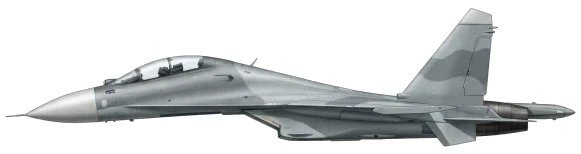
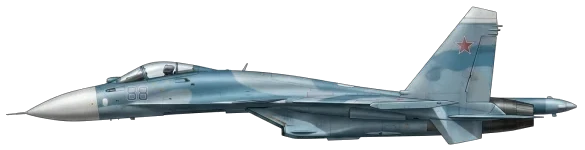
| Su-30 Flanker-C | Su-33 Flanker-D | |
|---|---|---|
| Origin country | 🇷🇺 Ex-USSR | 🇷🇺 Ex-USSR |
| Category | Combat Aircraft | Combat Aircraft |
| Manufacturer | Sukhoi | Sukhoi |
| First flight | 30 December 1989 | 17 August 1987 |
| Year introduced | 1996 | 1998 |
| Number produced | 630 units | 22 units |
| Average unit price | $37 million | $45 million |
| Wing area | 62.0 m² | -- m² |
| Wingspan | 14.7 m | 15.0 m |
| Height | 6.4 m | 6.0 m |
| Length | 21.9 m | 22.0 m |
| Maximum speed | 2125 km/h | 2300 km/h |
| Operational range | 3,000 km | 3,000 km |
| Service ceiling | 17,500 m | 18,000 m |
| Max. takeoff weight | 34,500 kg | 33,000 kg |
| Empty weight | 17,700 kg | 14,800 kg |
| Total thrust | 2 x 12,500 kgf | 2 x 12,797 kgf |
Detailed Comparison
Sukhoi’s Su-30 and Su-33 evolved from the baseline T-10 airframe to satisfy opposing doctrinal requirements. The Su-30 emerged as a two-seat, land-based multirole strike fighter that captured the global export market with 630 units built. The Su-33 was strictly engineered as a fleet air defense interceptor for the Soviet Navy’s Project 1143.5 carrier, yielding a total production run of just 22 airframes before the line closed.
Development and Design
The Su-33 prioritized STOBAR (Short Take-Off But Arrested Recovery) operations for the Admiral Kuznetsov. Sukhoi integrated canards to increase low-speed lift, reinforced the undercarriage, and added an arrestor hook and folding wings to reduce deck footprint. The Su-30 went in a different direction, adding a second seat for a Weapons System Officer (WSO) to manage air-to-ground ordnance and long-range radar tasks. Later variants of the Su-30, particularly the Indian Su-30MKI and Russian Su-30SM, incorporated canards and AL-31FP thrust-vectoring nozzles to regain the dogfighting agility lost to the heavier 17,700 kg two-seat airframe.
Specifications and Performances
A comparison of the airframes reveals the aerodynamic and operational tolls of navalization. The Su-33 achieves a higher maximum speed of 2,300 km/h compared to the Su-30’s 2,125 km/h, largely because early Su-30 variants carry a drag-inducing twin-seat canopy. However, the Su-33 suffers from strict payload limits. Operating from a ski-jump mandates lower takeoff weights, meaning Su-33s rarely launch with their theoretical 33,000 kg maximum takeoff weight or full internal fuel.
The land-based Su-30 faces no such restrictions. Using its full MTOW, the aircraft routinely carries heavier ordnance profiles:
- Heavy anti-ship and standoff missiles (Kh-31, Kh-59)
- Active radar homing air-to-air missiles (R-77)
- Western and indigenous targeting pods (on export variants)
Both share a 3,000 km baseline range, but the Su-30's dual-crew layout makes long-duration missions practically executable.
Deployment and usage
The Su-30 operates globally. The Indian Air Force flies over 260 Su-30MKIs, employing them during the 2019 Balakot skirmishes for combat air patrol against Pakistani F-16s. Russian Su-30SMs routinely conduct strike and escort missions in Ukraine and Syria. By contrast, the Su-33 remains an operational dead end. Its sole combat deployment occurred off the Admiral Kuznetsov in Syria in 2016. Operations were curtailed after a Su-33 was lost to an arresting wire failure. The Russian Navy has since shifted procurement to the lighter MiG-29K, recognizing the Su-33 lacks modern precision-guided munitions capability and modern radar integration.
Conclusion
The Su-30 possesses a definitive edge in utility, combat effectiveness, and survivability. Sukhoi successfully evolved the land-based Flanker into a modernized strike platform capable of integrating standoff weapons and thrust-vectoring evasion tactics. The Su-33 is an obsolete maritime interceptor constrained by its carrier’s lack of catapults, an exorbitant $45 million unit cost, and its own 1990s-era analog avionics. For any operator requiring multirole mass and modern sensor integration, the Su-30 is the sole viable option.


