MiG-29 Fulcrum vs Su-30 Flanker-C
MiG-29 Fulcrum vs Su-30 Flanker-C at a glance — top speed 2,450 vs 2,125 km/h, range 2,100 vs 3,000 km, max takeoff weight 18,000 vs 33,000 kg, built 1,600 vs 630 units.
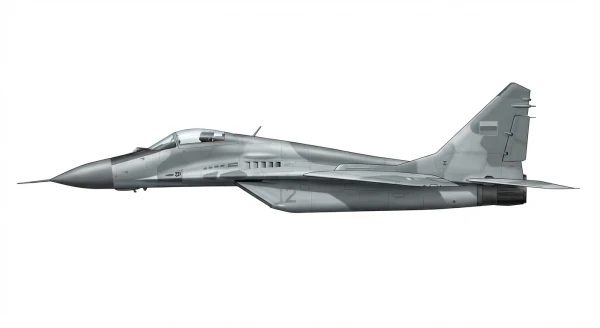
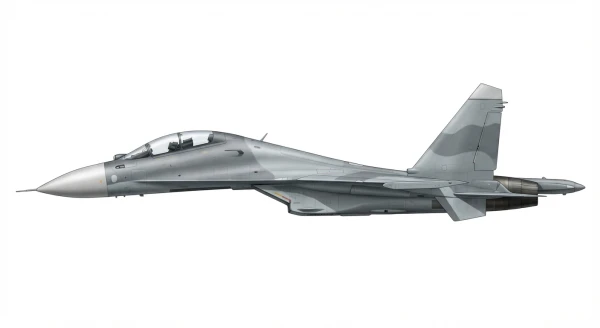
| MiG-29 Fulcrum | Su-30 Flanker-C | |
|---|---|---|
| Origin country | 🇷🇺 Ex-USSR | 🇷🇺 Ex-USSR |
| Category | Combat Aircraft | Combat Aircraft |
| Manufacturer | Mikoyan | Sukhoi |
| First flight | 6 October 1977 | 30 December 1989 |
| Year introduced | 1983 | 1996 |
| Number produced | 1600 units | 630 units |
| Average unit price | $25 million | $37 million |
| Wing area | 38.0 m² | 62.0 m² |
| Wingspan | 11.4 m | 14.7 m |
| Height | 4.7 m | 6.4 m |
| Length | 17.3 m | 21.9 m |
| Maximum speed | 2450 km/h | 2125 km/h |
| Operational range | 2,100 km | 3,000 km |
| Service ceiling | 18,000 m | 17,500 m |
| Max. takeoff weight | 18,000 kg | 33,000 kg |
| Empty weight | 11,000 kg | 17,700 kg |
| Total thrust | 2 x 8,319 kgf | 2 x 12,500 kgf |
Detailed Comparison
Conceived under the Soviet High-Low doctrine of the 1970s, the MiG-29 was built as a frontline tactical fighter to operate alongside the heavier Su-27. Three decades later, the Su-27’s two-seat multirole derivative, the Su-30, eclipsed the MiG-29 in export markets and operational relevance. The evolution of aerial warfare marginalized the short-legged point-defense fighter in favor of heavy, long-endurance platforms capable of projecting power across broader theaters.
Development and Design
Mikoyan designed the MiG-29 around a specific Soviet requirement: operating from austere, battle-damaged forward airstrips to defend advancing mechanized columns. Its rugged landing gear and dorsal auxiliary air intakes reflect this localized, ground-control-dependent doctrine. Sukhoi’s Su-30 traces its lineage to the long-range Su-27 air superiority fighter but transitioned into a dedicated two-seat multirole platform. By adding a weapon systems officer, canards, and thrust-vectoring nozzles (on variants like the MKI and SM), Sukhoi adapted the airframe for complex strike packages and extended patrols, breaking reliance on ground-based radar networks.
Specifications and Performances
The raw metrics dictate the doctrinal divide between these airframes. The Su-30’s maximum takeoff weight of 33,000 kg dwarfs the MiG-29’s 24,000 kg, directly translating to payload and endurance. Powered by twin AL-31FP turbofans producing nearly 25,000 kgf of thrust, the Su-30 sustains a combat radius suited for deep-penetration strikes. It travels 3,000 km unrefueled. The MiG-29, utilizing RD-33 engines, is restricted to a 1,430 km range. Pilots consistently note the MiG-29’s high fuel consumption at low altitudes, severely limiting its loiter time in combat zones. The Su-30 compensates for its larger radar cross-section with an active radar seeker and heavier payload of R-77 and R-27 missiles across 12 hardpoints, compared to the MiG-29’s seven.
Deployment and usage
Export models of the MiG-29 suffered heavily in the 1990s. Stripped of advanced avionics and operating without Soviet ground control interception, Iraqi and Yugoslav MiG-29s sustained high loss rates against NATO F-15s and F-16s. In the 1999 Eritrean-Ethiopian War, Ethiopian Su-27s consistently defeated Eritrean MiG-29s in beyond-visual-range engagements. Conversely, the Su-30 became the default heavy fighter for non-Western aligned air forces.
- India deployed its Su-30MKIs as a nuclear delivery platform and theater air superiority asset during the 2019 Balakot skirmishes.
- China operates the Su-30MKK for long-range maritime strike and Taiwan Strait patrols.
- Russia actively employs the Su-30SM in Syria and Ukraine for combat air patrols and escorting strike packages.
Conclusion
The Su-30 holds a definitive advantage in modern combat. The MiG-29 is an obsolete design optimized for a European ground war that never materialized, constrained by fuel capacity and a reliance on ground-based vectors. The Su-30’s 3,000-km range, tandem-seat workload distribution, and 12-hardpoint payload capacity make it a self-sufficient theater asset. Air forces demand multirole endurance; the Su-30 provides it, while the MiG-29 requires constant aerial refueling and off-board sensor support to survive beyond localized airspace defense.