Su-35 Flanker-E vs Su-37 Super Flanker
Su-35 Flanker-E vs Su-37 Super Flanker at a glance — top speed 2,400 vs 2,494 km/h, range 4,500 vs 3,300 km, max takeoff weight 34,500 vs 35,000 kg, built 151 vs 1 units.
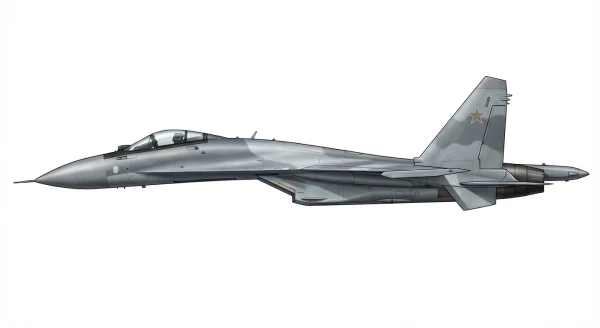
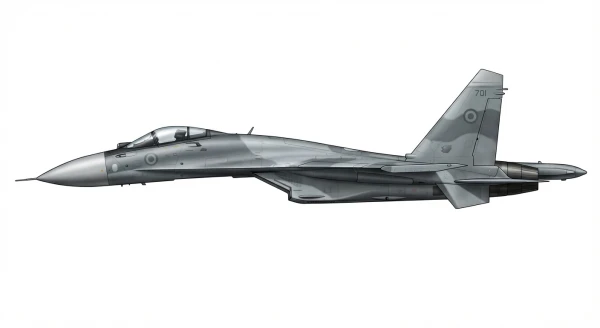
| Su-35 Flanker-E | Su-37 Super Flanker | |
|---|---|---|
| Origin country | 🇷🇺 Russia | 🇷🇺 Russia |
| Category | Combat Aircraft | Combat Aircraft |
| Manufacturer | Sukhoi | Sukhoi |
| First flight | 19 February 2008 | 12 April 1996 |
| Year introduced | 2014 | 1997 |
| Number produced | 151 units | 1 units |
| Average unit price | $83 million | $70 million |
| Wing area | 62.0 m² | 62.0 m² |
| Wingspan | 15.3 m | 14.7 m |
| Height | 5.9 m | 6.4 m |
| Length | 21.9 m | 22.2 m |
| Maximum speed | 2400 km/h | 2494 km/h |
| Operational range | 4,500 km | 3,300 km |
| Service ceiling | 18,000 m | 18,000 m |
| Max. takeoff weight | 34,500 kg | 35,000 kg |
| Empty weight | 19,000 kg | 18,500 kg |
| Total thrust | 2 x 14,000 kgf | 2 x 14,480 kgf |
Detailed Comparison
Sukhoi’s Su-35 Flanker-E and Su-37 Super Flanker occupy divergent positions in Russian aerospace procurement. The Su-35 is a serialized, mass-produced multirole fighter with 151 units constructed, serving as the current high-end bulk of the Russian Aerospace Forces (VKS). Conversely, the Su-37 was a 1990s single-airframe technology demonstrator built to test thrust-vectoring engines and canards, ultimately terminating without procurement. Comparing them contrasts a finalized, operational weapons system against an abandoned aerospace experiment.
Development and Design
Sukhoi developed the Su-37 in the mid-1990s during a period of severe Russian budget deficits, aiming to integrate thrust-vectoring control (TVC) and an N011M phased-array radar into the Su-27M airframe. The design relied on foreplane canards to maintain aerodynamic stability during high angles of attack. The program stalled due to a lack of government funding. Sukhoi later pivoted to the Su-35BM prototype, which matured into the production Su-35S. Su-35 engineers eliminated the drag-inducing canards, relying instead on a modernized digital fly-by-wire system and Saturn AL-41F1S engines to achieve 3D thrust vectoring. The Su-35 also structurally reinforced the airframe, increasing its payload ceiling and service life well beyond the Su-37 baseline.
Specifications and Performances
While both airframes share the fundamental Flanker geometry—spanning roughly 15 meters in width and 22 meters in length—their propulsion metrics dictate different flight envelopes. The Su-35 generates 27,400 kgf of combined thrust from its AL-41F1S turbofans, outperforming the Su-37’s AL-37FU engines, which generated 15,196 kgf. This thrust deficit on the Su-37, combined with its heavier 35,000 kg maximum takeoff weight (versus the Su-35’s 34,000 kg), resulted in a lower thrust-to-weight ratio. The Su-35 leverages its excess power to carry an 8,000 kg payload across 12 hardpoints, while maintaining a 3,600 km combat radius without aerial refueling—a 300 km edge over the Su-37.
Deployment and usage
The Su-37 has zero operational history. The sole prototype (Bort 711) flew airshow flights starting in 1996 before crashing in 2002 due to a structural failure, permanently ending the program. In contrast, the Su-35 entered service in 2014 and has seen sustained combat use. The VKS deployed it to Syria in 2016 for air superiority escorts, providing data to refine its electronic warfare suites. In Ukraine, Su-35s fly combat air patrols using R-37M air-to-air missiles. On the export market, the Su-35 met mixed results:
- China procured 24 units, completing deliveries by 2018.
- Egypt canceled a $2 billion order for 24 airframes.
- Indonesia abandoned a contract for 11 units.
These cancellations were driven largely by the threat of US CAATSA sanctions and pressure to pivot toward Western platforms.
Conclusion
The Su-35 definitively outclasses the Su-37. The Su-37 was an aerodynamic dead end that relied on heavy canards to compensate for immature flight control software. The Su-35 solved these aerodynamic problems through raw engine power and modern fly-by-wire computers, allowing engineers to strip excess weight and increase payload capacity. For any operator requiring a heavy multirole fighter, the Su-35 is a realized, combat-tested platform with active production lines, whereas the Su-37 remains a defunct 1990s prototype incapable of modern combat operations.