Yak-130 Mitten vs Yak-141 Freestyle
Yak-130 Mitten vs Yak-141 Freestyle at a glance — top speed 1,060 vs 1,800 km/h, range 2,100 vs 3,000 km, max takeoff weight 10,290 vs 19,500 kg, built 186 vs 4 units.
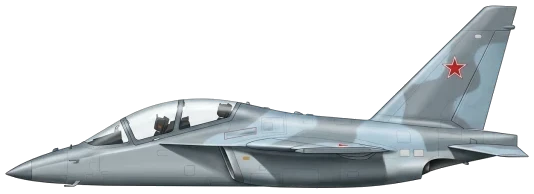
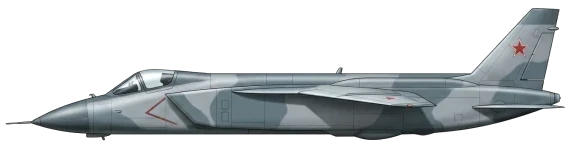
| Yak-130 Mitten | Yak-141 Freestyle | |
|---|---|---|
| Origin country | 🇷🇺 Russia | 🇷🇺 Ex-USSR |
| Category | Military Training Aircraft | Combat Aircraft |
| Manufacturer | Yakovlev | Yakovlev |
| First flight | 26 May 1996 | 9 March 1987 |
| Year introduced | 2010 | -- |
| Number produced | 186 units | 4 units |
| Average unit price | $18 million | -- |
| Wing area | 23.5 m² | 31.7 m² |
| Wingspan | 9.8 m | 10.1 m |
| Height | 4.8 m | 5.0 m |
| Length | 11.5 m | 18.4 m |
| Maximum speed | 1060 km/h | 1800 km/h |
| Operational range | 2,100 km | 3,000 km |
| Service ceiling | 12,500 m | 15,500 m |
| Max. takeoff weight | 10,290 kg | 19,500 kg |
| Empty weight | 4,600 kg | 11,650 kg |
| Total thrust | 2 x 2,500 kgf | 1 x 11,022 kgf |
Detailed Comparison
The Yakovlev Yak-130 Mitten and Yak-141 Freestyle represent two vastly different outcomes from the same design bureau. The Yak-130 is a successful subsonic advanced jet trainer and light combat aircraft currently in widespread service, while the Yak-141 was a technologically ambitious but ultimately cancelled supersonic Vertical Take-Off and Landing (VTOL) fighter prototype. The former is a pragmatic, modern workhorse; the latter is a high-performance relic of late-Cold War naval aviation ambitions.
Development and Design
The Yak-130 was conceived in the 1990s with a clear, modern purpose: to train pilots for 4th and 5th-generation fighters. Its design philosophy emphasizes versatility. It features an advanced fly-by-wire system capable of replicating the flight characteristics of various combat aircraft, from stable platforms to more agile fighters. Its dual-role capability is integral to the design, with nine hardpoints for a significant weapons load. In contrast, the Yak-141 was designed with a more singular, demanding role: a carrier-based supersonic interceptor to replace the limited Yak-38 Forger. Its key innovation was its complex propulsion system, combining a single R-79 lift/cruise engine with a swiveling nozzle for both vectored thrust and forward flight, supplemented by two dedicated RD-41 vertical lift jets. This configuration was a significant leap over previous VTOL designs. The use of composite materials for 28% of its airframe was also advanced for its time. However, its development was halted by the post-Soviet funding crisis.
Specifications and Performances
The performance data underscores the aircrafts' divergent missions. The Yak-141 is substantially larger and heavier, with a Maximum Takeoff Weight of 19,500 kg compared to the Yak-130's 10,290 kg. This size supported its primary role as a formidable fleet defender. Its performance metrics are those of a true fighter: a maximum speed of 1800 km/h (Mach 1.7) and a remarkable climb rate of 250 m/s. The Yak-130 is a high-subsonic aircraft with a top speed of 1050 km/h and a climb rate of 65 m/s, perfectly adequate for its training and light attack roles. The Yak-141's complex three-engine VTOL system provided immense thrust, while the Yak-130 relies on two simple, efficient Ivchenko-Progress AI-222-25 turbojets. This fundamental difference in powerplant dictates their entire performance envelope and operational concept.
Deployment and usage
The contrast in deployment is stark. The Yak-130 is an operational success story, with over 180 units built. It serves as the primary advanced trainer for the Russian Air Force and has been exported to numerous countries. It has been used to prepare pilots for front-line aircraft like the Su-30 and Su-57. Furthermore, its robust armament capability, including guided missiles like the R-73 and Kh-25, has seen it deployed in light combat and counter-insurgency roles by some operators. The Yak-141 never entered service. Only four prototypes were ever built, serving as technology demonstrators. Its operational history is confined to test flights, including setting several records for VTOL aircraft before a landing accident and the program's subsequent cancellation in 1991. The technology, particularly the swiveling main engine nozzle, lived on, with Yakovlev later cooperating with Lockheed Martin during the development of the X-35, the precursor to the F-35B.
Conclusion
The Yak-130 and Yak-141 offer a clear lesson in military aircraft development. The Yak-141 was a testament to Soviet engineering ambition, pushing the boundaries of VTOL performance at a time when the strategic need and financial capacity for such a platform were evaporating. It was a technological marvel that became a footnote. The Yak-130, born from a more constrained era, succeeded through pragmatism. By focusing on a defined, dual-purpose market—advanced training and light attack—Yakovlev created a reliable, versatile, and commercially viable aircraft that meets the needs of modern air forces. One represents the high-water mark of a fading power's naval aspirations, while the other embodies the successful adaptation to a new geopolitical and economic reality.


