Leopard 2 vs T-72
Leopard 2 vs T-72 at a glance — weight 62,500 vs 44,500 kg, top speed 70 vs 60 km/h, range 340 vs 500 km, crew 4 vs —.
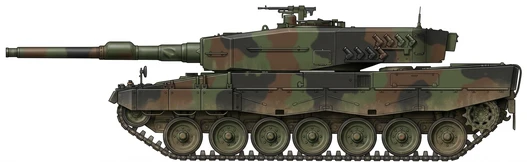
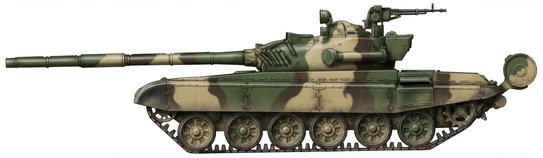
| Leopard 2 | T-72 | |
|---|---|---|
| Origin country | 🇩🇪 Germany | 🇷🇺 Ex-USSR |
| Category | Main Battle Tank | Main Battle Tank |
| Type | Heavy Main Battle Tank | Medium Main Battle Tank |
| Manufacturer | Krauss-Maffei | Malyshev HMB Plant |
| Number produced | 3,600 units | 25,000 units |
| Estimated unit price | $29 million | $2 million |
| Combat weight | 62.5 tons | 44.5 tons |
| Maximum speed | 70 km/h | 60 km/h |
| Operational range | 340 km | 500 km |
| Length | 9.97 m | 9.73 m |
| Width | 3.76 m | 3.59 m |
| Height | 3.00 m | 2.23 m |
| Crew | 4 | 3 (commander, gunner, driver) |
Detailed Comparison
At 62.5 tons and $29.0 million per unit, the German Leopard 2 outweighs the 44.5-ton, $2.0 million Soviet T-72 by a wide margin in both mass and procurement cost. These two main battle tanks clash directly on the battlefields of Syria and Ukraine. The Leopard 2 relies on heavy composite armor, blowout panels, and a four-man crew. The T-72 leverages a low silhouette, a three-man crew, and mechanical autoloading to reduce weight and maximize production volume.
Development and Design
Originating in 1973, the T-72 was designed at Uralvagonzavod as a mobilization model. It stripped away the mechanical complexities of the T-64, prioritizing mass production and cost-efficiency. Utilizing the V-45 engine and a modified suspension, it generated a platform that could be rapidly built (over 25,000 units produced). Conversely, Krauss-Maffei developed the Leopard 2 (entering service in 1979) after the collapse of the US-German MBT-70 project. German designers prioritized crew survivability and first-round hit probability. This resulted in a larger vehicle with an internal layout separating the crew from the main turret ammunition storage—contrasting directly with the T-72's space-saving but highly volatile carousel autoloader.
Protection and Firepower
The Leopard 2 fields the Rheinmetall 120 mm smoothbore cannon (upgraded from L/44 to L/55), coupled with digitized fire control. Its spaced multilayer armor provides heavy frontal protection. The T-72 mounts a 125 mm 2A46M series gun, fed by a 22-round autoloader. This autoloader dictates the tank's primary engineering flaw: catastrophic secondary explosions when the hull is breached. While Russian upgrades like the T-72B3 add explosive reactive armor (ERA) and Sosna-U thermals, the baseline metallurgy and crew layout cap its survivability.
Mobility and Logistics
The Leopard 2 uses an MTU MB 873 1,500 hp diesel engine, achieving a top speed of 70.0 km/h. Its 62.5-ton weight limits its deployment on softer terrain and exacts a toll on recovery assets. The T-72 provides exact logistical contrasts:
- A 44.5-ton combat weight allows transit over lighter Eastern European bridges.
- Compact dimensions facilitate standard rail transport.
- A 500 km operational range (compared to the Leopard 2's 340 km) reduces fuel train requirements.
The T-72 is powered by engines ranging from early 780 hp models to the 1,130 hp V-92S2F, topping out at 60.0 km/h.
Deployment and Combat Record
The T-72 fought in the 1982 Lebanon War, Desert Storm, Chechnya, Syria, and Ukraine. In Iraq (1991), older export variants suffered heavy losses to Western thermal optics. The Leopard 2 saw combat in Kosovo and Afghanistan, surviving IED strikes. In Syria, Turkish Leopard 2A4s took losses from ATGMs, proving older un-upgraded variants are vulnerable. In Ukraine, Leopard 2 models take hull damage from artillery and mines but consistently preserve their crews. The T-72 family suffers frequent catastrophic kills, forcing mass abandonment.
Conclusion
The Leopard 2 holds the edge in high-intensity, tank-on-tank engagements and crew survivability. Its thermal imaging fidelity, main gun stabilization, and ammunition containment make it the most effective platform for professional armor formations capable of supporting its massive logistical footprint. The T-72 wins in sheer volume, operational range, and terrain accessibility. For militaries needing mass and a low-cost platform, the T-72 remains the logical choice. However, combat feedback from Ukraine confirms the T-72's baseline architecture is a dead end for crew protection, making the Leopard 2 the more lethal and survivable warfighting platform in peer conflict.