Leopard 2 vs T-90
Leopard 2 vs T-90 at a glance — weight 62,500 vs 48,000 kg, top speed 70 vs 60 km/h, range 340 vs 550 km, crew 4 vs 3.
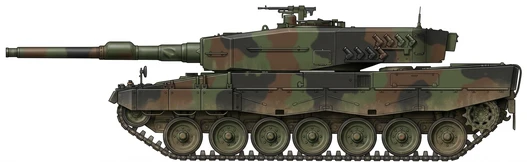
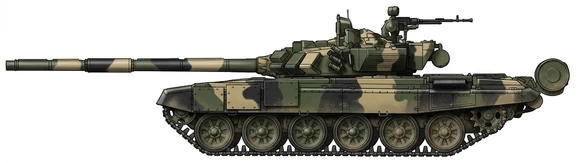
| Leopard 2 | T-90 | |
|---|---|---|
| Origin country | 🇩🇪 Germany | 🇷🇺 Russia |
| Category | Main Battle Tank | Main Battle Tank |
| Type | Heavy Main Battle Tank | Medium Main Battle Tank |
| Manufacturer | Krauss-Maffei | Malyshev HMB Plant |
| Number produced | 3,600 units | 4,000 units |
| Estimated unit price | $29 million | $4.5 million |
| Combat weight | 62.5 tons | 48.0 tons |
| Maximum speed | 70 km/h | 60 km/h |
| Operational range | 340 km | 550 km |
| Length | 9.97 m | 9.63 m |
| Width | 3.76 m | 3.78 m |
| Height | 3.00 m | 2.22 m |
| Crew | 4 | 3 |
Detailed Comparison
The German Leopard 2 and Russian T-90 are third-generation main battle tanks (MBTs) originating from Cold War requirements but modernized for contemporary warfare. The Leopard 2, weighing 62.5 tons, acts as a heavy MBT emphasizing crew survivability and long-range gunnery, while the 48-ton T-90 is a lighter, lower-profile medium MBT prioritizing cost-efficiency and strategic mobility. With 3,600 and 4,000 units built respectively, both platforms constitute the armored backbone of their primary user nations.
Development and Design
Krauss-Maffei delivered the first Leopard 2 in 1979 following the cancellation of the MBT-70 joint project. It employs a conventional four-man crew layout with manual loading and prioritizes internal volume. Conversely, the T-90, manufactured by Malyshev, entered service in 1992 as a direct evolution of the T-72B (Object 188). It retains the Soviet design lineage of a compact, low-profile silhouette (2.22 m height versus the Leopard's 3.0 m) and a three-man crew supported by an automatic loader.
Protection and Firepower
The Leopard 2 utilizes spaced multilayer composite armor, with variants from the A5 onwards incorporating wedge-shaped appliqué turret armor. Its primary armament is the Rheinmetall 120 mm smoothbore gun (L/44 or L/55) paired with advanced thermal imaging. Ammunition is stored in a turret bustle with blow-off panels to enhance crew safety. The T-90 combines composite armor with explosive reactive armor (ERA), such as Kontakt-5 or Relikt, and the Shtora active protection system. It mounts a 125 mm 2A46M-5 smoothbore gun capable of firing standard munitions and AT-11 Sniper guided missiles. Unlike the Leopard, the T-90's ammunition is located within the hull autoloader mechanism, presenting a higher risk of catastrophic detonation upon penetration.
Mobility and Logistics
Powered by a 1,500 hp MTU diesel engine, the Leopard 2 achieves 70 km/h despite its 62.5-ton mass, utilizing torsion bar suspension for cross-country performance. However, its weight restricts transport across certain bridges. The T-90 uses a V-92S2F engine; while lighter at 48 tons, it has a lower top speed of 60 km/h but a greater operational range of 550 km compared to the Leopard's 340 km. The T-90's lighter footprint simplifies strategic rail and air transport and demands less fuel support.
Deployment and Combat Record
Leopard 2 deployments include KFOR in Kosovo and ISAF operations in Afghanistan, where Canadian and Danish units confirmed resistance to IEDs. Turkish employment in Syria exposed vulnerabilities to side and rear ATGM strikes. T-90 combat history spans Dagestan, Syria, and Nagorno-Karabakh. Both platforms are currently engaged in the Russo-Ukrainian War. High-intensity combat has resulted in documented losses for both types, with T-90 attrition attributed to various anti-tank systems, while Leopard 2s have faced dense minefields and artillery.
Conclusion
The Leopard 2 is optimized for defensive operations where hull-down positioning utilizes its superior gun depression and turret armor, prioritizing crew survival through munition isolation. The T-90 offers logistic advantages due to lower weight and cost ($4.5 million vs $29.0 million), making it suitable for large-scale maneuvers requiring extended operational range. While the Leopard represents a high-cost Western doctrine focused on individual unit superiority, the T-90 reflects a doctrine emphasizing mass, lower profile, and integrated missile capabilities.