M113 vs M2 Bradley
M113 vs M2 Bradley at a glance — weight 11,343 vs 22,940 kg, top speed 61 vs 66 km/h, range 480 vs 483 km, crew 2 vs 3.
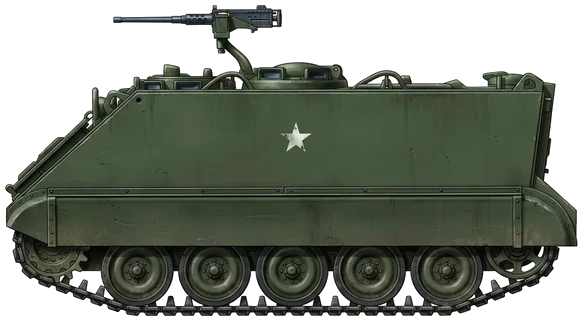
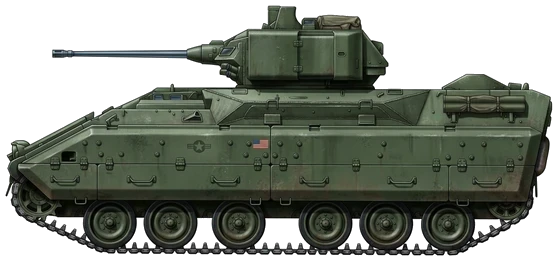
| M113 | M2 Bradley | |
|---|---|---|
| Origin country | 🇺🇸 United States | 🇺🇸 United States |
| Category | Armored Personnel Carrier | Infantry Fighting Vehicle |
| Type | Armored Personnel Carrier | Infantry Fighting Vehicle |
| Manufacturer | FMC | FMC |
| Number produced | 80,000 units | 6,800 units |
| Estimated unit price | $0.6 million | $4.4 million |
| Combat weight | 11.3 tons | 22.9 tons |
| Maximum speed | 61 km/h | 66 km/h |
| Operational range | 480 km | 483 km |
| Length | 2.52 m | 6.55 m |
| Width | 2.70 m | 3.60 m |
| Height | 1.85 m | 2.57 m |
| Crew | 2 | 3 |
| M113 | M2 Bradley | |
|---|---|---|
| Main armament | 1 M2 HB 12.7mm machine gun | 1 M242 Bushmaster 25mm gun |
| Secondary weapon | 1 M240 7.62mm machine gun | 1 TOW 2 double anti-tank launcher |
| Engine | General Motors 6V53 Diesel Engine with 212 hp | Cummins VTA-903T V8 Turbo-Diesel Engine with 500 hp |
Detailed Comparison
The 11.3-ton M113 operates as an armored personnel carrier, shuttling infantry to the forward edge of the battle area. The 22.9-ton M2 Bradley operates as an infantry fighting vehicle (IFV), fighting directly alongside main battle tanks with organic anti-armor capabilities.
Development and Design
The U.S. Army introduced the M113 in 1960, prioritizing manufacturability and air transportability. FMC built 80,000 units using 5083 aircraft-quality aluminum, resulting in a low unit cost of $0.6 million. The chassis fits 15 passengers and a crew of two. By 1981, the proliferation of Soviet BMPs forced a doctrinal shift. BAE Systems (formerly United Defense) designed the $4.35 million M2 Bradley to survive overmatch threats and keep pace with the M1 Abrams. To accommodate a turret and heavy armor, the Bradley sacrifices internal volume, carrying a crew of three and seven dismounts.
Protection and Firepower
The M113 relies on an aluminum hull rated for 7.62mm rounds and artillery splinters. Its baseline armament is a single .50-caliber M2 Browning. The Bradley increases firepower via a turreted M242 25mm chain gun and a dual TOW 2 missile launcher. Protection strictly favors the Bradley. While the M113 is vulnerable to rocket-propelled grenades (RPGs) and heavy machine guns, M2A2 and subsequent Bradleys integrate steel applique armor, Kevlar spall liners, and explosive reactive armor (ERA). The M2A4 variant adds the Iron Fist active protection system to intercept anti-tank munitions.
Mobility and Logistics
Both platforms achieve similar maximum road speeds: 61 km/h for the M113 and 66 km/h for the Bradley. The M113 uses a 212-horsepower General Motors diesel, while the Bradley requires a 500-horsepower Cummins VTA-903T diesel.
- The M113 exerts lower ground pressure, allowing it to cross soft terrain and weight-restricted infrastructure that halts heavier armor.
- The Bradley consumes more fuel and requires more maintenance hours per operating hour, tying it to established supply lines.
Deployment and Combat Record
In Vietnam, M113s conducted reconnaissance in jungle terrain, utilizing ACAV gun shield kits to mitigate crew exposure. During the Yom Kippur and 1982 Lebanon wars, IDF M113s suffered heavy losses to AT-3 Sagger missiles, forcing Israel to transition to the heavy Namer platform. The Bradley recorded high kill ratios during the Gulf War, destroying more Iraqi armor than the Abrams using TOW missiles. In the Russo-Ukrainian War, combat usage diverges strictly by survivability. Ukrainian forces relegate M113s to rear-guard transport and medical evacuation. Conversely, the 47th Mechanized Brigade uses Bradleys in direct assaults, utilizing the 25mm gun to blind and disable Russian T-90M tanks. The Bradley’s layered armor routinely allows crews to survive FPV drone strikes that destroy M113s.
Conclusion
The M2 Bradley provides the required lethality and survivability for contested mechanized assaults against peer adversaries. Its thermal sights, 25mm gun, and ERA ensure infantry survive the approach phase. The M113 retains utility only in rear-echelon logistics and low-intensity operations, where its $0.6 million cost, 15-passenger capacity, and C-130 transportability outweigh the requirement to withstand direct anti-tank fire.