T-72 vs T-80
T-72 vs T-80 at a glance — weight 44,500 vs 46,000 kg, top speed 60 vs 70 km/h, range 500 vs 415 km, crew — vs 3.
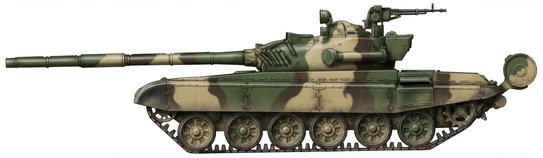
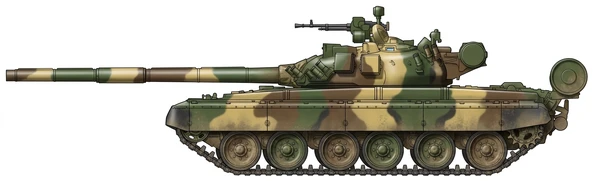
| T-72 | T-80 | |
|---|---|---|
| Origin country | 🇷🇺 Ex-USSR | 🇷🇺 Ex-USSR |
| Category | Main Battle Tank | Main Battle Tank |
| Type | Medium Main Battle Tank | Medium Main Battle Tank |
| Manufacturer | Malyshev HMB Plant | Malyshev HMB Plant |
| Number produced | 25,000 units | 5,500 units |
| Estimated unit price | $2 million | $2.5 million |
| Combat weight | 44.5 tons | 46.0 tons |
| Maximum speed | 60 km/h | 70 km/h |
| Operational range | 500 km | 415 km |
| Length | 9.73 m | 9.65 m |
| Width | 3.59 m | 3.60 m |
| Height | 2.23 m | 2.20 m |
| Crew | 3 (commander, gunner, driver) | 3 |
Detailed Comparison
Soviet tank design in the Cold War produced two parallel tracks: the low-cost, mass-produced T-72 intended for mobilization, and the premium, turbine-powered T-80 designed for elite units stationed in Eastern Europe. While both share a 125mm main gun and a low-silhouette three-man layout, their underlying automotive architecture and internal configurations dictate distinct operational realities.
Development and Design
Uralvagonzavod developed the T-72 in 1973 as a mechanically simpler, diesel-powered alternative to the technically troubled T-64. Omsktransmash’s T-80, entering service in 1976, pursued maximum automotive performance using a gas turbine engine, creating a faster but more logistics-dependent platform. A mechanical divergence lies in their automated loading mechanisms: the T-72 uses the AZ electro-mechanical autoloader storing 22 rounds horizontally, while the T-80 utilizes the MZ hydro-electromechanical system, storing 28 projectiles and propellants vertically.
Protection and Firepower
Both platforms rely on the 125mm 2A46-series smoothbore gun. Historically, the T-80 received more advanced fire control systems, such as the 1A46 suite on the T-80U, while T-72s relied on basic optics until the integration of Sosna-U thermal sights in modernized T-72B3s. Armor layout relies entirely on Explosive Reactive Armor (ERA) to defeat modern threats, with Kontakt-5 or Relikt bolted onto the base steel-composite turrets.
Survivability remains a shared, fatal flaw. The placement of ammunition in hull floor carousels guarantees catastrophic secondary explosions upon penetration. The T-80 is demonstrably more vulnerable; its vertical propellant storage sits higher in the hull, making it statistically more prone to detonation from side-aspect penetrations than the T-72’s flat-laying carousel.
Mobility and Logistics
The T-80’s GTD-1250 gas turbine generates 1,250 hp, pushing the 46-ton vehicle to 70 km/h. It accelerates faster than the 44.5-ton T-72 and starts reliably in extreme Arctic temperatures. However, the turbine consumes nearly twice the fuel at idle compared to the T-72’s modern V-92S2F 1,130 hp diesel engine, reducing the T-80's operational range to 415 km versus the T-72’s 500 km. Both platforms suffer from obsolete transmission designs that dictate their tactical employment:
Deployment and Combat Record
At $2.0 million per unit, the T-72 achieved massive export success with over 25,000 units built. It defined armored warfare in the Middle East, suffering against Western armor in 1991 but sustaining attritional operations in Syria. The T-80 ($2.5 million, 5,500 units) remained mostly within Soviet borders. In the First Chechen War, Russian T-80s suffered heavy losses in Grozny due to top-attack vulnerabilities. In the Russo-Ukrainian War, both chassis have sustained massive attrition from modern ATGMs and loitering munitions.
Conclusion
The T-72 holds the edge in sustained, mass-scale conflicts. Its diesel engine eases the logistics chain, and its horizontal autoloader offers marginally better survivability against side impacts. The T-80 wins strictly in tactical mobility and cold-weather operations, but its gas turbine creates an unsustainable logistical burden that outweighs its acceleration advantage. Ultimately, the T-72 functions better as a macro-level combat system, though both vehicles share terminal survivability defects that render them obsolete against peer anti-tank capabilities.