T-90 vs Type 99
T-90 vs Type 99 at a glance — weight 48,000 vs 52,000 kg, top speed 60 vs 65 km/h, range 550 vs 450 km, crew 3 vs 3.
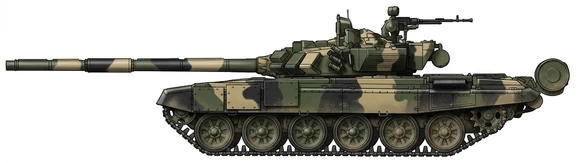
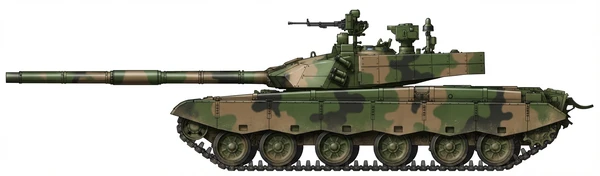
| T-90 | Type 99 | |
|---|---|---|
| Origin country | 🇷🇺 Russia | 🇨🇳 China |
| Category | Main Battle Tank | Main Battle Tank |
| Type | Medium Main Battle Tank | Medium Main Battle Tank |
| Manufacturer | Malyshev HMB Plant | Norinco |
| Number produced | 4,000 units | 1,300 units |
| Estimated unit price | $4.5 million | $2.5 million |
| Combat weight | 48.0 tons | 52.0 tons |
| Maximum speed | 60 km/h | 65 km/h |
| Operational range | 550 km | 450 km |
| Length | 9.63 m | 9.99 m |
| Width | 3.78 m | 3.45 m |
| Height | 2.22 m | 2.30 m |
| Crew | 3 | 3 |
Detailed Comparison
The Type 99 and T-90 are third-generation main battle tanks armed with 125mm smoothbore guns and autoloader systems, reflecting a shared Soviet engineering lineage. While the Russian T-90 utilizes the established T-72 chassis for cost-effective mass deployment, the Chinese Type 99 incorporates a heavier chassis, a welded turret, and a 1500 hp engine to achieve higher performance parameters restricted to domestic use.
Development and Design
China's 201st Research Institute initiated the Type 99 program in 1989 to replace the Type 88, utilizing T-72 chassis studies from the Type 90-II project. It features a welded turret and modular armor, with the modernized Type 99A entering service in 2011. Conversely, the T-90 originated as the Object 188 by the Kartsev-Venediktov Design Bureau. Adopted in 1992, it serves as a direct modernization of the T-72B, prioritizing component commonality and simplicity. The T-90M, delivered starting in 2020, introduces a modernized turret and digital systems.
Protection and Firepower
Both tanks utilize 125mm main guns (ZPT-98 for Type 99; 2A46M-5 for T-90) capable of firing APFSDS, HEAT, and gun-launched ATGMs (GP125 and AT-11 Sniper, respectively). The Type 99 integrates the JD-3 active laser self-defense system to disrupt optical sensors and the GL-6 hard-kill APS on select variants. Its protection suite combines modular composite panels with third-generation ERA. The T-90 relies on a steel/composite mix supplemented by Kontakt-5 or Relikt ERA. It employs the Shtora active protection system for jamming missile guidance. While both use thermal imaging and ballistic computers, the Type 99A's fire control system includes millimeter-wave radar for target identification.
Mobility and Logistics
The Type 99 possesses a higher power-to-weight ratio, driven by a 1500 hp liquid-cooled diesel engine, propelling its 52-ton combat weight to 65 km/h. The T-90, weighing 48 tons, utilizes the V-92S2F engine and achieves a maximum speed of 60 km/h. The Type 99's operational range is limited to 450 km compared to the T-90's 550 km. Logistically, the Type 99B variant is specifically configured for high-altitude operations in Himalayan regions, whereas the T-90's lighter weight facilitates easier rail and air transport.
Deployment and Combat Record
The People's Liberation Army is the sole operator of the Type 99, deploying it in heavy combined arms brigades within the Beijing and Shenyang regions; it has no recorded combat history. In contrast, the T-90 has seen extensive export to nations including India and Algeria, with over 4,000 units built. Its combat record spans the Dagestan War, the Syrian Civil War, and the 2020 Nagorno-Karabakh conflict. During the full-scale invasion of Ukraine since 2022, T-90A and T-90M variants have sustained documented losses to various anti-tank systems.
Conclusion
The T-90 represents a scalable, export-oriented platform that balances protection and firepower with manufacturing economy, evidenced by its widespread global adoption and frequent combat application. The Type 99 constitutes a higher-cost, domestic-only superiority asset, prioritizing raw engine output and electronic warfare countermeasures like the JD-3 system. While the T-90 provides operational data from multiple theaters, the Type 99 remains a theoretically potent but unproven system designed for specific regional dominance.