TPz Fuchs
The TPz Fuchs is a German 6x6 armoured personnel carrier introduced in 1979, primarily used for troop transport and battlefield support, distinguished by its amphibious capability. Key figures: weight 23.5 t, top speed 105 km/h, range 800 km, built 1,800. In service with 6 armies — Algeria (1,034), Germany (825), United Arab Emirates (32) and 3 others.
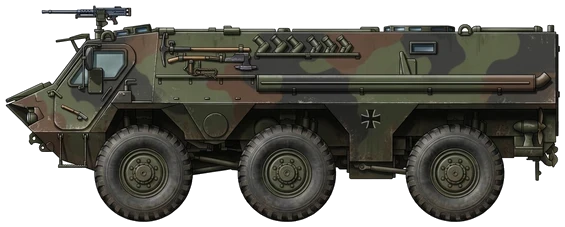
| Sub-type | 6x6 Amphibious armoured personnel carrier |
| Crew | 2 + 10 troops personnels |
| Range | 800 km |
| Mass | 23.5 tons |
| Height | 2.5 m (8.2 ft) |
| Width | 2.98 m (9.8 ft) |
| Length | 6.8 m (22.3 ft) |
| Max. speed | 105 km/h (65 mph) |
| Engine | Mercedes-Benz OM 402A 12.8 L V8 diesel, 320 hp |
| Weapon 1 | 1x Rheinmetall MG3 7.62 mm machine gun |
| Weapon 2 | 40 mm HK GMG grenade launcher or M2 Browning 12.7 mm (deployed vehicles) |
| Weapon 3 | 6x 76 mm smoke grenade dischargers |
| Weapon 4 | Up to 30 mm autocannon or ATGM launcher (Fuchs 2) |
Description
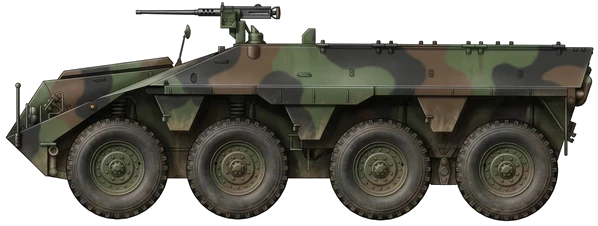
The TPz Fuchs is a 6×6 armoured personnel carrier designed by Daimler-Benz. In 1977 Rheinstahl Wehrtechnik, building under licence from Daimler-Benz, received a German Army contract for 996 Transportpanzer Fuchs 1; the firm subsequently became Henschel Wehrtechnik, then Rheinmetall Landsysteme, and today Rheinmetall MAN Military Vehicles. The first production vehicle was handed over in December 1979 and deliveries ran at roughly 160 per year until late 1986. It was the second wheeled armoured vehicle to enter Bundeswehr service. German Army deliveries comprised the TPz 1 Standard (504), the TPz 1A1 EloKa electronic warfare variant (87, non-amphibious), the TPz 1A2 Funk command vehicle (265) and the TPz 1A3 ABC/Spürpanzer NBC reconnaissance vehicle (140). Production of the Fuchs 1 totalled 1,236 vehicles.
By early 1998, 55 vehicles had received an IBD-Deisenroth passive fibre-composite add-on armour package for service with IFOR in Bosnia, adding external side armour, spall liners, floor elements against mines and improved window protection. Two pre-production Fuchs KRK were built in 1997 but the type was not serialised. In 2002 the BWB awarded a €45 million contract to bring 123 vehicles to TPz A7 standard, work carried out at Kassel between 2004 and 2007. The TPz A8 followed, with deliveries from March 2008, introducing mine and IED protection for units in Afghanistan; amphibious capability was deleted on this standard. In 2013 the German Army stated a long-term intention to retain a fleet of up to 728 vehicles at A8 standard.
The hull is all-welded steel, protecting against armour-piercing small arms fire and shell splinters. The driver sits front left with the commander to his right, both with side doors, shuttered vision blocks and roof periscopes. The rear troop compartment has two assisted doors, three or four roof hatches and folding bucket seats for ten infantrymen. Power comes from a Mercedes-Benz OM 402A V8 diesel with a six-speed planetary torque-converter transmission; the powerpack can be run outside the vehicle for testing. Rigid hub-reduction axles with differential locks are sprung by coil springs, power steering acts on the front four wheels, and the tyres are run-flat. Amphibious propulsion uses two four-bladed propellers that swivel through 360°, with a hydraulically erected trim vane and bilge pumps. Armament varies by role: an MG3 over the commander's position and six 76 mm grenade dischargers are standard; MILAN ATGM fits were formerly carried by reconnaissance, Panzergrenadier, mountain and Jäger units and the Franco-German Brigade, while Afghanistan-bound vehicles mounted a GMG or M2 Browning.
The Fuchs 2, first shown at MSPO 2001, has a raised roof, blast-resistant seating for up to nine, an MTU 6V 199 TE20 diesel with ZF automatic transmission and retarder, optional CTIS, and can mount weapons up to a 30 mm cannon.
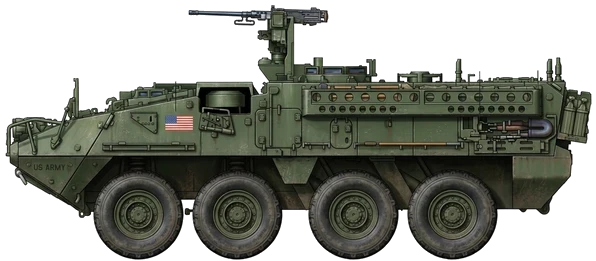
Export users include the Netherlands, Norway, Saudi Arabia, Kuwait, Israel and Venezuela. The United States adopted the type as the M93 Fox NBC reconnaissance vehicle, selected in July 1989; ex-German vehicles served as the XM93 in Operation Desert Storm, later upgraded to M93A1, M93A1P1 and M93A1P2 standards, with replacement planned by the Stryker NBCRV. British NBC variants delivered in 1990 serve with Falcon Squadron, Royal Tank Regiment. Algeria is the principal Fuchs 2 operator under a 2014 contract for 980 vehicles with progressive local production.
Frequently Asked Questions
What type of vehicle is the TPz Fuchs?
What is the weight of the TPz Fuchs?
What is the maximum speed of the TPz Fuchs?
What is the operational range of the TPz Fuchs?
How many crew members does the TPz Fuchs require?
How many TPz Fuchs have been built?
What weapons does the TPz Fuchs carry?
- SEP 42026 Verified Weight verified against the published specifications
- AUG 292026 Created TPz Fuchs page created (specs, description, operators, related vehicles)