407
American civil and military utility helicopter, developed in the late 20th century, widely operated globally for transport, reconnaissance, and medical evacuation. Key figures: top speed 260 km/h, range 600 km, service ceiling 5,700 m, max takeoff weight 2,722 kg, built 1,600. In service with 8 air forces as of 2026 — United Arab Emirates (43), Iraq (40), Mexico (17) and 5 others.
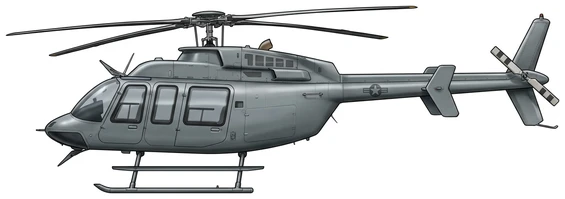
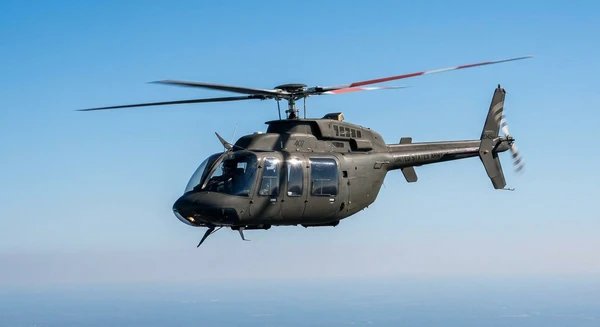
| Crew | 1 |
| Length | 12.7 m (41.7 ft) |
| Wingspan | 10.7 m (35.0 ft) |
| Height | 3.6 m (11.7 ft) |
| Wing area | 89.4 m² (962.3 sqft) |
| Empty weight | 1,210 kg (2,668 lbs) |
| Max. takeoff weight | 2,722 kg (6,001 lbs) |
| Powerplant | 1 × Allison 250-C47B 606 kW each |
| Maximum speed | 260 km/h (162 mph) |
| Operational range | 600 km (373 mi) |
| Service ceiling | 5,700 m (18,701 ft) |
-
 United Arab Emirates
43
United Arab Emirates
43
-
 Iraq
40
Iraq
40
-
 Mexico
17
Mexico
17
-
 United States
10
United States
10
-
 Bangladesh
2
Bangladesh
2
-
 Argentina
1 +5
Argentina
1 +5
-
 Guatemala
1
Guatemala
1
-
 Panama
1
Panama
1
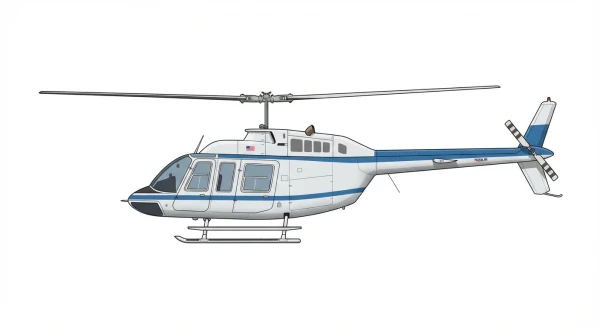
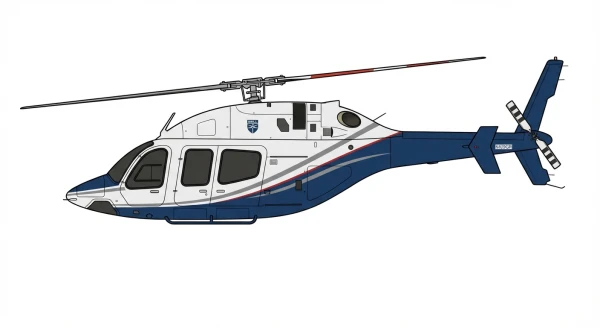
Description
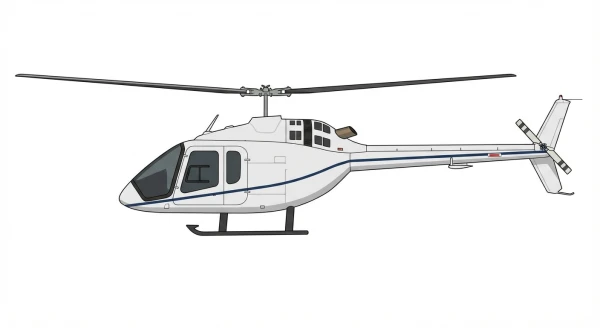
The Bell 407 is a single-engine utility helicopter produced by Bell Textron. Derived from the Bell 206L-4 LongRanger, the aircraft was developed for civil, police, and military roles, entering operational service in 1996. It is known for integrating the four-blade soft-in-plane composite main rotor system originally developed for the U.S. Army's OH-58D Kiowa Warrior.
Development
Bell began development of the 407 in 1993 under the New Light Aircraft program to replace the Model 206 series, using a modified 206L-3 LongRanger as a flight demonstrator in 1994. The first prototype flew on June 29, 1995, followed by the flight of the first production aircraft on November 10, 1995. Transport Canada certified the helicopter on February 9, 1996, and the U.S. Federal Aviation Administration granted certification on February 23, 1996. Production took place at Bell's facility in Mirabel, Quebec, delivering 140 airframes in 1997 and exceeding 1,600 total units produced by early 2023.
Design
The aircraft features a four-blade composite main rotor and hub with unlimited service life, replacing the two-blade teetering rotor used on the 206L-4. Its fuselage is 8 inches (20 cm) wider than the 206L-4, which expands internal cabin space and accommodates cabin windows that are 35 percent larger. Power is provided by a Rolls-Royce/Allison 250-C47 turboshaft engine producing 813 shp (606 kW), enabling a maximum takeoff weight of 6,000 lb (2,722 kg). Standard seating allows for two crew members and five passengers in the main cabin.
Armament
Armed configurations such as the 407GT utilize the Universal Weapons Pylon, which is derived from the Bell OH-58 Kiowa. This pylon allows the aircraft to carry machine guns, unguided rockets, and anti-armor missiles.
Operational History
Initial deliveries began in February 1996 to launch customers Petroleum Helicopters International, Niagara Helicopters, and Greenland Air. The Iraqi Army Aviation Command acquired 30 aircraft between 2010 and 2013, including 24 IA-407 armed scouts, three gunships, and three T-407 trainers for military operations against Islamic State militants. On October 8, 2014, an Iraqi IA-407 was shot down by militants using a shoulder-fired surface-to-air missile. Military and government operators include the armed forces of Argentina, Bangladesh, Guatemala, Iraq, Jamaica, Mexico, Nepal, Panama, the United Arab Emirates, and the United States.
Variants
-
ARH-70: An upgraded military armed reconnaissance variant developed for the U.S. Army before its cancellation in 2008.
-
Bell 407GT: An armed version of the 407GX featuring a Garmin G1000H flight deck and a Universal Weapons Pylon for ordnance.
-
Bell 407AH: An armed civil-certified version designed for government and security forces.
-
Eagle 407 HP: A modified conversion built by Eagle Copter powered by a 1,021 shp Honeywell HTS900 engine.
-
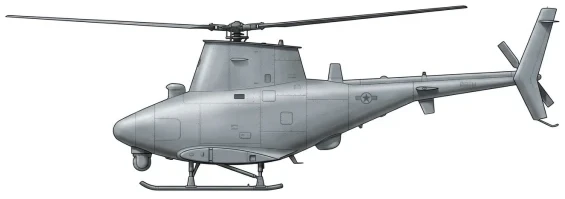
Northrop Grumman MQ-8C Fire Scout: An unmanned aerial vehicle developed for the U.S. Navy using the Bell 407 airframe and dynamic systems.
Frequently Asked Questions
What type of aircraft is the 407?
What is the maximum speed of the 407?
What is the range of the 407?
When did the 407 first fly?
How many 407 have been built?
Which countries operate the 407?
What is the service ceiling of the 407?
- AUG 42026 Created Page created: 407