Do 27
West German single-engine STOL utility and liaison aircraft of the mid-1950s, the first mass-produced German aircraft after the war, flown by the Bundeswehr and exported widely, notably to Portugal. Key figures: top speed 250 km/h, range 870 km, service ceiling 5,500 m, max takeoff weight 1,570 kg, built 571.
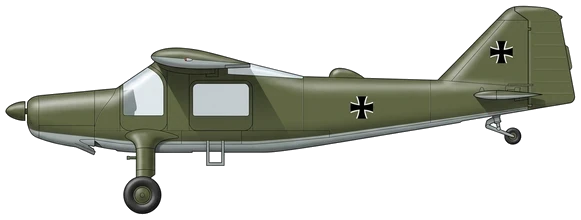
| Crew | 1 |
| Length | 10.1 m (33.1 ft) |
| Wingspan | 12 m (39.4 ft) |
| Height | 4.2 m (13.7 ft) |
| Wing area | 19.4 m² (208.8 sqft) |
| Empty weight | 985 kg (2,172 lbs) |
| Max. takeoff weight | 1,570 kg (3,461 lbs) |
| Powerplant | 1 × piston engine Lycoming GO-480-B1A6 205 kW each |
| Maximum speed | 250 km/h (155 mph) |
| Operational range | 870 km (541 mi) |
| Service ceiling | 5,500 m (18,045 ft) |
| Climb rate | 6.4 m/s (21.0 ft/s) |
Description
The Dornier Do 27 is a single-engine STOL utility aircraft designed and manufactured by Dornier GmbH (later DASA Dornier and Fairchild-Dornier) of West Germany. It was the first aircraft mass-produced in Germany after the Second World War. The West German Air Force and Army adopted it from the mid-1950s for utility transport, liaison and training, and it was widely exported. Some examples remained in use into the twenty-first century.
Development
Dornier opened a technical office in Madrid in January 1951. It already had strong ties with Spain through licence production of the Messerschmitt Bf 109 there. In 1951 it won a Spanish Ministry of Aviation development contract for a light STOL aircraft, which became the Do 25. The first prototype flew in July 1954, powered by a 110 kW (150 hp) ENMA Tigre G.V that proved underpowered. The second prototype received a Continental O-470 and served as the demonstrator for the improved Do 27.
Spain did not select the Do 25 for production, but Dornier continued development. The Do 27 prototype first flew in Spain on 27 June 1955. Construcciones Aeronáuticas SA built 40 aircraft as the CASA-127. The first German-built aircraft flew on 17 October 1956. The German Air Force and German Army placed a combined order for 428 Do 27A transports and dual-control Do 27B trainers, and 428 aircraft were built in Germany. Production ended in 1966.
Design
The Do 27 is a high-wing monoplane with oversized flaps, a wraparound windscreen and fixed tailwheel landing gear. Its cabin seats four to six. The Do 27A is powered by a 205 kW (275 hp) Lycoming GO-480-B1A6 six-cylinder horizontally opposed engine driving a two-bladed Hartzell constant-speed propeller of 2.48 m diameter. Fuel totals 220 L in two wing tanks.
The wing spans 12 m, has an area of 19.4 m² and uses a NACA 23018 airfoil. Empty weight is 985 kg and gross weight is 1,570 kg. Maximum speed is 250 km/h, cruise speed 205 km/h and stall speed 58 km/h. Range is 870 km and service ceiling 5,500 m. Take-off distance to 15 m is 170 m, and landing distance from 15 m is 160 m.
Operational History
The German military used the Do 27 for utility transport and liaison into the 1980s, when helicopters replaced it. Many ex-German aircraft were then exported. Portugal received 40 new-build and 106 ex-German aircraft. The Portuguese Air Force flew them from 1961 to 1975 in all three African theatres of the Portuguese Overseas War. In April 1973 insurgents in Portuguese Guinea shot down two Do 27s with SA-7 Grail MANPADS.
The Nigerian Air Force had 20 Do 27As at the start of the Nigerian Civil War. The Swedish Army operated five from 1961 to 1991, and the South African Air Force flew two between 1958 and 1967. Other operators included Israel, Belgium, Switzerland, Spain, Turkey, Sudan, Tanzania and the Republic of the Congo. In 1959 a Do 27 became the first aircraft to land on the Caribbean island of Saba.
Variants
- Do 27A-1: Military five-seat STOL utility transport, 177 built.
- Do 27B-1: Dual-control trainer version of the A-1, 86 built.
- Do 27H-1: Do 27B-2 with a 254 kW (340 hp) Lycoming GSO-480 engine, three-bladed propeller and larger tail, one built.
- Do 27Q-1: Six-seat civil variant of the A-1, 16 built.
- Do 27T: One Do 27Q-4 converted with a Turbomeca Astazou II turboprop engine.
Frequently Asked Questions
What type of aircraft is the Do 27?
What is the maximum speed of the Do 27?
What is the range of the Do 27?
When did the Do 27 first fly?
How many Do 27 have been built?
Which countries operate the Do 27?
What is the service ceiling of the Do 27?
- OCT 12026 Created Page created: Do 27