DHC-2 Beaver
Canadian utility aircraft, renowned for bush flying since the mid-20th century, widely deployed for civilian and military operations. Key figures: top speed 254 km/h, range 732 km, service ceiling 5,486 m, unit price $0.4M, built 1,657. In service with 1 air force as of 2026 — United States (2).
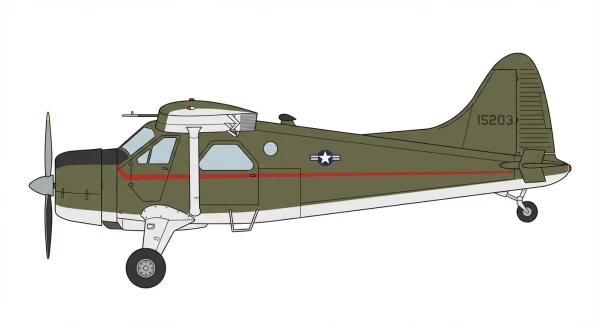
| Crew | 1 |
| Length | 9.2 m (30.3 ft) |
| Wingspan | 15 m (49.2 ft) |
| Height | 2.7 m (9.0 ft) |
| Wing area | 23 m² (247.6 sqft) |
| Empty weight | 1,361 kg (3,000 lbs) |
| Powerplant | 1 × pistons engine Pratt & Whitney R-985-AN-1 336 kW each |
| Maximum speed | 254 km/h (158 mph) |
| Operational range | 732 km (455 mi) |
| Endurance | 5 hours |
| Service ceiling | 5,486 m (17,999 ft) |
| Climb rate | 5.2 m/s (17.1 ft/s) |

Description
Following the Second World War, de Havilland Canada turned to the civilian sector, tasking Punch Dickins, Director of Sales, with gathering feedback from pilots about their needs for a new aircraft. Pilots emphasized STOL performance and the ability to use wheels, skis, or floats. Full-sized doors on both sides for easy loading were also requested. A design team led by Phil Garratt, including Fred Buller, Dick Hiscocks, Jim Houston, and Wsiewołod Jakimiuk, created an all-metal design with significant power. Pratt & Whitney Canada's offer of war-surplus 450 hp Wasp Junior radial engines enhanced its STOL capabilities. Named after the hard-working beaver, the DHC-2 first flew on August 16, 1947, piloted by Russell Bannock. After flight testing and improvements, the prototype became a demonstration model and was later sold for commercial use. The first production aircraft was delivered to the Ontario Department of Lands and Forests in April 1948.
Design
The de Havilland Canada DHC-2 Beaver is a single-engined high-wing propeller-driven STOL aircraft designed to operate in diverse conditions. Many Beavers are equipped with floats for water operations. The standard engine is a 450 hp (340 kW) Pratt & Whitney R-985 Wasp Junior radial engine. The engine is mounted rearwards to optimize weight balance and loading flexibility, with elements such as the oil tank positioned in the cockpit's center console. Fuel management across tanks, including optional wingtip tanks, is essential for maintaining the aircraft's center of gravity. The remanufactured DHC-2T Turbo Beaver features a 680 shp (510 kW) PT6A-34 turboprop engine. While the front doors are narrow, the aft doors were designed to accommodate 45-imperial gallon barrels. The Beaver Mk.I can carry up to seven passengers, while the Beaver Mk.III can accommodate up to 11. For takeoff, both the ailerons and flaps are lowered, enabling STOL performance. The flaps can extend to an extreme 58-degree position, though this setting is recommended only for emergency landings.
Armament
The DHC-2 Beaver was primarily designed for utility and transport roles, rather than combat, and therefore had limited armament capabilities. The standard versions were not equipped with any built-in offensive or defensive weaponry. However, its robust design allowed for the carriage of a substantial payload of approximately 2,100 lb (953 kg), making it suitable for transporting cargo and personnel to remote locations. Some military operators may have field-modified Beavers to carry light armament or reconnaissance equipment, but these were not part of the original factory specifications. The remanufactured DHC-2T Turbo Beaver can carry up to 2,450 lb (1,110 kg) of freight.
Operational History
Despite production ceasing in 1967, many Beavers continue to operate, often heavily modified to adapt to modern technology and requirements. Kenmore Air in Washington state, a notable example, rebuilds Beaver and Otter airframes with zero-hour fatigue-life ratings and possesses numerous supplemental type certificates for aircraft modifications; rebuilt Beavers with these upgrades are often referred to as "Kenmore Beavers". The original Wasp Jr radial engine of the Beaver is no longer in production, creating difficulty in sourcing repair parts. As a result, some operators have converted to turboprop engines like the PT6, which offers greater power, lighter weight, and increased availability of kerosene fuel, but at a significant cost. The British Army Air Corps deployed the Beaver during the Troubles in Northern Ireland for photo-reconnaissance missions until at least 1979. In one notable incident, a Beaver sustained machine gun fire while photographing an IRA checkpoint near the border with the Republic of Ireland, an area subsequently known as "Beaver Junction" by the British Army. In early 2008, significant numbers of piston-Beavers were operated by Air Saguenay and Harbour Air in Canada, and Kenmore Air in the United States. The Civil Air Patrol also utilized many DHC-2 Beavers for search and rescue missions. Furthermore, the United States Navy has operated a pair of DHC-2s at the United States Naval Test Pilot School for decades, instructing students in flight quality evaluation and glider towing. In recent years, the Beaver has seen increasing use in the leisure industry for pleasure flights, skydiving, and aerial filming, with its good climb rate and the option for a roller door allowing it to quickly transport skydivers to high altitudes.
Variants
Main Variants:
-
Beaver I: The baseline single-engined STOL utility transport aircraft, serving as the foundation for subsequent variants.
-
Beaver AL Mk 1: A STOL utility transport variant specifically designed for the British Army, tailored to their operational requirements.
-
L-20A Beaver: A STOL utility transport aircraft adopted by the U.S. Army and later redesignated as U-6A in 1962, with 968 units built for diverse military applications.
-
Turbo-Beaver III: An improved model powered by a Pratt & Whitney PT6A-6 or -20 turboprop engine, enhancing its performance capabilities.
-
Viking DHC-2T Turbo Beaver: Remanufactured Beavers by Viking Air, upgraded with a Pratt & Whitney Canada PT6A-34 turboprop engine.
Frequently Asked Questions
What type of aircraft is the DHC-2 Beaver?
What is the maximum speed of the DHC-2 Beaver?
What is the range of the DHC-2 Beaver?
When did the DHC-2 Beaver first fly?
How many DHC-2 Beaver have been built?
Which countries operate the DHC-2 Beaver?
How much does a DHC-2 Beaver cost?
What is the service ceiling of the DHC-2 Beaver?
- JUL 232026 Updated Sources and cross-references refreshed
- APR 72026 Updated Picture credits updated in a site-wide editorial pass
- FEB 72026 Updated Endurance added
- JAN 122026 Updated Range updated in a site-wide editorial pass