F9F Panther
American carrier-based jet fighter, developed in the late 1940s, extensively employed by naval and marine forces in the Korean War and later used in training and secondary roles. Key figures: top speed 932 km/h, range 2,100 km, service ceiling 13,000 m, max takeoff weight 8,492 kg, built 1,385.
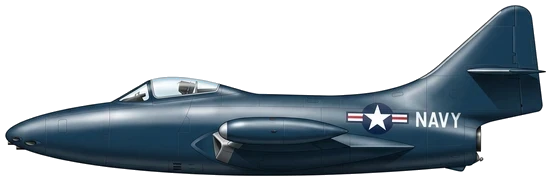
| Crew | 1 |
| Length | 11.8 m (38.8 ft) |
| Wingspan | 11.6 m (38.0 ft) |
| Height | 3.7 m (12.2 ft) |
| Wing area | 23 m² (247.6 sqft) |
| Empty weight | 4,603 kg (10,148 lbs) |
| Max. takeoff weight | 8,492 kg (18,722 lbs) |
| Powerplant | 1 × turbojet Pratt & Whitney J48-P-6A 2,835 kgf each |
| Maximum speed | 932 km/h (579 mph) |
| Operational range | 2,100 km (1,305 mi) |
| Service ceiling | 13,000 m (42,651 ft) |
| Climb rate | 25.9 m/s (85.0 ft/s) |
- Unguided Bomb General-purpose bombs (up to 2,000 lb)
- Rocket Pod Underwing air-to-ground rockets
Description
The Grumman F9F Panther is a single-engined, straight-winged, carrier-based jet fighter designed and produced by Grumman in the United States. It was Grumman's first jet fighter and the first U.S. Navy jet fighter to engage in air-to-air combat. Cleared for carrier operations in September 1949, it was the primary jet fighter and ground-attack aircraft of the U.S. Navy and Marine Corps during the Korean War. Its only export operator was the Argentine Naval Aviation.
Development
Grumman began jet fighter studies near the end of World War II and submitted the G-75 design to a Navy competition for a carrier-based night fighter. On 3 April 1946 the Navy selected the Douglas F3D Skyknight. On 11 April 1946 the Bureau of Aeronautics nonetheless ordered two G-75 prototypes as XF9F-1, as insurance against Skyknight problems. Grumman judged the G-75 to have little growth potential and was already working on the single-engined G-79 day fighter, so BuAer amended the contract to cover three G-79 prototypes, which became the Panther. The prototype first flew on 21 November 1947. Carrier suitability trials began in May 1949. Concerns that the Panther was inferior to the MiG-15 led Grumman to develop the swept-wing F9F Cougar under Design 93. Australia evaluated the Panther in 1949 as a licence-built fighter but adopted the Gloster Meteor F.8 and CAC Sabre.
Design
The Navy specified the 5,000 lbf (22 kN) Rolls-Royce Nene, licence-built by Pratt & Whitney as the J42, because available American engines were considered unreliable. Later aircraft used the Allison J33 or the Pratt & Whitney J48, a licence-built Rolls-Royce Tay. Permanent wingtip fuel tanks compensated for limited internal fuel and improved roll rate. The wings had leading-edge flaps, and speed brakes were fitted under the fuselage. The F9F-4 was the first aircraft to use compressor bleed air blown across its flaps, reducing stall speed by 9 kn for takeoff and 7 kn on landing approach. The F9F-5 had a J48-P-6A of 6,250 lbf (27.8 kN), a maximum speed of 932 km/h, a range of 2,100 km, a service ceiling of 13,000 m and an AN/APN-1 radar altimeter.
Armament
Fixed armament was four 20 mm AN/M3 cannon with 760 rounds in total. Underwing racks carried air-to-ground rockets and up to 2,000 lb (910 kg) of bombs. The F9F-5 had eight hardpoints with a capacity of 3,465 lb (1,572 kg).
Operational History
Panthers flew 78,000 sorties in Korea. On 3 July 1950, a VF-51 pilot flying an F9F-3 shot down a Yak-9 for the Navy's first air victory of the war. Panther pilots claimed seven MiG-15s for the loss of two F9Fs. The first was downed on 9 November 1950 by a VF-111 pilot near the Sinuiju bridges. On 18 November 1952, a VF-781 pilot flying from USS Oriskany shot down four Soviet Naval Aviation MiG-15s in an engagement kept secret for decades. Panthers later concentrated on ground attack, flak suppression and reconnaissance. Neil Armstrong, John Glenn and Ted Williams flew the type in Korea. The Panther left front-line service in 1956 and reserve units in 1958, and was the Blue Angels' first jet.
Argentina bought 28 ex-USN F9F-2Bs in 1957 and put 24 into service. Because the catapult of ARA Independencia was underpowered, they operated from land. During the 1963 Navy Revolt, rebel Panthers attacked the Army 8th Tank Regiment, destroying several M4 Shermans, and one was shot down. A shortage of spares forced their retirement in 1969, and the Douglas A-4Q Skyhawk replaced them.
Variants
- F9F-2: First production version, powered by the J42, 567 built.
- F9F-2P: Unarmed photo-reconnaissance version used in Korea, 36 built.
- F9F-3: J33-powered version built as insurance against J42 failure and later converted to J42s, 54 built.
- F9F-5: Lengthened J48-powered variant, 616 built, redesignated F-9D in 1962.
- F9F-5P: Unarmed photo-reconnaissance version with a longer nose, 36 built.
Frequently Asked Questions
What type of aircraft is the F9F Panther?
What is the maximum speed of the F9F Panther?
What is the range of the F9F Panther?
When did the F9F Panther first fly?
How many F9F Panther have been built?
Which countries operate the F9F Panther?
What is the service ceiling of the F9F Panther?
- OCT 192026 Created Page created: F9F Panther